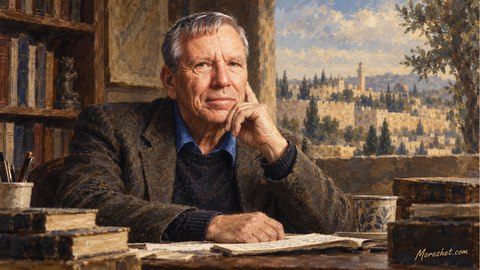
Yoram Kaniuk
A writer and artist whose restless fiction connected the memory of war with the search for an individual Israeli identity
Yoram Kaniuk (1930–2013) wrote from deep involvement in Israeli experience and an equally strong resistance to simplified accounts of it. A teenage Palmach fighter, painter, journalist and novelist, he turned memories of war, encounters with Holocaust survivors and the energy of urban life into original, often unruly fiction. His writing gave space to people who do not fit comfortably inside public narratives of heroism, enlarging the range of lives Israeli literature could recognise.
From Tel Aviv to a wider artistic world
Kaniuk grew up in a Tel Aviv household connected to education and art; his father helped establish and administer the city’s art museum. He joined the Palmach at seventeen, fought in the War of Independence and was wounded. The experiences of young people carrying responsibilities far beyond their years remained a central source of his writing.
After the war he pursued painting and lived abroad, including an extended period in the United States. New York’s artistic life broadened his imaginative vocabulary. Returning to Israel, he brought a voice intensely connected to the country but receptive to forms, rhythms and cultural encounters beyond it.
Fiction able to accommodate the wound
Himmo, King of Jerusalem centres on a severely wounded soldier and the relationships around him. Adam Resurrected approaches life after the Holocaust through disturbing, grotesque invention. The Last Jew broadens the exploration of Jewish identity, memory and the attempt to carry a destroyed world into the present. In these books, imaginative excess becomes a way of approaching pain that conventional realism may struggle to hold.
Kaniuk’s dark humour, shifting time frames and unstable narratives also make room for contradictions within individual lives. His characters can remain damaged, uncertain or difficult without being reduced to symbols. This artistic freedom was an important contribution to the development of Israeli prose.
A later encounter with an earlier war
In 1948, published late in his career, Kaniuk returned to the war he had experienced as a teenager. The book offers personal, fragmentary recollection rather than a comprehensive historical account. Its willingness to acknowledge fear, confusion and the limits of memory helped it reach a new readership. It won the Sapir Prize in 2011.
Kaniuk also received the Bialik Prize and other literary recognition. His books were translated widely and adapted for theatre and cinema. Commander of the Exodus, about Yossi Harel, brought his interest in individual lives to a central episode of clandestine Jewish immigration. His essays and public interventions continued to question inherited definitions of belonging and identity.
Why Yoram Kaniuk belongs in Moreshet
Kaniuk belongs in Moreshet at Moreshet.com because he expanded the ways Jewish and Israeli experience could be remembered. Behind words such as “war,” “survivors” and “the generation of 1948,” he insisted on particular people with irreducible inner lives. His legacy demonstrates that artistic independence, vulnerability and the courage to revisit memory can strengthen a culture’s understanding of itself.