Yonatan “Yoni” Netanyahu
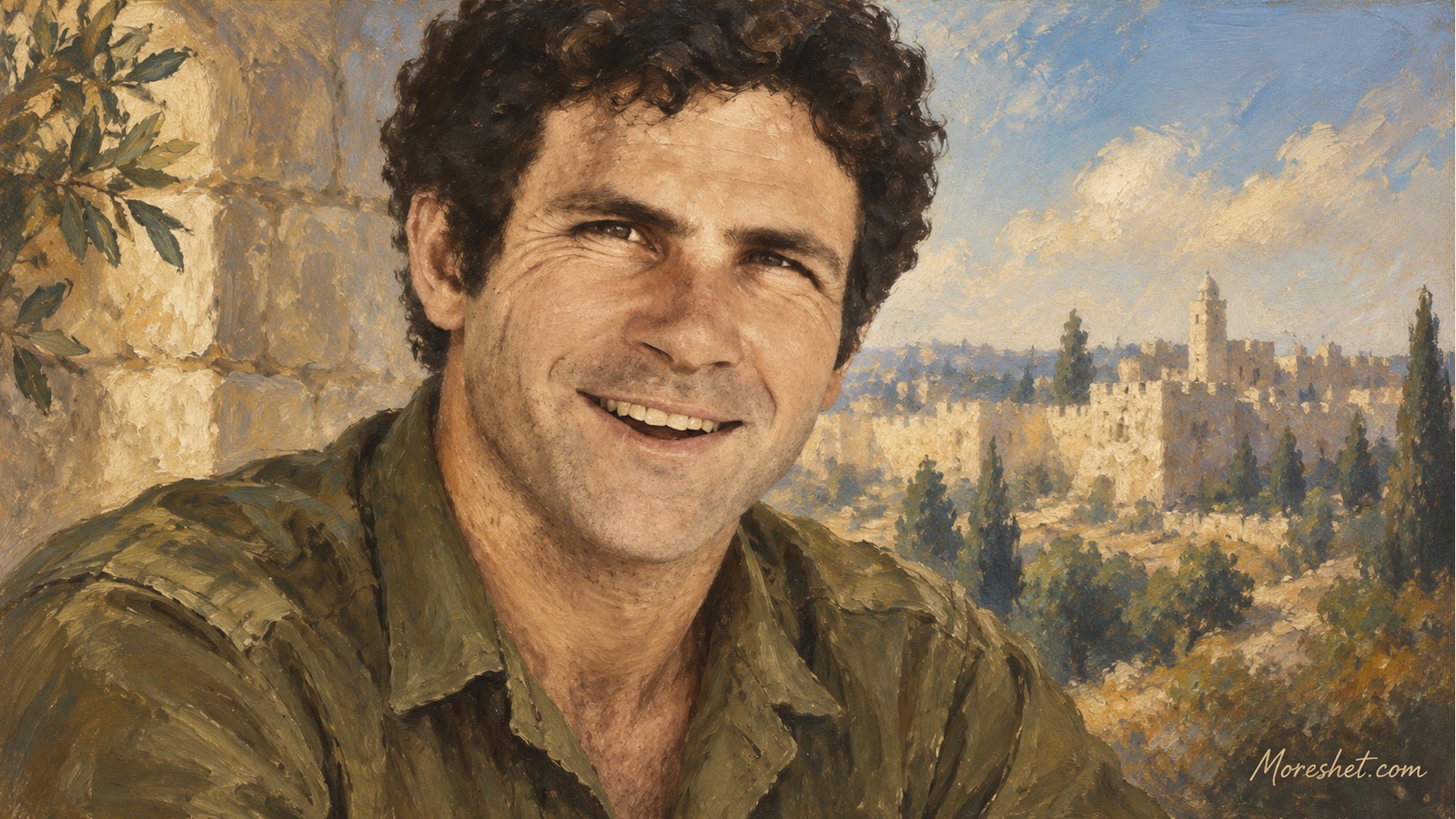
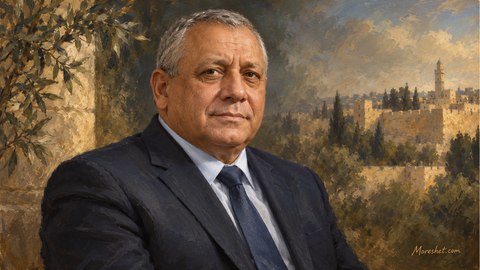
Yonatan Netanyahu — AI-generated artistic portrait · Moreshet.com
Israeli officer, Sayeret Matkal commander and recipient of the Medal of Distinguished Service who fought in the Six-Day and Yom Kippur wars, rebuilt an armored battalion after the war and was killed at thirty while commanding the assault force in the Entebbe hostage rescue later named Operation Yonatan
Yonatan “Yoni” Netanyahu (March 13, 1946 – July 4, 1976) was an Israeli military officer, lieutenant colonel, commander of Sayeret Matkal and recipient of Israel's Medal of Distinguished Service. During twelve years in the Israel Defense Forces he served in the Paratroopers Brigade, fought in the Six-Day War, held command positions in special operations units, led Sayeret Matkal forces during the Yom Kippur War, volunteered afterward to help rebuild an armored battalion devastated by the war, and ultimately returned to command Sayeret Matkal. He was killed at the age of thirty while commanding the principal assault force in the rescue operation at Entebbe, Uganda, in which more than one hundred hostages from a hijacked Air France flight were rescued. The mission was officially renamed Operation Yonatan in his memory.
Netanyahu's life is larger than its final night at Entebbe. He was wounded in the Six-Day War while attempting to help another soldier, commanded highly sensitive special operations, rescued the wounded Yossi Ben-Hanan from behind Syrian lines during the Yom Kippur War, received a military decoration for his wartime conduct, and then deliberately left the special-forces track for a period to rebuild an armored battalion after the heavy losses of 1973. He was also a serious student drawn to philosophy, mathematics and physics, studying at Harvard and the Hebrew University of Jerusalem. His personal letters, collected after his death, preserved the voice of a young man repeatedly weighing academic and private ambitions against what he regarded as an obligation to serve Israel.
A childhood between New York and Jerusalem
Yonatan Netanyahu was born in New York City on March 13, 1946, the eldest son of Tzila and Benzion Netanyahu. His father was a historian and Zionist activist. His younger brothers were Benjamin Netanyahu, later Prime Minister of Israel, and Iddo Netanyahu, a physician and writer.
Family accounts connect his name with two figures: his paternal grandfather, Rabbi and Zionist activist Nathan Mileikowsky, and Lieutenant Colonel John Henry Patterson, former commander of the Jewish Legion and a friend of the family who attended Yonatan's circumcision.
As a young child Yoni moved with his family to Israel, where they settled in Jerusalem. He attended Beit Darom School, later known as the Szold School, and then Gymnasia Rehavia. He was also active in the Modi'in troop of the Scouts.
His father's academic career took the family back to the United States for periods of time. In 1963, when Yoni was in the eleventh grade, the family again moved to America. He completed high school at Cheltenham High School in Pennsylvania. Letters from these years show a teenager already preoccupied with purpose, achievement and the question of what a worthwhile life should contain.
Returning to Israel and joining the paratroopers
After finishing high school, Netanyahu returned to Israel and enlisted in the IDF in August 1964. He volunteered for the Paratroopers Brigade and served in Battalion 890. He completed infantry training, a squad-commanders course and the infantry officers course, graduating with distinction.
He was subsequently appointed a paratroop platoon commander. In that capacity he took part in the Samu operation in November 1966. His early service established traits that later commanders and soldiers repeatedly associated with him: demanding preparation, physical endurance, insistence on standards and a willingness to share the risks imposed on his men.
The Six-Day War and a wound on the Golan Heights
Netanyahu completed his regular service in January 1967 and had been accepted to Harvard University. He intended to begin his studies that autumn, but the military crisis preceding the Six-Day War brought him back into reserve service before he left Israel.
During the war he served with the reserve 80th Paratroopers Brigade and fought at Um Katef in Sinai. His unit was subsequently sent north to reinforce the fighting on the Golan Heights. During combat near Darbashiya, he was wounded while attempting to assist another wounded soldier. The injury permanently limited movement in his elbow but did not prevent his return to demanding combat duty.
The episode foreshadowed another rescue under far more dangerous circumstances six years later, when he led a force to recover a badly wounded officer from behind Syrian lines during the Yom Kippur War.
Harvard, marriage and the pull of military service
In August 1967 Netanyahu married his longtime girlfriend Tirza “Tuti” Krasnoselsky, later Tirza Goodman. The couple went to the United States, where he enrolled at Harvard University. He studied subjects including philosophy and mathematics and performed strongly during his first year.
As the War of Attrition intensified, however, he found remaining abroad increasingly difficult. The academic path available to him was genuine, but he felt a stronger obligation to return to Israel. He transferred to the Hebrew University of Jerusalem, continued his studies for a short period and by early 1969 had returned to full-time military service.
The tension between scholarship and service never completely disappeared. He returned to Harvard during later periods of leave and repeatedly considered resuming academic life. Each time, renewed military demands drew him back.
Sayeret Matkal and special operations
After returning to active duty, Netanyahu joined Sayeret Matkal. His younger brother Benjamin, then serving in the unit, recommended him to commander Uzi Yairi, but Yoni's subsequent progression depended on his own performance.
He became a team commander, later commanded a company in Sayeret Haruv and then returned to Sayeret Matkal as a company commander. In the summer of 1972 he was appointed deputy commander of Sayeret Matkal.
These were formative years for Israeli special operations. Missions demanded precise intelligence, long-distance navigation, secrecy, improvisation and the ability to make decisions under severe uncertainty. Netanyahu developed within this environment from an accomplished infantry officer into a commander of complex operations.
Operation Argaz
In 1972 Netanyahu commanded an operation generally known as Operation Argaz, designed to capture senior Syrian officers and use them as leverage in efforts to recover Israeli airmen held in Syrian captivity.
Sayeret Matkal ambushed the officers in southern Lebanon, captured them and brought them to Israel. The prisoners subsequently became part of negotiations surrounding prisoner exchanges. The mission demonstrated Netanyahu's emergence as a commander capable of handling an operation whose consequences extended beyond the immediate battlefield.
Operation Spring of Youth
In April 1973 Netanyahu participated in Operation Spring of Youth in Beirut, a coordinated action involving Sayeret Matkal, Shayetet 13, paratroopers and Mossad support against PLO and Fatah targets.
The mission required clandestine arrival in the Lebanese capital, simultaneous action against several objectives and rapid extraction. It was another stage in Netanyahu's progression toward senior command in Israel's special-operations community.
The Yom Kippur War
When the Yom Kippur War began in October 1973, Netanyahu returned to combat and commanded a Sayeret Matkal force on the Golan Heights. The unit was used in urgent conventional combat as well as missions more typical of special forces.
His force fought alongside Golani troops against Syrian commandos in the central Golan and undertook additional operations across the front. Sayeret Matkal also participated in missions connected with artillery operations behind the lines and the battle for Mount Hermon.
One of Netanyahu's best-known actions in the war was the rescue of Lieutenant Colonel Yossi Ben-Hanan, later an IDF major general, who had been wounded near Tel Shams and left behind Syrian lines. Netanyahu led a force into the area and brought Ben-Hanan out.
For his actions during the war, Netanyahu received the Medal of Distinguished Service. The decoration is important in assessing his military record because it documents recognized battlefield leadership before Entebbe. His public image eventually became inseparable from his final operation, but the IDF had already formally recognized his conduct in combat.
An unexpected move to the Armored Corps
After the Yom Kippur War Netanyahu could have remained on the direct special-forces command track. Instead, he volunteered for the Armored Corps, which had suffered exceptionally heavy losses in the war, including among its officers.
He completed the tank officers conversion course with distinction and took command of Battalion 71 in the 188th Armored Brigade. The battalion had been badly depleted during the war and required reconstruction of its personnel, training, command structure and operational confidence.
This period reveals a dimension of Netanyahu's leadership less dramatic than a special operation but no less important. Rebuilding a battalion required sustained work rather than a single night of combat: training crews, developing junior commanders and restoring an effective fighting organization.
Returning to Sayeret Matkal as commander
In 1975 Netanyahu returned to Sayeret Matkal. In June he was promoted to lieutenant colonel and appointed commander of the unit.
He now carried responsibility for one of the IDF's most sensitive formations: selecting and training soldiers, maintaining readiness, developing commanders and planning missions, many of which remained classified for years.
His command lasted only about a year. It ended with a mission that became one of the most famous hostage rescues in modern military history.
The hijacking of Air France Flight 139
On June 27, 1976, Air France Flight 139, traveling from Tel Aviv to Paris via Athens, was hijacked by Palestinian and German militants. The aircraft was diverted first to Libya and then to Entebbe Airport in Uganda, ruled at the time by Idi Amin.
At Entebbe many non-Israeli and non-Jewish passengers were eventually released, while Israeli and Jewish hostages remained at the old terminal together with the Air France crew. The hijackers demanded the release of prisoners and imposed a deadline.
The distance from Israel, the presence of Ugandan forces, uncertainty about conditions at the terminal and the danger that the hostages would be killed made a rescue attempt extraordinarily difficult. While political contacts continued, the IDF began developing military options.
Planning the Entebbe rescue
The chosen plan required Israeli aircraft to fly thousands of kilometers to Uganda, land at Entebbe, move rapidly toward the old terminal, kill or neutralize the hijackers, free the hostages and return everyone to Israel.
The Sayeret Matkal force commanded by Netanyahu received the central assault mission at the terminal. Additional paratroop and Golani forces were assigned tasks including securing the airport, protecting the evacuation and preventing Ugandan military aircraft from interfering.
The operation demanded coordination among intelligence officers, pilots, special-forces units, medical personnel and senior commanders under intense time pressure. Netanyahu was directly involved in preparing and rehearsing the assault element for the terminal.
The night at Entebbe
The Israeli aircraft departed on July 3, 1976, and reached Entebbe during the night of July 3–4. Vehicles were unloaded from the transport aircraft and the assault force moved toward the old terminal.
During the opening phase, shooting broke out. Netanyahu was struck by gunfire outside the terminal. Medical personnel attempted to save him, but the wound proved fatal and he died during the operation.
Accounts differ regarding the precise identity and location of the person whose fire killed him. The secure historical point is that he was hit during the initial assault near the terminal and died of his wounds. The profile therefore does not adopt one disputed version as established fact.
More than one hundred hostages brought home
Despite the loss of the assault-force commander, the rescue continued. Sayeret Matkal soldiers reached the hostages and killed the hijackers while other Israeli forces secured the operational area and aircraft.
A total of 102 hostages were rescued and flown out of Uganda. Three hostages were killed during the rescue. Dora Bloch, a passenger who had previously been taken to a Kampala hospital, was murdered in Uganda after the raid. Netanyahu was the only Israeli soldier killed in the rescue operation.
The ability to project a force thousands of kilometers from Israel, seize the terminal and return almost all of the remaining hostages made Entebbe one of the world's most studied and widely remembered hostage-rescue operations.
Operation Entebbe becomes Operation Yonatan
After the mission, Israel officially renamed it Operation Yonatan in memory of the Sayeret Matkal commander who had been killed during the assault. His name thus became permanently linked not only with his biography but with the operation itself.
Netanyahu was buried in the military cemetery on Mount Herzl in Jerusalem on July 6, 1976. Large crowds, senior military commanders and public officials attended the funeral. His grave lies near that of former IDF Chief of Staff David Elazar.
The private life behind the commander
Netanyahu married Tirza “Tuti” Krasnoselsky in 1967. The couple had a daughter who died only days after birth. They divorced in 1972.
During the final years of his life his partner was Bruria Shaked-Akron. Five days before his death he wrote one of his final letters to her.
These details matter because the public memory created by Entebbe can make Netanyahu appear almost entirely symbolic. His letters and personal history restore the image of a thirty-year-old man who experienced love, bereavement, divorce, intellectual ambitions and uncertainty while carrying an increasingly demanding military responsibility.
The Letters of Jonathan Netanyahu
After his death, his brothers Benjamin and Iddo assembled letters he had written to family members, friends and partners. They appeared in Hebrew as Mikhtevei Yoni, usually translated as The Letters of Jonathan Netanyahu, and were subsequently issued in additional editions and languages.
The letters gave readers something military reports could not: Netanyahu's own voice. They deal with study, love, Israel, war, time, mortality, personal standards and the recurring tension between the life he might have pursued and the service he felt compelled to perform.
The collection became an important part of his legacy precisely because it complicates the heroic public image. The reader encounters an intellectually curious and self-questioning young man who understood that his choices carried a cost.
Commemoration in Israel and abroad
Netanyahu's name has been given to streets, schools, youth groups, leadership projects and other institutions throughout Israel. A military camp connected with Battalion 71 was named for him, and a memorial garden stands at the entrance to the Hebrew University's Givat Ram campus, where he once studied.
Commemorations also exist in the United States. Cheltenham High School, which he attended in Pennsylvania, has memorial trees and a plaque, and a memorial was established in Philadelphia. A street in New York was also named in his honor.
In 2026, fifty years after Entebbe, a particularly unusual memorial was added at the site where he died.
2026: a statue at the old Entebbe terminal
On August 1, 2026, the Ugandan military unveiled a statue of Yonatan Netanyahu at the old terminal of Entebbe International Airport, the location where he had been fatally wounded fifty years earlier. Uganda's Chief of Defence Forces, General Muhoozi Kainerugaba, commissioned and unveiled the monument, describing it as a tribute to courage, duty and commitment to protecting innocent life.
The location gives the memorial unusual historical meaning. In 1976, Idi Amin's Uganda had been the scene of the Israeli raid and Ugandan troops fought the rescuing force. Half a century later, Uganda's own military placed a memorial to the Israeli commander at the old terminal.
The statue adds a new geographical dimension to Netanyahu's commemoration: his memory is now formally marked not only in Israel and the United States but at the physical site of his final battle.
Yoni Netanyahu in film and theater
The Entebbe story entered popular culture almost immediately. Menachem Golan's 1977 Israeli film Operation Thunderbolt portrayed Netanyahu with Israeli actor and singer Yehoram Gaon in the role. American productions included Victory at Entebbe and Raid on Entebbe.
Later works included plays and documentaries. The 2012 documentary Follow Me used Netanyahu's letters and personal writings to connect his life story with the final mission. The continuing return to his story demonstrates that Entebbe has been remembered not only as a military case study but as a human story of command, risk and personal cost.
The Jonathan Institute
In 1979 the Jonathan Institute was established in his memory. It organized international conferences in Jerusalem and Washington devoted to terrorism and the responses available to democratic states. Government officials, security specialists and scholars from several countries participated.
The conferences formed part of an effort by Netanyahu's family and associates to translate remembrance into a broader discussion of terrorism, hostage-taking and democratic self-defense. Different political and strategic views have surrounded those questions, but the Institute itself became another way in which his name entered international debate.
Leadership measured before Entebbe
Because Netanyahu died during one of the IDF's most famous operations, it is easy to reduce his life to its final minutes. His complete record is broader: paratroop platoon commander, wounded Six-Day War veteran, special-forces officer, deputy commander of Sayeret Matkal, combat commander in the Yom Kippur War, recipient of the Medal of Distinguished Service, commander of an armored battalion and finally commander of Sayeret Matkal.
His decision to help rebuild Battalion 71 after the Yom Kippur War is particularly revealing. He temporarily left the elite special-operations environment in which his reputation was already established and moved to a corps suffering from devastating losses because experienced commanders were needed. It was less dramatic than a covert raid but demonstrated a broader understanding of military responsibility.
A legacy of responsibility, service and cost
The figure remembered in Israel contains several layers: Yoni the soldier and commander; Yoni the student interested in philosophy, mathematics and physics; Yoni the letter writer; and Yoni repeatedly deciding between private plans and return to military service.
Remembering him does not require turning every decision into a universal prescription. His historical significance lies partly in how vividly his short life records the experience of a generation of young Israelis living through recurring wars, state-building, intense public responsibility and a search for personal meaning.
His death at thirty left many possibilities unrealized. The letters make that loss especially tangible because they show how consciously he thought about time, purpose and what should be done with a life whose length no one can know.
Why this legacy belongs in Moreshet
Yonatan “Yoni” Netanyahu merits inclusion in Moreshet because his record combines military service, command, sacrifice and an unusually rich personal documentary legacy. Before Entebbe, he had already fought in the Six-Day War, commanded special operations, rescued Yossi Ben-Hanan from behind Syrian lines and earned the Medal of Distinguished Service during the Yom Kippur War. After that war he chose to help rebuild a badly depleted armored battalion before returning to Sayeret Matkal as its commander.
Operation Entebbe made his name a lasting part of Israeli and Jewish memory. An Israeli force flew thousands of kilometers to rescue hostages held in a distant country; 102 were brought out alive, and Netanyahu was the only Israeli soldier killed in the rescue. The official renaming of the mission as Operation Yonatan permanently joined his name to one of the best-known hostage rescues of the twentieth century.
Moreshet.com also documents Netanyahu because his legacy extends beyond the battlefield. The Letters of Jonathan Netanyahu preserve the voice of an intellectually curious young man confronting study, love, duty and mortality; memorials in Israel and the United States carried his story into public space; and in 2026 the Ugandan military added a memorial at Entebbe itself, fifty years after his death. His place in Moreshet therefore rests on a short life with an unusually long afterlife — in the IDF, Israeli memory and continuing discussions of leadership, responsibility and the willingness to risk one's life to save others.