Yehiel Dov Dresner
Irgun fighter and commander whose execution made him one of the enduring symbols of the Jewish underground and Israel’s struggle for independence
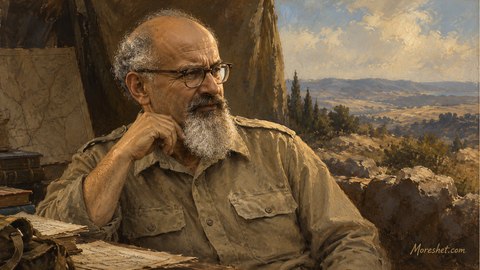
Yehiel Dov Dresner (October 13, 1922–April 16, 1947) was an Irgun fighter and commander and one of the Olei Hagardom, the underground members executed by the British authorities in Mandatory Palestine. In a life cut short before his twenty-fifth birthday, he became a youth guide, intelligence operative, field commander, and a figure whose final stand entered the public memory of the Jewish struggle for statehood.
Dresner was captured after an Irgun operation, tried by a British military court, and hanged at Acre Prison with Eliezer Kashani and Mordechai Alkahi. Their comrade Haim Golevsky, who was 17, received a life sentence. The prisoners’ refusal to recognize the court’s authority, their singing of “Hatikvah,” and the public shock that followed their executions made Dresner’s name part of the heritage of the Yishuv and the founding memory of Israel.
Childhood, immigration, and Zionist formation
Dresner was born in Lviv, Poland, to Yafa-Shindel and Efraim-Zalman Dresner. He was one of four brothers. His mother came from a distinguished rabbinical family. From an early age he took part in Zionist youth activities and absorbed the idea of Jewish immigration to the Land of Israel. When he was 11, he moved with his family to Palestine, where they settled in Jerusalem. He studied at the religious Ma'aleh school and, at 13, joined the Jerusalem branch of the Betar youth movement.
The 1938 execution of Shlomo Ben-Yosef, the first Betar member to be hanged by the British and later remembered as the first Oleh Hagardom, deeply affected him. Dresner recorded his response in his diary. Nine years later, he would be taken to the gallows at the same Acre prison.
Financial hardship forced Dresner to leave high school and help support his family. After a period of temporary work, he left Jerusalem in 1940, at the age of 18, and moved to Netanya, where he entered the diamond industry. He initially had to manage on his own and sometimes slept in packing houses. These circumstances shaped the independence and endurance that later marked his underground career.
Joining the Irgun underground
In Netanya, Dresner joined the Irgun and volunteered as an instructor in the Betar youth squads. In 1942 he moved to Tel Aviv, where he worked in a factory and continued his underground activity. He also joined a group of Hebrew-language activists who opposed the widespread sale of foreign-language newspapers. During one Irgun assignment, he was arrested after being sent to obtain documents from the Committee for Soldiers’ Families. He was tried and acquitted, but the experience did not lessen his commitment.
In 1944, Dresner completed a course for group leaders. He devoted much of his time to training and propaganda work and later transferred to the Irgun intelligence service, known as the Delek. His responsibilities reflected the breadth of underground work: recruiting and instructing members, disseminating information, maintaining secrecy, and supporting operations.
When he learned that the police intended to arrest him, Dresner adopted the false identity Dov Rosenbaum. He left his home and job and first hid in Tel Aviv. He later moved to Zikhron Ya'akov, where he worked as a vineyard guard. His living conditions were harsh: he slept in a tent, received one meal a day, and remained largely cut off from the life of the settlement and from events elsewhere in the country.
He subsequently served as deputy commander of a secret training course, moved to Hadera, and became deputy commander of the local Irgun branch during the period known as the Hunting Season. When an attempt was made to abduct him, he escaped from a speeding taxi, jumped into a roadside ditch, and hid among the shrubs for a day. Returning to Tel Aviv, he assumed command positions in the Delek and later became commander of a company in the Irgun’s special units. He went on to serve in command posts in Ramat Gan and Petah Tikva.
Operations and capture
Dresner participated in operations against British infrastructure, including the November 1945 Night of the Trains, when Irgun units attacked railway targets at Lydda as part of a broader joint underground operation. He was also involved in railway sabotage and attacks on British facilities. On November 14, 1945, he received the rank of sergeant. His progression from youth instructor and organizer to commander reflected the trust placed in his judgment and his ability to operate under surveillance and danger.
On December 29, 1946, Dresner joined Eliezer Kashani, Mordechai Alkahi, Haim Golevsky, and Avraham Mizrahi in the operation later known as the Night of the Beatings. The action was planned as retaliation for the whipping of an imprisoned Irgun member. Near the Lod–Beit Dagan junction, close to Wilhelma, their car encountered a police roadblock. In the ensuing exchange of fire, Avraham Mizrahi, the driver, was fatally wounded. Dresner and the other three survivors were captured.
The prisoners were taken to a military camp, where they were subjected to beatings and humiliation for many hours. After five days they were transferred to Jerusalem Central Prison. There they joined Dov Gruner, another Irgun fighter already under a death sentence.
The trial and confrontation with British rule
On February 10, 1947, the four prisoners were tried before a British military court for illegal possession of weapons. They rejected the court’s authority and refused to participate in the proceedings on the terms imposed upon them. Speaking for all four, Dresner delivered a denunciation of British rule, declaring: “You thought that we too would bow our heads before your tyranny. You were mistaken! We will break your whip!”
Dresner, Alkahi, and Kashani were sentenced to death by hanging. Golevsky, who was 17, was sentenced to life imprisonment. Public figures and institutions in the Yishuv appealed for clemency, and the municipality of Petah Tikva organized a petition on behalf of its sons. The prisoners themselves asked that the appeals cease, regarding them as humiliating compromises of national dignity. Immediately after the sentence was announced, the four men rose and sang “Hatikvah.”
Dresner continued to protect his assumed identity. Even while imprisoned, he was publicly known as Dov Rosenbaum, and his photograph did not appear with those of the other condemned men. Only a small number of underground members, his family, and the prison rabbi knew who he really was. The concealment was intended to protect his family and his brother Tzvi, who was interned in Africa, and it continued even after Dresner’s death.
Execution and burial in Safed
On April 15, 1947, the four condemned prisoners were secretly transferred from Jerusalem to Acre Prison. In the early hours of April 16, they were hanged one after another. The executions took place without advance warning, without a rabbi, and without allowing the prisoners to say farewell to their families. Each man sang “Hatikvah” on the way to the gallows, while the others joined from their cells. Jewish prisoners throughout the jail heard the singing and added their voices.
Dresner was the third to ascend the gallows. He was 24, approaching 25, and had spent his short adult life moving between instruction, intelligence work, organization, and command. The bodies of the four men were taken by an armored convoy to Safed and buried there without advance notice to their families or to the local burial society. Despite a curfew, hundreds of Jews came to the cemetery in the rain to honor them.
Dresner was buried under the name Dov Rosenbaum. His brother, then imprisoned in Kenya, learned of his death but was not permitted to observe the traditional mourning period, in accordance with Dresner’s wish that his false identity remain in force after death. His true identity was made public only about a year later. British guards remained near the graves for months to prevent Irgun members from moving the bodies to Rosh Pinna, near Shlomo Ben-Yosef’s grave, as the condemned men had requested.
Commemoration and enduring significance
The executions shocked the Yishuv and prompted condemnation from Jewish communities around the world. In the United States, American clergymen organized memorial gatherings. Dresner and his companions became associated with the human cost of underground resistance and with the willingness of young Jews to confront a foreign regime in pursuit of Jewish self-determination.
Streets named for Dresner can be found in Tel Aviv, Beersheba, Jerusalem, and Petah Tikva. A monument to seven Olei Hagardom was erected in the old Jewish cemetery in Safed. In 1982, Israel Post issued a commemorative sheet titled “Martyrs of the Kingdom in the Generation of Revival,” including a stamp bearing Dresner’s portrait. These forms of remembrance preserve both an individual story and the wider history of the underground generation whose activities shaped the road to Israeli independence.
Why Yehiel Dov Dresner belongs in Moreshet
Yehiel Dov Dresner merits inclusion in Moreshet because his life illuminates a decisive period in Jewish and Israeli history: the transformation of a young immigrant from a Jewish family in Poland into a youth instructor, intelligence operative, and commander in the underground struggle for Jewish independence in Palestine. His contribution was not limited to taking part in operations. He trained younger members, organized groups, carried information, accepted command responsibility, and continued working despite poverty, pursuit, imprisonment, and the danger to his family.
His story also gives national memory a human scale. It includes hardship and work, secrecy and isolation, loyalty to comrades, a public trial, and a final act of collective singing that became part of Israel’s founding narrative. The streets, monument, and postage stamp that bear his memory show how his life entered the public landscape and was transmitted to later generations. For these reasons, Dresner belongs in Moreshet.com, alongside the people whose lives help explain the sacrifice, courage, and Jewish aspirations that shaped the history of the Yishuv and the State of Israel.