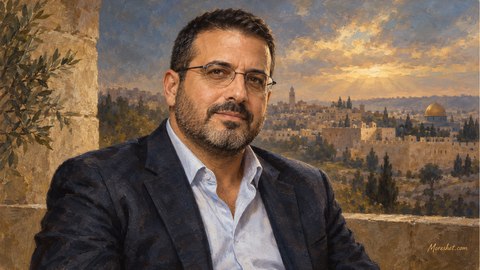
Alon Mizrahi
The Israeli striker known as “The Airplane,” record-setting league scorer and star of Israel’s national team
Alon Mizrahi, born on November 22, 1971, is a former Israeli football striker who represented Israel and became one of the most recognizable figures in the country’s football history. His nickname, “The Airplane,” came from the airplane gesture he performed after scoring. Across a career spanning more than a decade, Mizrahi was distinguished by his instinct inside the penalty area, his finishing ability and his relentless drive to score. His achievements made him a defining figure in Israeli football and a source of inspiration for generations of supporters and players.
Breaking through at Bnei Yehuda
Mizrahi developed in Bnei Yehuda Tel Aviv’s youth system and reached the senior team during a period in which the club won the championship in 1990. During the 1990/91 season, he was loaned to Hapoel Tel Aviv, which had returned to the top division the previous year. On April 20, 1991, he scored his first goal in Israel’s top division, against Hapoel Tzafririm Holon, and finished the season with four league goals in 18 appearances.
After returning to Bnei Yehuda, Mizrahi quickly became one of Israel’s leading strikers. Playing alongside figures such as Nikolay Koudrytsky and Haim Revivo, he established himself as a prolific scorer and won the league’s top-scorer title in two consecutive seasons: with 20 goals in 1991/92 and 26 goals in 1992/93. Those achievements began a period in which his name became closely associated with goalscoring in Israeli football.
Maccabi Haifa and a record-setting season
Before the 1993/94 season, Mizrahi was acquired by Ya'akov Shahar and joined Maccabi Haifa. In his first season with the club, he won the championship alongside Eyal Berkovic and Reuven Atar. Maccabi Haifa completed the season unbeaten, while Mizrahi won the league’s top-scorer title for the third consecutive year after scoring 28 goals. That personal record brought him close to Nissim Elmaliah’s historic mark of 30 goals in a single season.
During the 1994/95 season, Mizrahi was loaned to Maccabi Tel Aviv and later to Ironi Ashdod. He subsequently returned for additional spells with Bnei Yehuda and Maccabi Haifa. In 1998, he helped Maccabi Haifa win the State Cup, and the following season he was part of the team that reached the quarterfinals of the UEFA Cup Winners’ Cup. During that period, he received an offer from Nice in France’s second division. Although the move did not lead to a sustained professional breakthrough, it reflected his willingness to test himself beyond Israel. At the end of that season, he scored in Israel’s impressive 5–0 victory over Austria. He left Nice the following season amid the club’s financial difficulties and a dispute with its owner.
Beitar Jerusalem and the later club career
Before the 1999/2000 season, Mizrahi signed with Beitar Jerusalem. He remained with the club through the end of the 2000/01 season, scoring 21 goals in 50 league appearances. On September 10, 2000, he took part in Beitar’s victory in the Peace Cup, a tournament held at Rome’s Olympic Stadium. He scored two of the team’s seven goals in a 7–0 victory over Jordanian club Alוקאס, in a match played over a single 45-minute half, and also participated in Beitar’s victory over Roma in the same tournament.
Mizrahi later played for several other clubs, including Hapoel Be’er Sheva. By 2005, he had broken the cumulative scoring record and become the all-time leading scorer in the Israeli league. At the age of 34, he announced his retirement from active football. Nevertheless, before the 2005/06 season he joined Maccabi Amishav Petah Tikva of Liga Bet, explaining that he wanted to contribute on a voluntary basis. Around 1,500 spectators attended his first match, demonstrating the continuing public appeal of his name even after he had left the top level. After several appearances, he retired again, concluding that he had fulfilled the purpose for which he joined the club.
Israel’s national team
Mizrahi is the all-time leading scorer of Israel’s under-21 national team, with 15 goals in 13 appearances. For the senior Israel national team, he made 37 appearances and scored 17 goals. He made his senior debut on December 2, 1992, against Bulgaria at Ramat Gan Stadium in a 1994 World Cup qualifying match.
On March 24, 1993, he scored his first goals for Israel, netting twice in a friendly against Russia at Kiryat Eliezer Stadium. During the qualifying campaign for Euro 2000, he was Israel’s leading scorer, with five goals in seven appearances, including two in a 3–0 victory over Cyprus. His final national-team appearance came on June 2, 2001, in a 3–0 victory over Liechtenstein during 2002 World Cup qualifying.
For many years, Mizrahi was regarded as Israel’s leading scorer across all competitions. According to the supplied source, his total stood at 334 goals as of September 1, 2021, before Eran Zahavi moved ahead of him by scoring twice for the national team against the Faroe Islands and reaching 336 goals. The record reflects Mizrahi’s enduring place among Israel’s most productive goalscorers and the standard he set for the strikers who followed him.
Coaching and developing strikers
After retiring as a player, Mizrahi remained active in Israeli football. He coached and played in Israeli beach soccer, and during the 2008/09 season he coached Hapoel Yehud of Liga Gimel until March 2009.
During the 2009/10 season, he worked with Shlomi Arbeitman on movement inside the penalty area and finishing. That season, Arbeitman scored 28 goals for Maccabi Haifa, matching Mizrahi’s record from 1993/94. Mizrahi’s experience was therefore passed to a new generation not only through the memory of his achievements, but also through direct professional instruction.
In May 2010, Mizrahi was appointed Maccabi Petah Tikva’s striker coach. He worked mainly with the club’s youth players and, at times, with the senior team’s forwards. In February 2011, he became striker coach at Hapoel Nir Ramat HaSharon, again working primarily with the youth system while also assisting the senior team. In November 2012, he was appointed manager of Hapoel Kfar Saba, but left less than two months later because of difficulties in transferring ownership of the club. In January 2013, he became manager of Hapoel Petah Tikva and left the position at the end of the season. In December 2016, he was appointed representative of Bnei Yehuda owner Barak Abramov, leaving the role toward the end of the season.
Television and public communication
Mizrahi’s charisma and public recognition also carried him into television and media. In 2006, he hosted the talk show “Basalon Im HaAiron” on Ego Channel. He acted in the telenovela “The Champion,” playing the coach of the fictional Hakoah Jerusalem football team, and appeared in the series “Dani Hollywood” as an anonymous kidney donor.
He later worked as a football commentator for Sport 5, moved to ONE, wrote opinion columns for the website and joined the panel of “The Administration,” a program broadcast on the ONE channel. In 2018, he appeared in a Bezeq commercial with Gidi Gov and Omer Adam. These appearances expanded his public image beyond the pitch and made his story and distinctive football vocabulary part of Israeli popular culture.
Personal life and public engagement
Mizrahi studied at Moshe Hess Elementary School in Givatayim, Yosef Kalman Middle School in Ramat HaSharon and Municipal High School XI in Tel Aviv. In 1992, he married Vered; they lived in Ramat HaSharon and had three children. The couple divorced in 2020.
In 2008, Mizrahi joined the Social Justice Party and was placed fifth on its list for the Tel Aviv–Yafo municipal council. Although his principal public legacy was created on the football field, this involvement also reflects the way well-known athletes can move into areas of community life and civic discussion.
Why Alon Mizrahi belongs in Moreshet
Alon Mizrahi merits inclusion in the archive because his story captures a significant chapter in the development of Israeli football: the rise of a local striker who became a national star, his achievements with Bnei Yehuda and Maccabi Haifa, his contribution to Beitar Jerusalem and his prominent role in Israel’s national team. Three consecutive league scoring titles, 17 goals for the senior national team and the Israeli scoring record he held for many years are more than statistics. They show how Mizrahi shaped expectations of Israeli strikers and became part of the shared sporting memory of supporters across the country.
His legacy continued after his playing career through striker coaching, youth development, management, commentary and television. For Moreshet and Moreshet.com, Mizrahi is significant because his career connects individual sporting achievement with a wider cultural story: how a footballer becomes a public symbol, how performances on the field shape collective memories and how talent, persistence and personality can influence supporters and Israeli culture. His life documents the power of sport to create shared experiences and lasting figures in Jewish and Israeli public life.