Sir Nicholas Winton
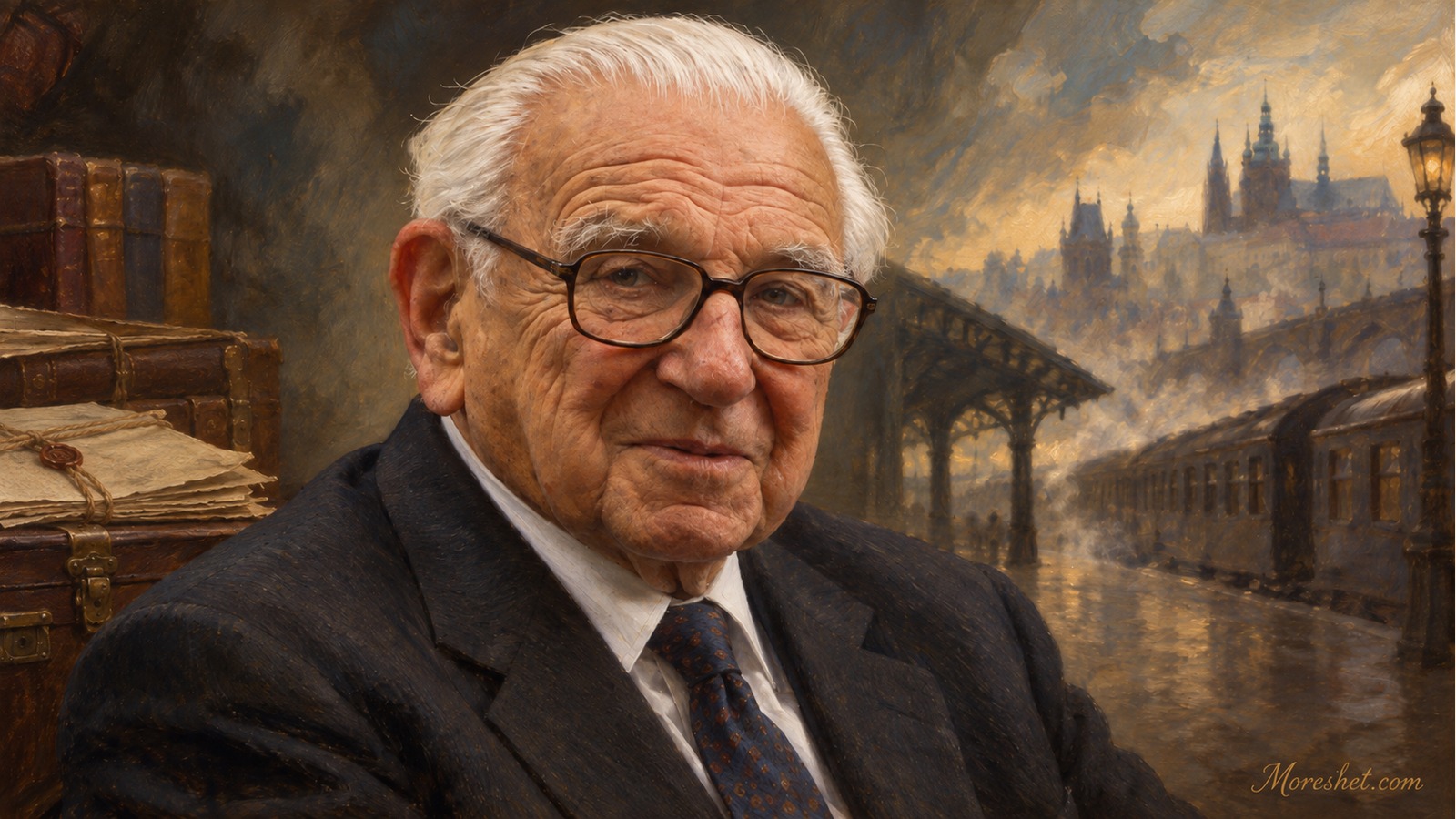
Sir Nicholas Winton — AI-generated artistic portrait · Moreshet.com
The organizer of the Prague Kindertransport who rescued 669 children from Nazi persecution
Sir Nicholas George Winton was a British man of German-Jewish family background whose personal initiative helped save 669 children from Czechoslovakia on the eve of the Second World War. Most of the children were Jewish. Winton arranged for them to leave Prague on special trains and reach Britain, where foster families took them in; a smaller number were sent to Sweden. His work became one of the best-known rescue efforts associated with the Czechoslovak Kindertransport.
From a Jewish-German family to a professional life in Britain
Winton was born in Hampstead on 19 May 1909 as Nicholas George Wertheim, the son of Rudolf and Barbara Wertheim, Jewish parents who had emigrated from Germany to England in 1907. His parents converted to Christianity, and he was baptized and raised as a Christian. During the First World War, the family adopted the more English-sounding surname Wortham. After his father's death in 1937, Nicholas changed his surname again, adopting the name Winton.
After finishing school, he worked in banks in Germany and France before returning to England and becoming a stockbroker. Nothing in that professional path necessarily pointed toward a role in the history of Holocaust rescue. That changed when he traveled to Prague in late 1938.
The mission in Prague
Winton had planned a holiday in Switzerland, but a friend involved in refugee relief asked him to come to Prague. There he saw the harsh conditions faced by refugees who had fled the Sudetenland after its annexation by Germany. Many were Jews; others were Communists, intellectuals and members of additional groups threatened by the Nazi regime.
The visit persuaded Winton that emergency assistance was not enough. He began working independently to find countries and families willing to receive children. At the same time, he had to meet British immigration requirements. After Kristallnacht, Britain allowed Jewish refugee children under the age of 17 to enter, provided that accommodation could be arranged and that £50 was deposited to cover the cost of a return journey should their eventual return become possible.
Winton returned to Britain but continued organizing the operation from there. He placed notices in newspapers, appealed to families, gathered documentation and raised the necessary funds, initially contributing money himself. His work turned a moral appeal into a practical rescue program requiring homes, guarantees, paperwork, transportation and coordination across several countries.
The children’s trains
Before the outbreak of war, Winton arranged the departure of 669 children from Prague on eight trains. Most were Jewish. Once in Britain, they were placed with foster families who provided safety at a moment when Nazi Germany was expanding its control over Europe and the danger facing refugees was increasing rapidly.
A ninth train, carrying approximately 250 children, was scheduled to leave on 3 September 1939. Following Germany’s invasion of Poland and the outbreak of war, it was unable to depart. Many of the children who did not escape faced a tragic fate. The contrast underlines the importance of the eight trains that did leave: they represented a brief opportunity for rescue that closed with the beginning of the war.
Winton did not act alone. Parents, relief workers, officials, foster families and communities in Britain and Czechoslovakia all contributed. His distinctive achievement was to recognize what might still be possible, take responsibility for organizing it and connect the people and institutions capable of making the rescue happen.
Silence, discovery and recognition
After the war, Winton rarely spoke about his work and even kept it from people close to him. For many years he did not meet the children he had helped save. He later said that he assumed they had left Britain when the emergency ended, as the relevant arrangements required. In the early 1980s he was appointed a Member of the Order of the British Empire, but that honor recognized his contribution to establishing housing for elderly people in need rather than his wartime rescue work.
In 1988, his wife, Greta, discovered a scrapbook containing Winton’s detailed records of the children, their parents and their foster families. The scrapbook transformed a largely private and forgotten effort into a documented historical story. The discovery enabled survivors and their descendants to learn more about the person whose initiative had shaped the fate of their families, and it brought Winton growing recognition in Britain, the Czech Republic and Slovakia.
A legacy carried by survivors and descendants
Winton’s story reached a broad public through film. Slovak director Matej Mináč made the drama All My Loved Ones in 1999 and the documentary Nicholas Winton: The Power of Good in 2001, which won an Emmy Award. These works, together with survivor testimony, brought the history of the Czechoslovak Kindertransport to audiences around the world.
In 1998, Winton received the Order of Tomáš Garrigue Masaryk. In 2002, Queen Elizabeth II knighted him in recognition of his rescue work. In the same year, Czech astronomers named the asteroid 19384 Winton after him. In 2008, the Czech government put his name forward for the Nobel Peace Prize.
Winton visited Israel in 2005 and met people he had helped rescue as well as their descendants. The meeting revealed the long reach of his actions. The children he helped save grew up, formed families and contributed to the societies in which they lived; their descendants inherited both the memory of the Holocaust and the story of the people who made their survival possible.
Winton was not recognized as a Righteous Among the Nations because that designation is reserved for non-Jews whose rescue of Jews involved personal risk. That distinction does not diminish the historical importance of his work. His actions belong to the wider history of rescue during the Holocaust and to the story of the Jewish children whose lives continued because they were able to leave Czechoslovakia.
On 1 September 2009, marking the seventieth anniversary of the children’s trains, a steam train left Prague’s central station on a four-day journey to Britain, recreating the original route. Some passengers had traveled on Winton’s trains as children; others were their descendants. A bronze statue commemorating Winton and his work was also unveiled at Prague station, and Winton welcomed the train when it reached London.
In 2009 he received the British Holocaust Hero award. In October 2014, at the age of 105, he received the Order of the White Lion, the Czech Republic’s highest state honor, from the Czech president in the presence of seven of the children he had rescued. Winton died on 1 July 2015 at the age of 106.
Why this legacy belongs in Moreshet
Sir Nicholas Winton merits inclusion in Moreshet because he responded to the persecution of Jewish children with organized, practical action. He found foster homes, raised money, handled documentation and coordinated the trains that carried 669 children away from danger. His contribution was not an abstract gesture of sympathy; it was an intricate rescue effort that depended on persistence, administration and personal responsibility.
His legacy lives in the survivors, their descendants and the public memory of the Holocaust in Britain, the Czech Republic, Israel and beyond. Winton’s story demonstrates how individual initiative can connect communities and produce consequences across generations. It also gives Jewish heritage a human story of rescue that complements the record of destruction: a story about the children who survived, the families who received them and the descendants who continue to remember. For these reasons, his life and work have a meaningful place in Moreshet and on Moreshet.com.