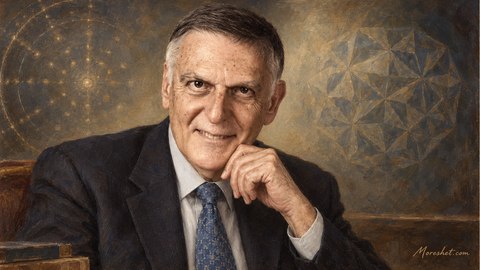
Saul Bellow
A defining voice of Jewish experience in American and world literature
Saul Bellow (1915–2005) was a Canadian-born Jewish American novelist who helped redefine the possibilities of American fiction. His books combine philosophical inquiry with comedy, streetwise speech and a close understanding of people under strain. Jewish experience is not an incidental detail in this achievement. It supplies a powerful vocabulary of family memory, moral argument and competing loyalties through which the modern world can be examined. Bellow received the Nobel Prize in Literature in 1976.
Immigration, education and Chicago
Born in Lachine, Quebec, to parents who had emigrated from the Russian Empire, Bellow moved with his family to Chicago at the age of nine. The city became one of the formative landscapes of his imagination. Its immigrant communities, economic pressures and opportunities for reinvention offered a dense human world in which inherited identities met new expectations.
He studied anthropology and sociology at Northwestern University and later combined writing with a long teaching career. His association with the University of Chicago’s Committee on Social Thought reflected the breadth of his interests. In his fiction, ideas belong within life: literature and philosophy meet the practical problems of earning a living, maintaining relationships and understanding oneself.
Thinking people in a restless world
Among Bellow’s major novels are The Adventures of Augie March, Herzog, Mr. Sammler’s Planet and Humboldt’s Gift. His characters frequently reach a point at which familiar explanations cease to work. A failed relationship, a financial setback or a confrontation with the past becomes the beginning of a larger inquiry into how to live.
What makes these inquiries compelling is their attachment to particular voices. Bellow can move from a comic observation to a difficult moral question without losing the person who is speaking. Intellectual ambition is tested against embarrassment, affection and disappointment. The reader encounters thought as an activity performed by vulnerable human beings rather than as an abstract system delivered from a safe distance.
Jewish memory and an engagement with Israel
In Mr. Sammler’s Planet, a Holocaust survivor confronts a changing New York. The relationship between historical memory and contemporary life gives the novel a distinctive moral pressure. More broadly, Bellow’s work explores what happens when inherited expectations, spiritual needs and the pursuit of success pull in different directions.
His connection with Israel found sustained expression in To Jerusalem and Back, written following a visit to the country. The book brings a novelist’s attention to conversations, personalities and the difficulty of understanding a society through ready-made categories. It also forms part of his larger presence as a Jewish voice within American intellectual life.
Why Saul Bellow belongs in Moreshet
Bellow belongs in Moreshet at Moreshet.com because he placed modern Jewish experience at the centre of internationally significant literature. The memory of migration, the force of family and the habit of moral questioning become resources for understanding lives far beyond a single community. His lasting contribution is a fiction expansive enough to accommodate both intellectual seriousness and ordinary human frailty, giving readers an unusually rich language for the search for meaning.