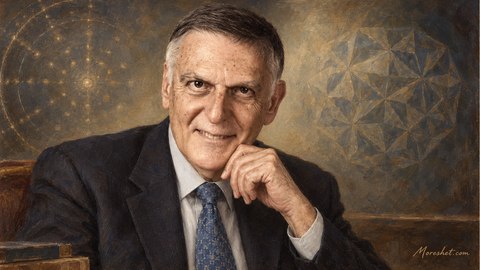
Elias Canetti
A Nobel laureate exploring individuals, crowds and the power of language
Elias Canetti (1905–1994) was a German-language writer and essayist born into a Sephardic Jewish family in Bulgaria. Awarded the 1981 Nobel Prize in Literature, he developed an unusually varied body of work encompassing fiction, drama, autobiography and reflections on society. Its central concern is human behaviour: the words people use, the fears they carry and the transformations that occur when individuals become part of a crowd. His writing approaches these questions with literary imagination and close attention to the particular person.
A childhood among languages
Canetti was born in Ruse, also known historically as Rustchuk, into a Ladino-speaking household. His family’s movements brought him into contact with several European languages and cultures. After his father’s death, his mother played a decisive role in his acquisition of German, the language in which he would write. Choosing it did not erase the Sephardic world of his childhood; that inheritance remained part of the many voices preserved in his work.
In Vienna, Canetti completed studies in chemistry in 1929 while developing the literary and intellectual interests that would determine his career. The city’s cultural life and episodes of public unrest sharpened his fascination with collective behaviour. Following the Nazi takeover of Austria, he and his wife, the writer Veza Canetti, escaped to England.
Knowledge, isolation and human perception
His novel Auto-da-Fé, known in Hebrew as Sanuverim, examines a world shaped by obsession and failures of understanding. Through grotesque comedy and unsettling imaginative extremes, it explores the difference between possessing knowledge and being able to comprehend other people. Books and learning offer no automatic protection against blindness to one’s surroundings.
Canetti also wrote plays, notebooks and short observations. These compact forms allowed him to turn a thought in several directions, questioning an assumption before it hardened into certainty. The diversity of his writing is connected by a persistent interest in the relationship between language, perception and the exercise of power.
Crowds, memory and the writer’s attention
Crowds and Power brings together historical and cultural material to consider fear, obedience, gathering and domination. It is an ambitious work of literary and intellectual interpretation, shaped by its author’s distinctive perspective. Its importance lies partly in prompting readers to notice patterns in public behaviour that might otherwise pass without examination.
His autobiographical writing returns to childhood, family and the encounters through which a writer’s consciousness develops. Language becomes a form of memory: a voice heard at home or a phrase learned in another country can remain alive long after a particular social world has changed. These recollections preserve a richly multilingual European experience, including the Sephardic Jewish culture from which he emerged.
Why Elias Canetti belongs in Moreshet
Canetti belongs in Moreshet at Moreshet.com for a distinctive contribution to world literature and for the cultural memory carried within it. His work connects Sephardic Jewish roots with enduring questions about fear, authority, listening and responsibility. It also demonstrates how an individual can preserve a heritage across languages and national borders. In his writing, the voices of childhood and the difficult lessons of modern history remain available to another generation of readers.