Dan Shechtman
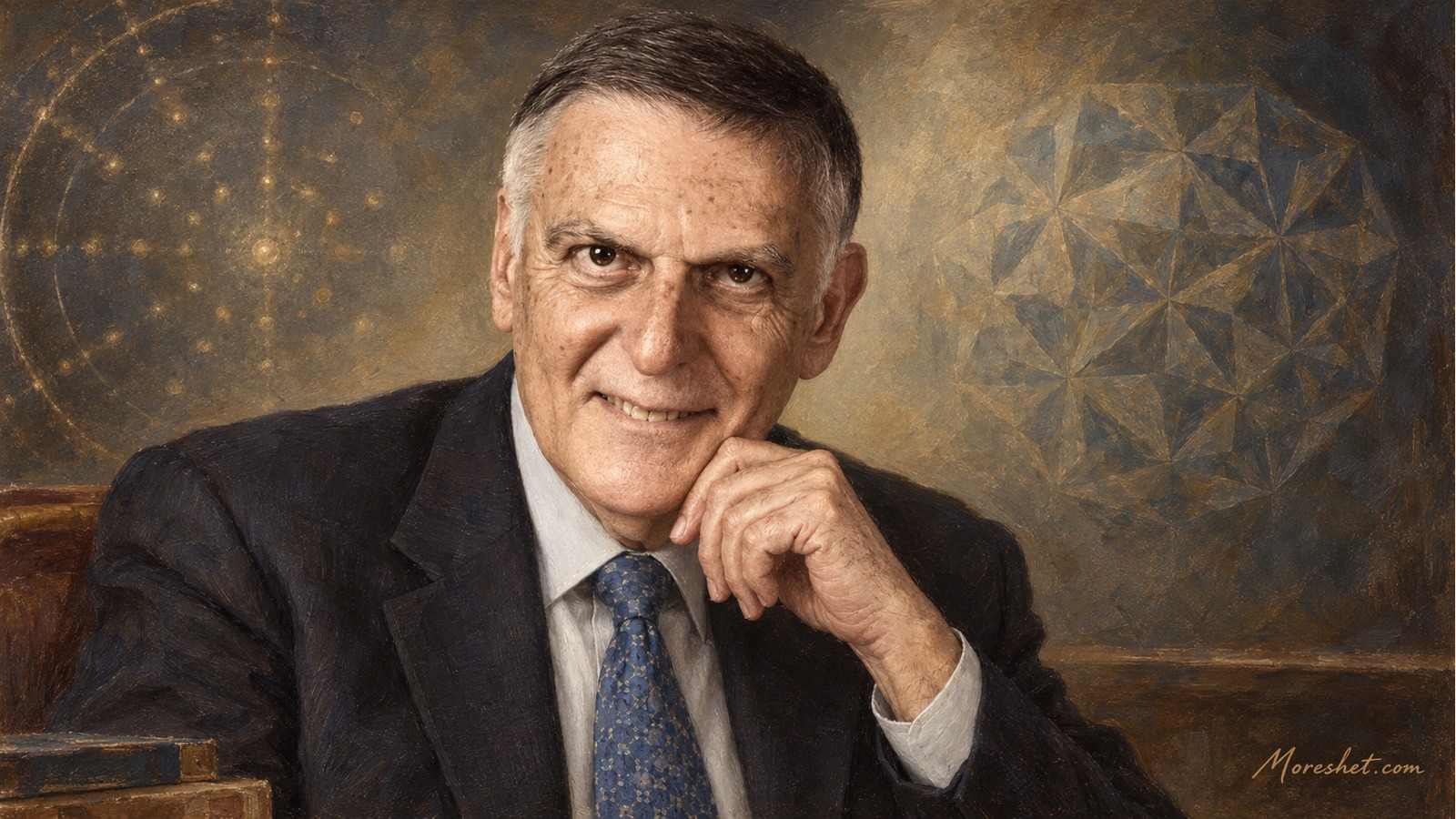
Dan Shechtman — AI-generated artistic portrait · Moreshet.com
Discoverer of quasicrystals, transforming the understanding of order in matter
Dan Shechtman, born in 1941, changed a basic concept in materials science: what counts as a crystal. His discovery of quasicrystals earned the 2011 Nobel Prize in Chemistry. It began with an observation that did not fit the textbooks, but its importance depended on what followed: repeated examination, collaboration and the development of a convincing explanation.
Learning to read the structure of materials
Shechtman trained in mechanical engineering and then materials engineering at the Technion, completing his doctorate in 1972. After research in the United States, he joined the Technion faculty. His work examined the microscopic structure of materials and the relationship between atomic arrangements and the properties of alloys. That expertise prepared him to recognize an anomaly during a research stay at the US National Bureau of Standards.
Order without ordinary repetition
On April 8, 1982, Shechtman examined an aluminum–manganese alloy using an electron microscope. Its diffraction pattern showed a symmetry considered impossible for a periodic crystal. He continued testing the finding despite resistance. Work involving Ilan Blech, John Cahn and Denis Gratias helped establish the result, published in 1984.
Quasicrystals demonstrate that long-range order can exist without the simple periodic repetition of one unit. The discovery expanded the definition of a crystal, connected mathematical ideas with physical evidence and opened new investigations into structures and material properties. It offered an unusually clear example of experiment requiring a revision of accepted theory.
Extending discovery into education
Alongside research, Shechtman promoted science education and technological entrepreneurship, including entrepreneurship teaching at the Technion. He encouraged students to develop ideas and understand the journey from engineering knowledge to a useful product. The Israel Prize and Wolf Prize, followed by the Nobel Prize, recognized the far-reaching significance of his scientific work.
Why this legacy belongs in Moreshet
Shechtman’s place in Moreshet rests on an Israeli contribution that changed a worldwide field of knowledge. Moreshet.com also records the intellectual example behind it: persistence supported by evidence, self-scrutiny and collaboration. His achievement connects the freedom to question established ideas with the responsibility to demonstrate why a different explanation is needed.