Roman Abramovich
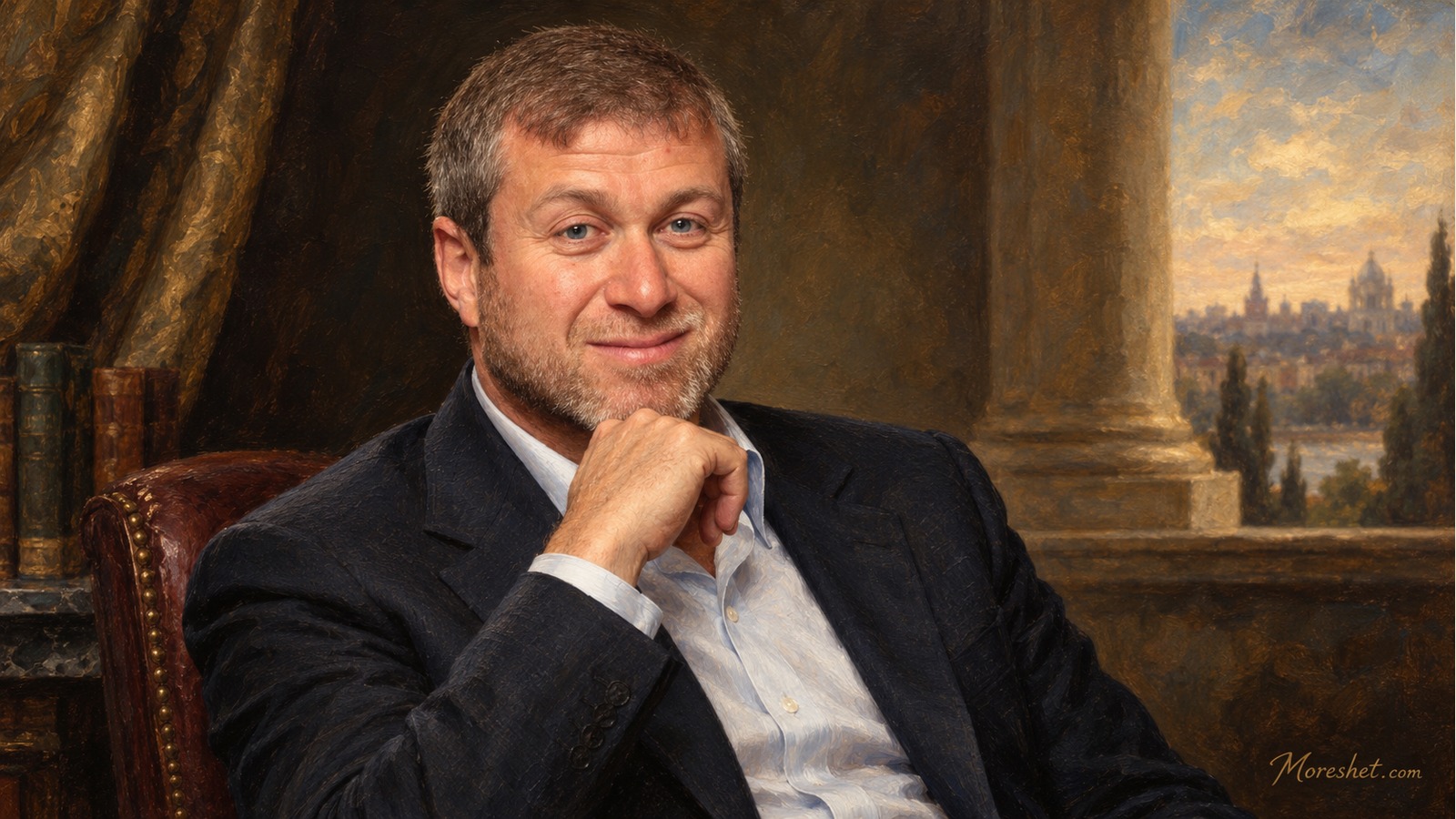
Roman Abramovich — AI-generated artistic portrait · Moreshet.com
Businessman, public leader and philanthropist supporting Jewish communities, Israeli medicine, science, culture and the fight against antisemitism
Roman Arkadyevich Abramovich, born on 24 October 1966 in Saratov in the Soviet Union, is a Russian-Israeli-Portuguese businessman, investor, public figure and philanthropist. He became internationally known as the owner of Chelsea Football Club, but his significance for Jewish and Israeli heritage lies in a wider record of action: supporting Jewish communities across several countries, investing in Israeli medicine and science, preserving Jewish memory, combating antisemitism and strengthening social and cultural institutions.
His life began in difficult circumstances. Abramovich lost his mother in early childhood and became an orphan after his father died when he was four. He was raised by Jewish relatives in Ukhta, in Russia’s Komi region. After serving in the Soviet Army and attending higher-education institutions without completing a degree, he began doing business during perestroika, trading in timber, sugar, food and consumer goods. With his first wife he also established a doll-manufacturing business. Within a few years, his activities expanded into oil, industry and investment.
From Small Trading to Industry and Investment
In the second half of the 1990s, Abramovich became a partner in the creation of Sibneft and later acquired full control of the oil company. The transaction took place within Russia’s controversial loans-for-shares privatization program. In 2005, he sold Sibneft to the Russian government for approximately $13.1 billion. He later helped consolidate Russian aluminum production in the company that became Rusal and acquired a substantial stake in the steel producer Evraz in 2006.
These activities made Abramovich one of Russia’s leading businessmen and an international investor. Through Millhouse Capital, his investment vehicle, he participated in ventures involving industry, agriculture, insurance, technology and other sectors. In Israel, he invested approximately $120 million in 20 start-ups working in fields including medicine, renewable energy and social media. Those investments connected private capital with Israeli innovation and helped young companies develop technologies and products in competitive markets.
Public Service in Chukotka
In 1999, Abramovich was elected to represent the Chukotka Autonomous Okrug in the Russian State Duma. In December 2000, he became governor of the region, serving until 2008. During his tenure, he directed substantial resources toward schools, hospitals, a college, hotels and the renewal of Anadyr’s airport. Sources describe his personal investment in the region as reaching hundreds of millions of dollars, with some estimates placing it still higher.
Chukotka was remote, sparsely populated and marked by weak infrastructure and severe winters. Abramovich’s spending improved access, education and public services, particularly for children. Average wages and economic activity also rose during his tenure. In this way, he turned private wealth into tangible regional development, rather than using it solely for commercial investment.
Chelsea: Building a Global Sporting Institution
In 2003, Abramovich acquired the companies controlling Chelsea Football Club. He invested heavily in players, professional staff and facilities, including the Cobham Training Centre, which opened in 2007. Under his ownership, Chelsea developed from a successful English club into an international sporting brand and one of the world’s most decorated football institutions.
Between 2003 and 2022, Chelsea won 21 major trophies, including English league titles, FA Cups and League Cups, two UEFA Champions League titles, two UEFA Europa League titles, the UEFA Super Cup and the FIFA Club World Cup. The investment transformed not only the club’s results but also its infrastructure, global profile and relationship with millions of supporters.
Abramovich also used Chelsea’s public reach to promote social responsibility. The club led the global Say No to Antisemitism campaign in partnership with Jewish and international organizations. Players, executives and supporters met Holocaust survivors, took part in the March of the Living and engaged with education against antisemitism and racism. A popular sports institution thereby became a platform for discussing Holocaust memory, human dignity and civic responsibility with audiences far beyond Jewish communal life.
Jewish Communities and Holocaust Memory
For many years, Abramovich has been among the major supporters of Jewish institutions and communities in Russia, Israel, Portugal, Britain, the United States, Lithuania and elsewhere. According to the supplied sources, he contributed more than $500 million to Jewish causes over approximately two decades, and he has held or holds leadership responsibilities in organizations representing Jewish communities in the former Soviet Union.
One of the projects most closely associated with his Jewish philanthropy is the establishment of a forest of approximately 25,000 trees in memory of Lithuanian Jews murdered during the Holocaust, together with a virtual memorial to Lithuanian Jewry. The project joins historical remembrance with a living, accessible space for future generations. He also supported the rehabilitation of the Jewish cemetery in Altona, Hamburg, in a project involving B’nai B’rith Portugal and the local Chabad community. Such work preserves Jewish presence in places where communities existed for centuries and gives physical dignity to a heritage devastated by murder and destruction.
Abramovich has also supported Jewish communities in Portugal and B’nai B’rith Portugal, as well as Jewish cultural initiatives including the M.ART contemporary culture festival in Tel Aviv. In 2019, he donated $5 million to the Jewish Agency for Israel to support global efforts against antisemitism. At Chelsea, he connected that work with sport, education and personal encounters with Holocaust survivors, bringing Jewish memory and the fight against antisemitism to broad international audiences.
Medicine, Science and Israeli Innovation
One of the clearest expressions of Abramovich’s activity in Israel is his support for healthcare. He donated more than $60 million to Sheba Medical Center at Tel Hashomer. The funds supported a nuclear-medicine center, cancer research, cardiac initiatives and a congenital-heart center serving children from across the Middle East. During the COVID-19 pandemic, he also supported the creation of a 5,400-square-meter underground intensive-care facility designed to expand Israel’s medical capacity in a national emergency.
In 2015, Abramovich donated approximately $30 million to Tel Aviv University to establish a center for nanoscience and nanotechnology. Such support creates more than a building: it enables research, trains scientists and helps develop future applications in medicine, engineering and industry. His backing of Israeli start-ups complemented the academic investment by connecting research with entrepreneurship and technology.
He also contributed to a Keren Kayemet LeIsrael program for the rehabilitation of forests in the southern Negev. This work combines environmental restoration, the strengthening of open spaces and the development of nature tourism in Israel. Taken together, his contributions extend from the laboratory and hospital to community life and the landscape, reflecting a broad investment in Israel’s future resilience.
Israeli Identity and a Continuing Legacy
Abramovich became an Israeli citizen in 2018 after moving to Israel. His Jewish identity and connection to Israel have been expressed not only through residence and philanthropy, but through sustained support for institutions, communities, science, medicine and culture. His activity spans countries and continents, yet repeatedly reinforces the same foundations: education, health, memory, community and the capacity to build a future.
The breadth of his work across business, public service, sport and philanthropy explains its reach. He used the resources he accumulated to build institutions, support research, improve public services and give Jewish concerns visibility in international life. In many cases, his support is not limited to a single gift; it creates enduring capacity—a hospital unit, a research center, a memorial project, an educational program or a community institution.
Why Roman Abramovich’s Legacy Belongs in Moreshet
Roman Abramovich merits inclusion in Moreshet because his influence is visible where heritage becomes action: preserving the memory of Lithuanian Jewry, restoring a Jewish cemetery, strengthening Jewish communities, combating antisemitism and supporting Jewish culture. At the same time, his contributions to Sheba Medical Center, Tel Aviv University, Israeli start-ups and environmental rehabilitation have affected lives, research and Israeli society.
His story also matters in the broader history of philanthropic leadership. Through Chelsea, he reached audiences who might not otherwise encounter Jewish themes and made opposition to antisemitism and racism part of an international public conversation. Through his investments in Israel, he supported innovation, medicine and the infrastructure of the future. Moreshet and Moreshet.com therefore document him not simply as a wealthy businessman, but as a figure whose actions helped shape institutions, communities and initiatives that can continue to serve people beyond his own lifetime.