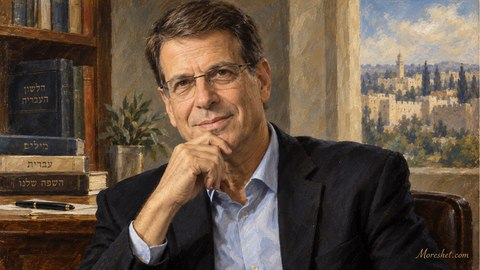
Razi Barkai
The broadcaster and journalist who made Israeli current affairs part of a daily public conversation
Reuven Ze'ev “Razi” Barkai, born on February 24, 1949, is an Israeli journalist, broadcaster, and interviewer. Across more than five decades, he worked in print journalism, public radio, military radio, and television, helping shape the way Israelis encountered news, politics, public affairs, and one another. His distinctive contribution was to turn complex national events into an ongoing, accessible conversation with listeners and viewers.
Family, education, and military service
Barkai was born in Holon to Rina and Shmuel Barkai, also known as Barkovitz, who served as Haganah commander of the Tel Aviv district. He graduated from the 13th class of the military boarding school for command at Haifa’s Reali School. At the age of 17, he lost his older brother Tsahi, who was killed in a training accident while serving as a cadet at the Israel Defense Forces officers’ school.
After enlisting in the IDF, Barkai volunteered for the Paratroopers and was assigned to Battalion 202. He trained as a combat soldier, completed infantry squad-commanders’ and officers’ courses, and returned to the Paratroopers as a platoon commander. During his service, he commanded Benjamin Netanyahu’s training squad and later commanded Shaul Mofaz’s team during officers’ training—experiences that placed him within the formative generation of Israeli military and political leadership.
His academic background was equally broad. Barkai earned bachelor’s degrees in political science and philosophy and a master’s degree in communications. The combination of military experience, political knowledge, philosophical study, and formal training in media gave his later journalism a particularly wide frame of reference.
From print journalism to Kol Yisrael
After leaving the army, Barkai began working for the newspaper Davar in 1970. In June 1971 he joined Kol Yisrael, Israel’s public radio service. He soon moved into positions that placed him close to the country’s centers of political decision-making. In 1977 he became Kol Yisrael’s Knesset correspondent, reporting from the heart of parliamentary life.
Until 1983 he headed the station’s political desk. That year he became its radio correspondent in Washington, gaining first-hand experience of the relationship between Israel, the United States, and the wider Middle East. After returning to Israel in 1986, he was appointed political-parties correspondent, a role that required close daily attention to the leaders, negotiations, and conflicts shaping the national agenda.
Founding “Everything Is Talk” and joining Galei Tzahal
In 1989 Barkai began hosting Everything Is Talk, a program he founded. The show formed part of Israeli radio’s movement beyond formal bulletins and official announcements toward open-ended discussion, interviews, listener engagement, and analysis. Barkai helped develop that format through a direct style that gave guests room to explain themselves while pressing them for clear answers.
In 1993, after hosting seven editions of a program on Israel’s Channel 1, he moved to Galei Tzahal, the IDF radio station. There he hosted the evening journal and the current-affairs program An Hour Before. In 1995 he began presenting the morning program What’s Burning, which became one of the broadcasts most closely associated with him. Its daily schedule gave him a platform to address politics, security, society, culture, and the experiences of ordinary Israelis.
The program’s format changed over time. In early 2017, several interviewers joined Barkai as co-presenters, although the shared format was later discontinued. Beginning in 2019, the program was shortened from two hours to one, and on special occasions Barkai presented joint broadcasts with Rino Tzror. In January 2022 he announced his retirement from Galei Tzahal and hosted the program for the last time on January 26. He returned to the station in August 2022 for a weekly program; in 2024, his work at the station ended.
Interviews that entered Israel’s public memory
Barkai’s career was marked by direct encounters with figures who shaped Israel’s history. In 1989 he interviewed Menachem Begin, who had remained outside public political life since resigning as prime minister in 1983. The interview was significant because it marked Begin’s first public conversation since his withdrawal, bringing the former prime minister’s voice back into the national discussion.
In 1995 Barkai conducted Yitzhak Rabin’s final interview before Rabin’s assassination. Barkai asked the prime minister about the repeated warnings that an attempt might be made on his life. Rabin replied, “I am not afraid.” The exchange became part of Israel’s collective memory because it was recorded shortly before an event that transformed the country’s political and social history.
Barkai also became known for his coverage of the diplomatic process that led from the Camp David talks to the peace treaty between Israel and Egypt. While near the White House, he noticed helicopters landing on the presidential lawn and inferred that the negotiations at Camp David had reached a decisive stage. He entered the complex without authorization and recorded interviews with Anwar Sadat, Jimmy Carter, Menachem Begin, and other senior figures. When a presidential secretary demanded the recording device and tape, Israel’s foreign minister, Moshe Dayan, intervened, allowing Barkai to retain them. The exclusive interviews were broadcast on Israeli radio the following day, giving listeners direct access to a defining diplomatic moment.
Television, recognition, and professional influence
Barkai also worked in television. In 1997 he began hosting Media File on Israel Educational Television. He left the program in 1998, returned to it in 2003, and departed again after approximately a year and a half. His television work broadened the audience for his journalistic approach and enabled him to examine the media itself, including the relationship between journalism, political power, and the public.
His professional achievements received substantial recognition. In 2002 he won the Sokolov Award for achievements in radio and television. At the 2008 Radio Conference he received the Outstanding Radio Broadcaster Award in memory of Shosh Atari. In 2009, What’s Burning received the IDF Radio Commander’s Award, and in 2011 Barkai received the OMETZ Award. A lighter moment from his career also entered Israeli media folklore: in 1996, during a live broadcast, he asked his producer to put “the person in charge of the Internet” on the phone. The line was later quoted in the 2004 book Taken Out of Context: The Punchlines of Israeli Media.
Continuing presence in public discourse
After leaving Galei Tzahal, Barkai continued to participate in Israeli media. From 2023 he served as a commentator on the Reshet 13 program Area of Choice. His movement among newspapers, public radio, military radio, television, and contemporary commentary reflects both his adaptability and the changing structure of Israeli media. Across those platforms, he retained a commitment to the interview and to the idea that public life becomes meaningful when citizens can hear its central participants explain themselves.
Barkai is married to Deborah, is the father of a son and a daughter, and lives in Kiryat Ono.
Why Razi Barkai belongs in Moreshet
Razi Barkai merits inclusion because his career documents—and helped shape—a long chapter in the life of the State of Israel: the transition from print journalism and public radio to military broadcasting, television, and a multi-platform media environment. He did more than report events. Through interviews, questions, and daily conversation, he made those events part of the shared memory of the Israeli public.
The interviews with Menachem Begin and Yitzhak Rabin, his exclusive coverage connected to the Camp David process, and the enduring influence of Everything Is Talk and What’s Burning place him within the history of Israeli journalism and broadcasting. His contribution is also cultural. He helped establish radio as a common civic space in which Israelis from different communities, generations, and backgrounds could encounter the same national agenda and take part in a shared conversation. For these reasons, Moreshet and Moreshet.com present his story as part of the record of the voices, institutions, and media habits that shaped modern Jewish and Israeli life.