Paul Krugman
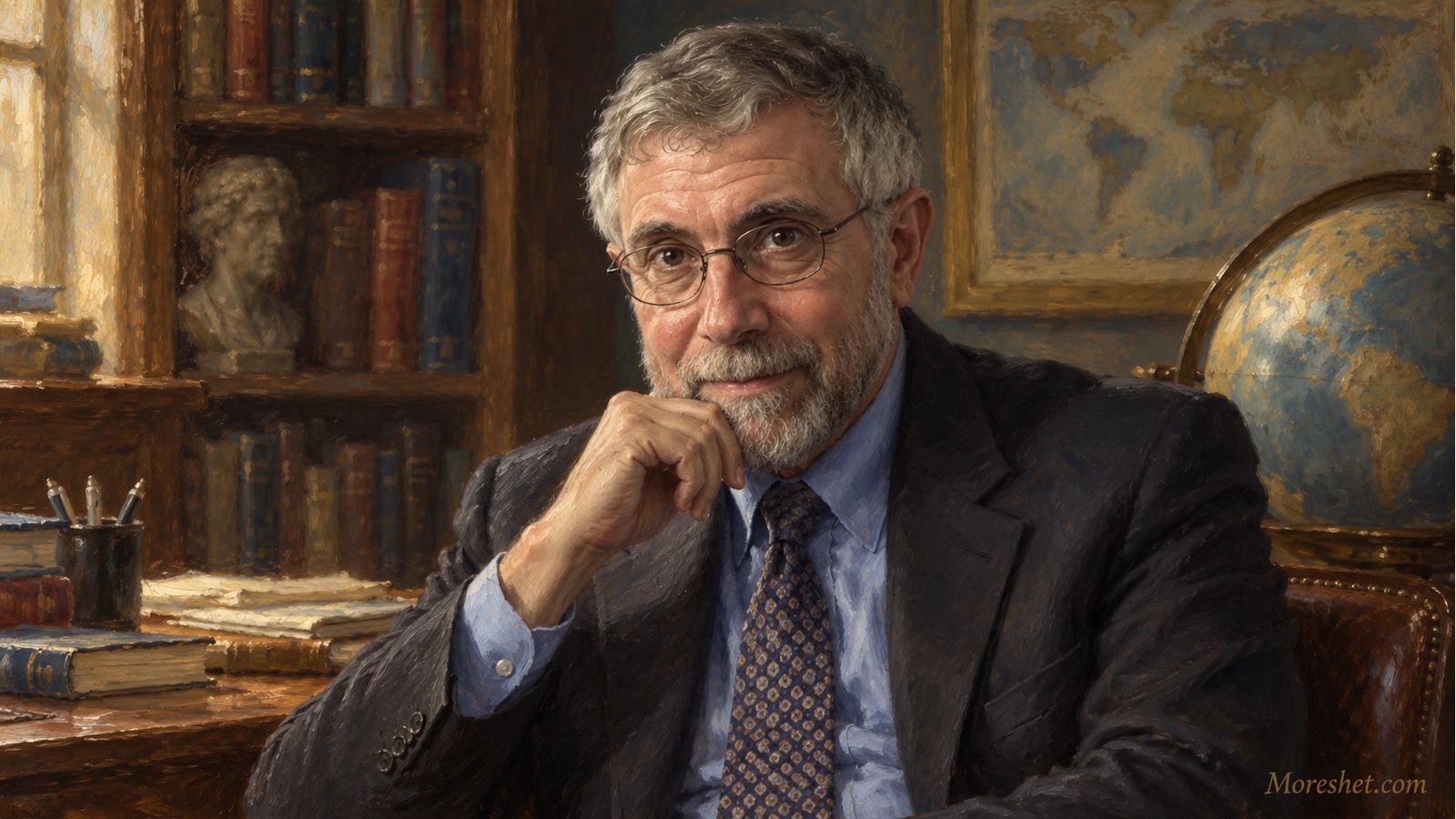
Paul Krugman — AI-generated artistic portrait · Moreshet.com
The Nobel Prize–winning economist who reshaped the study of trade, geography, and financial crises
Paul Robin Krugman, born on February 28, 1953, is an American economist, scholar, author, and public intellectual. He received the 2008 Nobel Memorial Prize in Economic Sciences for his contributions to new trade theory and new economic geography. His research changed how economists understand why similar countries trade with one another, why industries and populations concentrate in particular regions, and how financial crises move across borders.
Krugman's significance extends beyond the Nobel Prize and his academic publications. Through textbooks, books for general readers, newspaper columns, and online writing, he made difficult ideas about trade, unemployment, inflation, exchange rates, and inequality part of public conversation. His work reached students, researchers, policymakers, and ordinary readers, including readers in Israel and Jewish communities around the world.
Jewish Roots and Academic Formation
Krugman was born in Albany, New York, to a Jewish family with roots in Eastern Europe. His parents immigrated to the United States from Brest, Belarus, in 1922. He grew up on Long Island, graduated from Yale University with distinction in economics in 1974, and completed his Ph.D. at the Massachusetts Institute of Technology in 1977 with a dissertation on flexible exchange rates.
From the beginning of his career, Krugman sought to understand how economic decisions shape the lives of individuals and entire societies. He studied under economist Jagdish Bhagwati and later became one of the most prominent critics of some approaches to globalization. His academic career included teaching and research at Yale, MIT, the University of California, Berkeley, Stanford, and the London School of Economics, followed by Princeton University. In 2015, he joined the Graduate Center of the City University of New York.
The Research That Recast Trade Theory
Earlier trade theories largely explained commerce between countries with sharply different characteristics—for example, an agricultural country exchanging food for manufactured goods from an industrial country. Krugman addressed a central feature of the modern economy: why countries that resemble one another, and that produce similar goods, trade extensively with one another.
His model rested on two straightforward but powerful ideas. Consumers value variety, seeking a choice among different brands and products. At the same time, large-scale production lowers costs. Together, these forces explain why particular products become concentrated in certain countries or regions, and why international trade can benefit countries with similar levels of development.
This work, expressed in part in his 1979 paper on increasing returns, monopolistic competition, and international trade, became a foundation of new trade theory. It broadened the explanation of the gains from trade beyond natural differences between countries, showing how market size, transportation costs, product variety, and economies of scale shape international commerce.
New Economic Geography: Why Activity Concentrates
Krugman's trade research led him to develop what became known as new economic geography. In his seminal 1991 paper, “Increasing Returns and Economic Geography,” he showed how economies of scale, transportation costs, and differences in demand can cause industry, population, and services to cluster in particular places.
When a region attracts production, it creates jobs, infrastructure, and a larger consumer market. That larger market attracts additional production, which in turn increases demand and employment. This cumulative process helps explain why cities and industrial regions become economic centers while other areas may fall behind. Krugman's framework influenced the study of urbanization, regional development, industrial policy, and globalization.
The contribution also has clear relevance to Israel and Jewish life, where questions of geographic concentration, regional inequality, the development of the periphery, and the relationship between local economies and global markets remain central public concerns.
Financial Crises, Exchange Rates, and the Liquidity Trap
Krugman also made influential contributions to the study of currency and financial crises. In a 1979 paper on balance-of-payments crises, he showed how fixed exchange-rate regimes can become vulnerable to sudden speculative attacks. The paper became one of the important contributions to the first generation of currency-crisis models.
During the 1990s, he analyzed the East Asian financial crisis, Japan's prolonged stagnation, and the risks created when exchange rates no longer fit underlying economic conditions. He also warned about the vulnerability of highly leveraged financial systems and the dangers of assuming that markets will correct themselves without public intervention.
Krugman brought the Keynesian concept of a liquidity trap back into the center of economic debate. In such a situation, interest rates are already very low, yet households and businesses remain unwilling to borrow and invest because they fear the future. Lowering rates alone may therefore be insufficient; governments and central banks may need to support demand and prevent prolonged unemployment.
In The Return of Depression Economics and The Return of Depression Economics and the Crisis of 2008, he compared Japan's stagnation, the Mexican peso crisis, the Asian financial crisis, and the global financial crisis of 2008. He argued that these episodes can become self-reinforcing cycles of falling demand, layoffs, declining income, and fear. His analysis shaped debates about economic policy during later periods of crisis as well.
Public Scholarship: Books, Journalism, and Accessible Economics
Krugman has published more than two hundred scholarly articles and dozens of books, including academic studies, textbooks, and works for general readers. His textbook International Economics: Theory and Policy, co-authored with Maurice Obstfeld, became a standard introduction to international economics. With Robin Wells, he also wrote widely used introductory texts in microeconomics and macroeconomics.
In books including The Age of Diminished Expectations, Peddling Prosperity, The Conscience of a Liberal, End This Depression Now!, and Arguing with Zombies, he explained to non-specialists how taxation, unemployment, inequality, public investment, and financial crises affect everyday life.
From 2000 through 2024, Krugman wrote a regular column for The New York Times. Earlier, he contributed to Fortune, Slate, Harvard Business Review, The Economist, and other publications. His journalism made him one of the world's most recognizable economists. He did not simply present statistics; he explained what they meant for workers, families, students, businesses, and governments.
The Hebrew edition of The Return of Depression Economics, published in Israel as Economics in a Time of Crisis: How Do We Get Out? in a translation by Yaron Ben-Ami, brought his analysis to Israeli readers during the period when the global financial crisis dominated economic life.
Public Service and International Recognition
In 1982 and 1983, Krugman served on the staff of the Council of Economic Advisers during Ronald Reagan's presidency. Although he returned to academia, the experience gave him a close view of the distance between economic models and public decision-making.
In 1991, he received the John Bates Clark Medal, awarded to an American economist whose work is judged to have made an outstanding contribution while still relatively young. He was elected a Fellow of the American Academy of Arts and Sciences in 1992 and received Spain's Prince of Asturias Award in Social Sciences in 2004.
In 2008, Krugman was the sole recipient of the Nobel Memorial Prize in Economic Sciences. The Nobel committee cited his integration of economies of scale into general-equilibrium models and his contribution to understanding the determinants of trade and the location of economic activity. The award recognized research that did more than solve an abstract theoretical problem: it supplied tools for interpreting the real economic world.
Krugman continued to use his public platform to write about inequality, public policy, unemployment, climate change, and the relationship between government decisions and human welfare. His positions made him a prominent and sometimes polarizing participant in public debate, but his central contribution remains his ability to connect economic theory and evidence with human consequences.
Why Paul Krugman's Legacy Belongs in Moreshet
Paul Krugman merits inclusion in Moreshet because he forged an unusual connection between pathbreaking economic research and an intellectual responsibility to the public. He transformed the academic understanding of trade, industrial concentration, cities, and crises, while ensuring that these ideas reached readers beyond the university.
For Jewish and Israeli readers, his life represents a tradition of educational excellence, open argument, and the use of knowledge to address concrete social problems. His textbooks and scholarship influenced generations of students, while his journalism helped broad audiences understand forces that shape their economic future. On a global scale, his work helps explain why some places prosper, why others are left behind, and what governments can do when markets enter a crisis. Moreshet.com therefore preserves his story not merely as the biography of a Nobel laureate, but as part of the history of Jewish-American intellectual life, modern economics, and the effort to turn public knowledge into a tool for improving human lives.