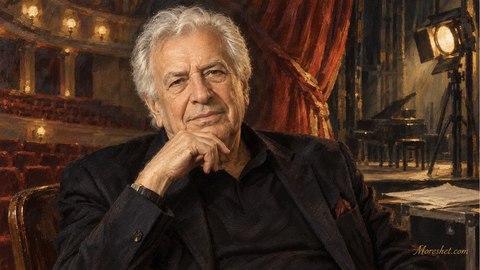
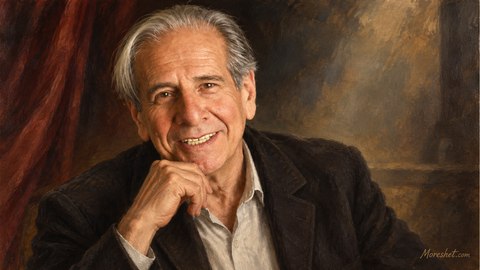
Oded Kotler
The actor, director and artistic leader who helped shape Israeli theatre
Oded Kotler is one of the defining figures in Israeli theatre from the second half of the twentieth century into the twenty-first. Born in Tel Aviv, he has worked for more than seven decades as an actor, director, artistic director, founder of cultural institutions and author. His importance lies not only in the roles he performed. Kotler helped build the professional and artistic infrastructure of Israeli theatre, championed original Hebrew-language drama and encouraged stages to engage directly with the country's social, moral and political realities.
From youth theatre to the centre of Israeli culture
Kotler began acting and directing while still in high school, with the youth theatre group Kelaim, which he established in Tel Aviv. At 17, he received his first commercial theatre role in Tea and Sympathy at Ha'Ohel Theatre. During his military service he acted and directed in the Central Command Entertainment Troupe. Afterward he performed with the Batzal Yarok troupe and appeared at Ha'Ohel and the Cameri Theatre, while also taking part in radio programmes, including the popular series Mishpachat Shimhon.
These early experiences placed Kotler within a generation seeking to create a confident Hebrew culture for the young State of Israel while remaining open to the world's dramatic traditions. From the beginning, he combined performance with directing, ensemble work and a sense of responsibility for the institutions that made artistic work possible.
Founder and artistic director
In the mid-1960s, Kotler co-founded Bamat HaSakhanim, or The Actors' Stage, an ensemble devoted to original plays. Its performers included Amnon Meskin, Liora Rivlin and Ilan Toren, and the group later joined the Haifa Theatre. From 1970 to 1978, Kotler served as Haifa Theatre's artistic director and made it an important centre for new Israeli writing. He supported plays that addressed power, memory, war, class, family and public life rather than treating theatre as entertainment detached from society.
In 1980 he founded the Neve Tzedek Theatre Center. He was also a co-founder of the Acco Festival of Alternative Israeli Theatre, which created room for experimental work, independent artists and theatrical languages outside the commercial mainstream. From 1985 to 1990 he directed the Israel Festival, served on the ensemble and artistic leadership of the Cameri Theatre, and founded The Laboratory Theatre in Jerusalem.
Kotler returned as artistic director of the Haifa Theatre from 1990 to 1998. He continued to promote Israeli plays, including works such as Hanoch Levin's The Doubter and Nissim Aloni's Eddie King, while also confronting the financial pressures facing a major cultural institution. In 2011 he became artistic director of the Herzliya Ensemble Theatre, a position that ended when the theatre closed in 2013.
A director of Israeli drama and world classics
Kotler's directing repertoire moved between Israeli plays, literary adaptations and major works of international drama. His notable productions included Hanoch Levin's Hefetz and The Labor of Life, Yaakov Shabtai's The Spotted Tiger, Nissim Aloni's The Cruelest King, Edna Mazya's Games in the Backyard, Savyon Liebrecht's I Speak Chinese to You, Yehoshua Sobol's Working-Class Hero and Tamir Greenberg's Hebron. The last examined the Israeli-Palestinian conflict through the perspectives of both sides.
He also directed works by Shakespeare, Chekhov, Ibsen, Aristophanes, Brecht, Pinter and other major playwrights. This work connected Israeli theatre to the international canon while demonstrating that Hebrew-language drama could stand at the heart of a serious, ambitious and relevant repertoire.
Theatre was also, for Kotler, a way to bring urgent social questions into public view. In 2005 he formed a new theatre group and staged An Unemployed Is Born at the Givatayim Theatre, a work about unemployment and social inequality in Israel. His approach treated theatre as a civic art: a place capable of disturbing complacency, giving form to experiences that are often overlooked and asking what responsibilities art carries within society.
Actor on stage, screen and television
Alongside his work as a director and administrator, Kotler developed a distinguished acting career. His film appearances included Hot Sands, Maybe I'll Go Down There, Mishpachat Shimhon, Beersheba Sands, Every Bastard a King and The Vinshel Affair. His leading performance in Uri Zohar's Three Days and a Child (1967), based on a story by A. B. Yehoshua, won him the Best Actor Award at the Cannes Film Festival. He was also prominent in Dan Wolman's My Michael (1975), based on Amos Oz's novel.
In 1985 he directed the feature film Serial Romance, starring Haim Topol and based on a story by Yitzhak Ben-Ner. He also directed documentaries and television projects, including the six-part series Family, My Successful Child about Naomi Polani and the revival of the Tarnegolim troupe, Traces in the Snow about Bulgakov and the Gesher Theatre production The Devil in Moscow, as well as a three-part television history of Israeli theatre.
His television appearances included Asi the Ugly, its sequel Elvis, Rosenthal and the Mysterious Woman, and Hasamba Generation 3, in which he played Yaron Zehavi, the commander of Hasamba. In 2002 he played the lead in the musical My Fair Lady. In 2017 he appeared in the monodrama Unwanted Child, based on the biography of Yitzhak Ben-Aharon and directed by Nola Chilton.
Writing, memory and a life in art
Kotler recorded his personal and professional journey in the autobiography Many Days Will Not Cover, published by Am Oved in 2016. In 2019 he published his first novel, The Journey: A Personal Diary by Dave Segal. These books add an introspective dimension to his stage work, exploring memory, identity, relationships and the costs and rewards of a life devoted to art.
His honours include five Kinor David Awards, the Knesset Speaker's Quality of Life Prize, the Margalit Prize, the French Government's Chevalier of the Ordre des Arts et des Lettres, the Rosenblum Prize for the Performing Arts, the Israel Theatre Prize for lifetime achievement, the EMET Prize and lifetime achievement awards from the Sam Spiegel Film and Television School and the Israeli Actors Guild. In 2022 he received the Israel Prize in Theatre. The breadth of these recognitions reflects not simply individual success, but his influence on generations of actors, directors, playwrights and cultural institutions.
Why this legacy belongs in Moreshet
Oded Kotler merits inclusion in Moreshet because he worked simultaneously as an artist and an institution-builder. He helped make original Israeli drama a central part of public culture, established platforms for new work and insisted that theatre could examine the society around it with intelligence and courage. His career connected local stages to the world's dramatic traditions while giving Israeli writers and performers a stronger place within the national cultural story.
Kotler's legacy shows how cultural heritage is made: not only through awards or celebrated performances, but through years of rehearsal, artistic choices, institution-building and opportunities created for others. Moreshet.com therefore presents him not merely as an acclaimed actor, but as a figure who helped shape the language, memory and imaginative possibilities of Israeli theatre.