Michael Bloomberg
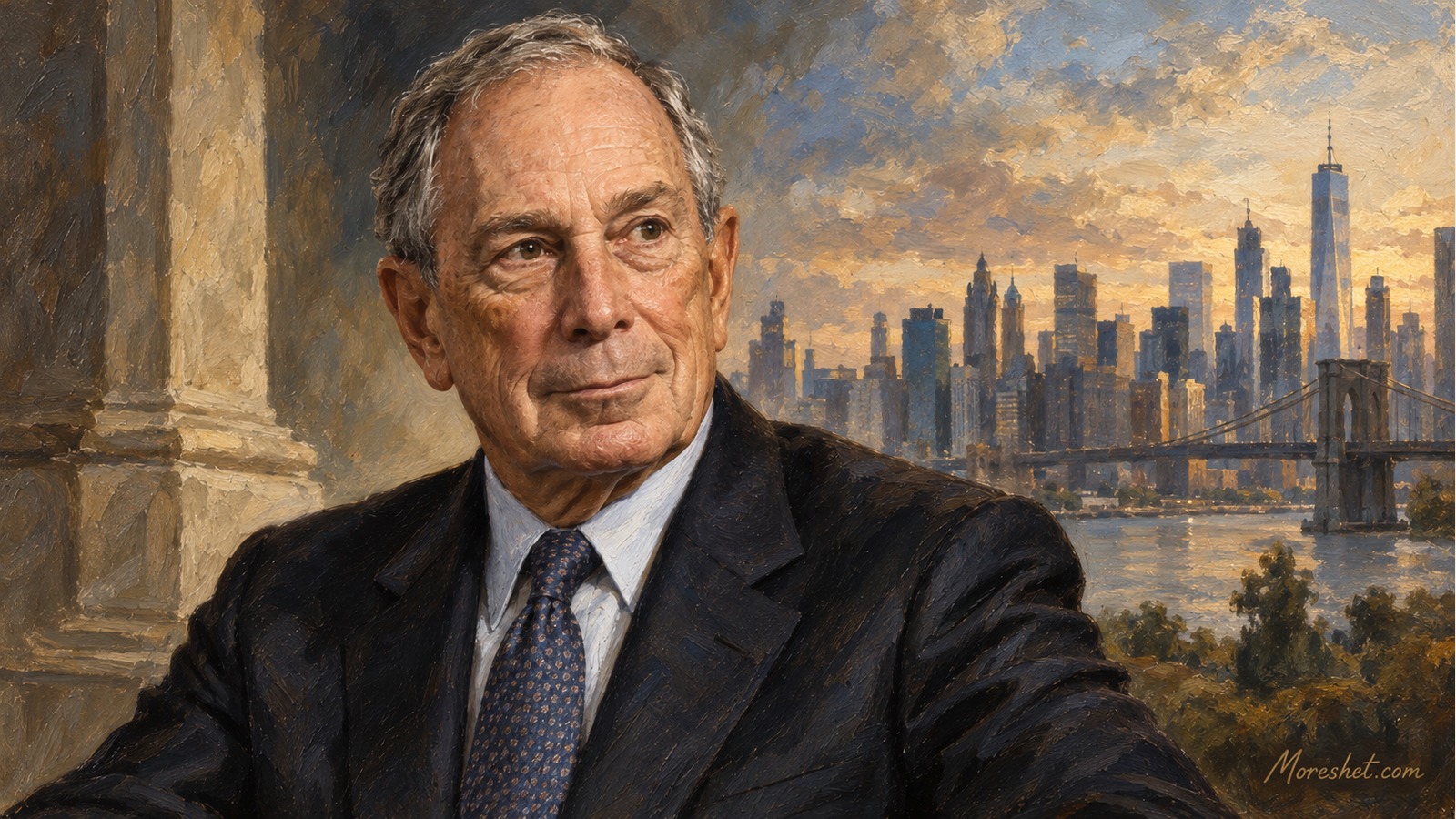
Michael Bloomberg — AI-generated artistic portrait · Moreshet.com
Jewish-American entrepreneur, New York mayor, and philanthropist who reshaped financial information, public health, education, climate action, and civic life
Michael Rubens “Mike” Bloomberg is a Jewish-American entrepreneur, media figure, politician, and philanthropist. He founded Bloomberg L.P., helped make real-time financial information a central tool of international markets, and served as mayor of New York City from 2002 through 2013. After leaving City Hall, he expanded his public work through Bloomberg Philanthropies, directing enormous resources toward public health, education, climate action, the arts, urban innovation, and Jewish institutions. His career connects technological entrepreneurship, city leadership, and global philanthropy.
From a Jewish family in Boston to Wall Street
Bloomberg was born on February 14, 1942, in Boston’s Brighton neighborhood, to a Jewish family with roots in Poland and Lithuania. His father, William Henry Bloomberg, worked as an accountant for a dairy company, and his mother, Charlotte Rubens Bloomberg, came from a family of Jewish immigrants. He grew up in Allston, Brookline, and Medford, Massachusetts, and graduated from Medford High School.
His early life already reflected a talent for initiative and leadership. At the age of 12, he became an Eagle Scout, the highest rank in the Boy Scouts of America. He earned a degree in electrical engineering from Johns Hopkins University in 1964 and an MBA from Harvard Business School in 1966.
Transforming financial information
Bloomberg began his career at the Wall Street brokerage Salomon Brothers, working in equity trading and systems development. After the firm was acquired in 1981, he used the money he received for his equity to establish Innovative Market Systems. His premise was straightforward but transformative: financial professionals needed accurate, immediate, searchable information rather than scattered tables and delayed reports.
The company developed terminals that delivered real-time market data, financial calculations, and analytical tools. Its first terminal reached the market in 1982, and in 1986 the company became Bloomberg L.P. Bloomberg News, Bloomberg Radio, Bloomberg Message, and Bloomberg Tradebook followed. The result was not simply a technology company but an integrated information, software, and media system that changed how banks, investment firms, governments, and news organizations made decisions.
In 1997, Bloomberg published his autobiography, Bloomberg by Bloomberg, written with Matthew Winkler. The book describes the management principles and innovations behind the company’s growth. Bloomberg L.P. became one of the world’s leading financial-information businesses, creating the economic foundation for Bloomberg’s later public and philanthropic work.
Mayor of New York City
In 2001, Bloomberg ran for mayor as a Republican after spending most of his adult life as a Democrat. He defeated Mark Green and took office on January 1, 2002, shortly after the September 11 attacks. He won reelection in 2005 and 2009, serving three consecutive terms until December 31, 2013.
Bloomberg brought a data-driven management style to City Hall. He gave agency commissioners broad room to act while requiring them to demonstrate results. During his administration, New York reduced a substantial budget deficit, expanded investment in affordable housing, and pursued major changes in transportation, infrastructure, and redevelopment.
His administration is associated with expanded bicycle lanes, the pedestrianization of parts of Times Square, the extension of the subway to Hudson Yards, and continued construction of the Second Avenue Subway. It also promoted charter schools and programs addressing disparities among young people, including the NYC Young Men’s Initiative.
Public health became a defining part of his mayoralty. New York banned smoking in indoor workplaces, including restaurants and bars, and in 2006 became the first American city to prohibit trans fats in restaurants. Other cities and states adopted similar measures, making public health a central element of urban policy. While some enforcement and surveillance policies generated serious disagreement, Bloomberg’s years in office left a lasting mark on municipal management and the global conversation about cities, health, and the environment.
Bloomberg declined the mayoral salary and accepted one dollar a year. He also financed much of his political activity personally. After leaving office, he remained active in public life. He formally rejoined the Democratic Party in 2019 and entered the 2020 race for the Democratic presidential nomination. He withdrew in March 2020 and endorsed Joe Biden.
A continuing connection to Israel and Jewish life
Bloomberg’s Jewish identity is reflected in his public commitments. He grew up in a Jewish home, attended Hebrew school, had a bar mitzvah, and was raised in a kosher household. Although his religious life is now largely secular, he remains connected to synagogue life. His hometown congregation in Medford was renamed the William and Charlotte Bloomberg Jewish Community Center in honor of his parents.
In January 2009, during Operation Cast Lead, Bloomberg visited Israel in an expression of solidarity and support, including communities near the Gaza border. He voiced support for Israel’s right to protect its residents from rocket attacks. He gave $50 million toward the construction of a Magen David Adom station in Jerusalem, inaugurated in October 2011. After Hamas’s October 2023 attack, he pledged to match donations to Magen David Adom; by that month, the matching commitment had reached $25 million.
In 2013, Bloomberg became the first recipient of the Genesis Prize, recognizing contributions to Jewish values and society. He announced that he would donate the $1 million prize through the Genesis Generation Challenge, a competition encouraging young adults to develop solutions to global problems. In 2024, he was also reported to have pledged 100 million shekels for the rehabilitation of northern Israeli communities affected during the Iron Swords War, through Bloomberg Philanthropies and the Bloomberg-Sagol Center for City Leadership at Tel Aviv University.
Philanthropy in education, medicine, cities, and the arts
Bloomberg’s giving has made him one of the most influential philanthropists in the world. Bloomberg Philanthropies focuses on five broad areas: public health, education, the arts, government innovation, and the environment. He has signed the Giving Pledge, committing to give away a substantial portion of his wealth during his lifetime.
Johns Hopkins University is the clearest institutional expression of his philanthropy. By 2024, Bloomberg had given the university more than $4.55 billion, making him the largest living donor to an American educational institution. His gifts supported a children’s hospital, research buildings, libraries, the Institute for Cell Engineering, the Malaria Research Institute, and the Johns Hopkins Bloomberg School of Public Health. He established the Bloomberg American Health Initiative and helped launch the Bloomberg–Kimmel Institute for Cancer Immunotherapy. In 2018, he gave $1.8 billion to enable need-blind admissions and full financial aid for admitted students. In 2024, he gave another $1 billion to expand tuition assistance for medical students.
His educational and research philanthropy extends far beyond Johns Hopkins. He gave $100 million to Cornell Tech, supported the American Talent Initiative to expand access to leading colleges for high-achieving students from lower-income families, and donated $50 million to Boston’s Museum of Science, which had stimulated his own curiosity as a child. In 2020, he gave $100 million to four historically Black medical schools, followed by a further $600 million in 2024 to strengthen their endowments.
Bloomberg has also supported New York’s cultural institutions, including The Shed and the Perelman Performing Arts Center at the World Trade Center site. As chairman of the National September 11 Memorial & Museum, he helped raise approximately $450 million, including a personal gift of $50 million, and helped overcome financial and design problems that had delayed completion. The memorial and museum became major institutions of American remembrance and education about freedom, responsibility, and loss.
Public health and climate action
Bloomberg’s public-health work extends well beyond New York. Bloomberg Philanthropies has supported global tobacco-control efforts, including monitoring, legislation, public education, and capacity-building. The foundation has directed hundreds of millions of dollars to the World Health Organization and other partners, helping developing countries strengthen policies to reduce the harms of tobacco. In 2016, the World Health Organization appointed Bloomberg its Global Ambassador for Noncommunicable Diseases.
During the COVID-19 pandemic, Bloomberg supported treatment and vaccine research, contact-tracing training through Johns Hopkins, nonprofit organizations in New York, and meals for health-care workers. He also helped create networks through which mayors and local leaders could share practical knowledge about pandemic response.
Climate action is another central focus. Bloomberg chaired the C40 Cities Climate Leadership Group, a network of cities working to reduce emissions, and helped connect it with other international initiatives. He funded the Beyond Coal campaign, which grew from a state-level effort into a national and international drive to retire coal-fired power plants. Beyond Carbon, Beyond Petrochemicals, and America’s Pledge sought to connect cities, states, businesses, and universities even when the federal government stepped away from climate commitments.
In 2014, Bloomberg was appointed the United Nations Special Envoy for Cities and Climate Change, and later served as the UN Secretary-General’s Special Envoy for Climate Ambition and Solutions. He has also supported ocean conservation, clean energy, and initiatives that translate climate risks into economic information that decision-makers can use.
Why this legacy belongs in Moreshet
Michael Bloomberg merits inclusion in Moreshet because his work has shaped several fields that affect Jewish, Israeli, and wider human life: information and communications, city leadership, public health, education, the environment, and philanthropy. He turned a technological idea into a global information infrastructure, applied measurement and accountability to municipal government, and invested his fortune in institutions of research, medicine, culture, and education.
His connection to Israel and the Jewish people is practical as well as personal. His support for Magen David Adom, the Genesis Prize, Jewish institutions, and recovery efforts in Israel reflects sustained engagement with Jewish communities and human life. At the same time, his gifts to Johns Hopkins, tobacco-control programs, medical schools, cultural institutions, and climate initiatives have affected people far beyond the Jewish community. Moreshet and Moreshet.com therefore preserve Bloomberg’s story not simply as the story of a wealthy businessman or public official, but as the record of a figure whose institutions, resources, and ideas continue to shape the lives of others.