Menashe Kadishman
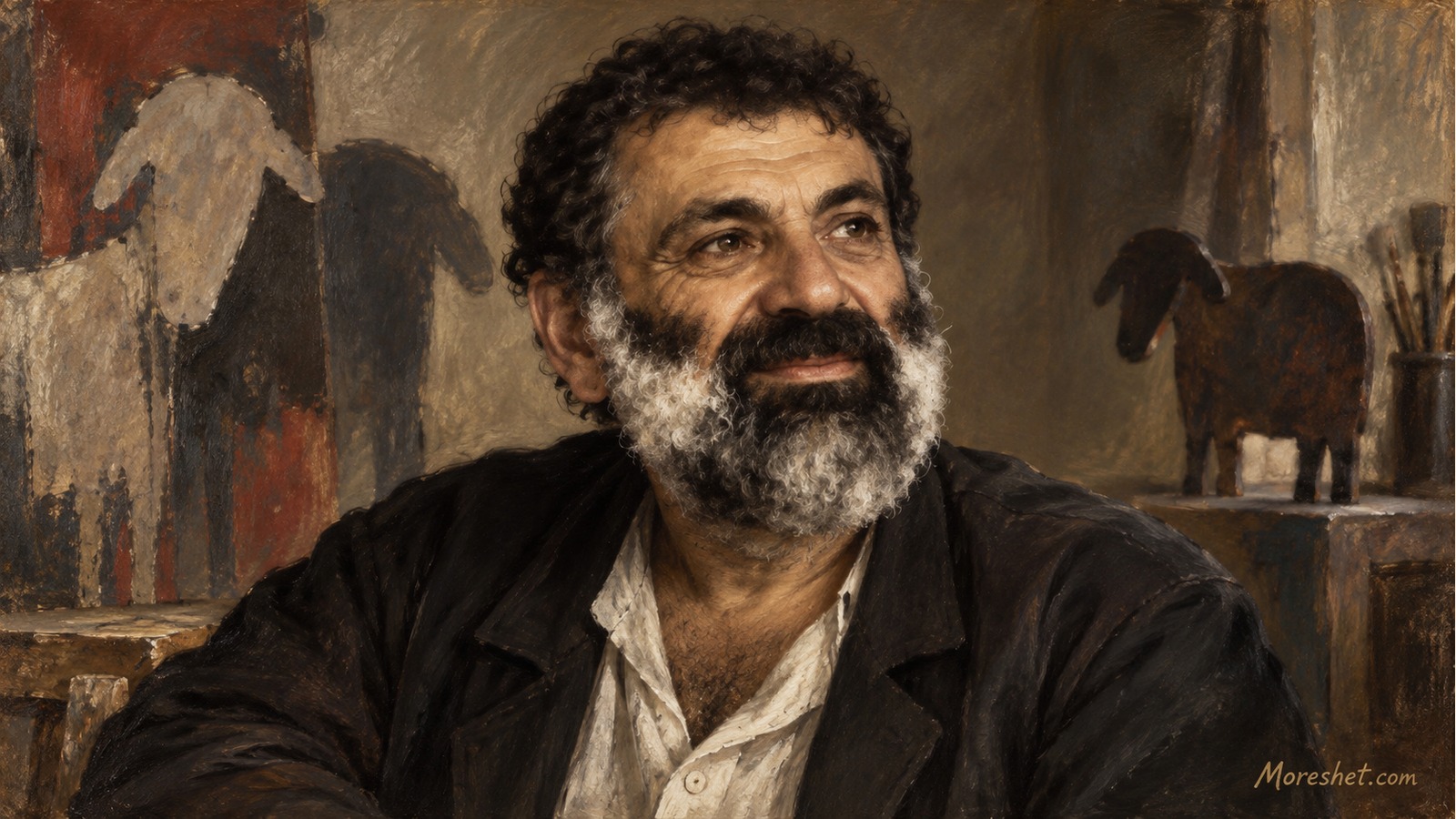
Menashe Kadishman — AI-generated artistic portrait · Moreshet.com
The Israeli painter and sculptor who transformed sheep, steel and public space into a language of nature, memory and identity
Menashe Kadishman (August 21, 1932 – May 8, 2015) was one of the most recognizable figures in Israeli art during the second half of the twentieth century and the beginning of the twenty-first. Working as a painter, sculptor and public artist, he received the Israel Prize for sculpture. His career moved between international modernism and immediately accessible images of sheep, trees, families and mothers. In doing so, he connected a contemporary artistic vocabulary with local experiences of borders, kibbutz life, nature, war, memory and everyday Israeli life.
Tel Aviv, the Nahal and the shepherd’s experience
Kadishman was born in Tel Aviv to Bilha and Ben-Zion Kadishman. His father made aluminum cutouts of pioneers as a hobby, and the household encouraged an interest in art. As a young man, Menashe studied painting with Aharon Avni and sculpture with Moshe Sternschuss, while also participating in the Gordonia youth movement. After completing his studies at the Max Fein Vocational School, he joined the IDF and became part of its first Nahal unit.
He was stationed at Kibbutz Ma’ayan Baruch in the Upper Galilee and worked as a shepherd. The experience became a foundation of his artistic imagination. In charcoal and pencil drawings he recorded the flock, the landscape and the fences of the northern border. In time, the sheep developed from a record of rural work and nature into a complex symbol of vulnerability, belonging and human existence within political boundaries.
Training and artistic development
Between 1947 and 1950, Kadishman studied with Moshe Sternschuss and later with the sculptor Rudi Lehmann. He spent several years as a member of Kibbutz Yizre’el, but left after the kibbutz declined to finance his advanced studies. In 1959–1960 he studied in London at Saint Martin’s School of Art and the Slade School of Art, working in an environment shaped by important modernist sculptors including Anthony Caro. During the 1960s he lived and worked in London, where he began to gain international recognition.
His early sculptures used iron, glass and other materials to create sharp geometric forms that seemed to challenge gravity. Works such as Suspense and Segments depended on balance, tension and carefully constructed relationships between solid material and open space. Glass allowed the surrounding environment to become part of the work, turning sculpture from a closed object into an encounter involving light, movement and architecture. Over time, Kadishman moved toward more figurative and symbolic forms without abandoning the tension and balance of his early work.
Sheep from the border to an Israeli artistic signature
In 1968 Kadishman represented Israel at Documenta in Kassel. At the 1978 Venice Biennale, he presented Sheep Project: Nature as Art and Art as Nature, an installation of 18 live sheep painted blue. The work transformed his memories of shepherding into a vivid encounter between nature, human intervention and artistic invention.
Beginning in 1995, he painted hundreds and eventually thousands of colorful sheep portraits. Each sheep was distinct, yet together they formed an instantly recognizable series. These images reached children and adults alike, but their apparent simplicity carried deeper associations: the northern landscape, kibbutz life, borders and the individual within a group. In December 2005, the sheep project was recreated at the Tel Aviv Museum of Art in the exhibition Draw Me a Sheep. The documentary The Blue Sheep, directed by Dany Dotan and Dalia Mevorach, also introduced a broad audience to Kadishman’s life and work.
Public sculpture, memory and the Israeli landscape
Kadishman’s art was not confined to galleries. He placed sculpture in the settings where people encountered it as part of daily life: beside theaters, museums, universities, schools and memorial sites. Uprise, a 15-meter steel sculpture near the Habima Theatre in Tel Aviv, became a landmark of its surroundings. The Sacrifice of Isaac, made of Corten steel and installed opposite the Tel Aviv Museum of Art and the courthouse, connects a biblical narrative with human pain and Israeli memory through a powerful public form.
His public works also include trees, families, births and human figures. The Family Plaza at Yad Vashem’s International School for Holocaust Studies places his sculptural language within a setting of Jewish and human remembrance. Other works are held or installed at the Israel Museum, the Tel Aviv Museum of Art, the Weizmann Institute and the Hebrew University, as well as at institutions abroad, including The Jewish Museum in New York and the Jewish Museum Berlin.
Recognition and cultural influence
Kadishman received grants and awards in Israel and abroad, including first prize for sculpture at the Paris Biennale in 1967, the Sandberg Prize in 1978, the Eugene Kolb Prize for Israeli Graphic Arts in 1981, the Dizengoff Prize in 1990 and the Israel Prize for sculpture in 1995. In 2002, the Tel Aviv Museum of Art named him an honorary fellow.
His public presence also extended beyond painting and sculpture. In 1976–1977 he appeared in the films Only Today and The Robber Robs an Acquittal, directed by Zeev Revach, playing a maharishi. These appearances reflected the distinctive public persona he brought to Israeli culture: a direct, recognizable and sometimes playful artist who made ideas from modern art part of the street, the cultural institution and the shared visual memory of the country.
Why Menashe Kadishman’s legacy belongs in Moreshet
Menashe Kadishman merits a prominent place in Moreshet because his work documents and shapes a vital chapter in Israeli cultural history. He brought the experience of Nahal service and shepherding, the landscapes of the border and the tension between nature and statehood into Israeli art, then developed them into a language that was at once modern, local and accessible. From the abstract sculptures of his London years to the colorful sheep and monumental public works of his later career, he expanded the ways Israeli art could address both an international artistic conversation and its own society.
His influence is visible not only in prizes and museum collections, but in the way people encounter art in Israel: in a public square, beside a theater, in a museum, at a memorial site and through images that have become part of popular culture. For Moreshet and Moreshet.com, Kadishman’s story matters because it brings together the history of Israeli art, kibbutz and military life, Jewish and Israeli memory, and the wider human questions of loss, belonging and hope.