Martin Cooper
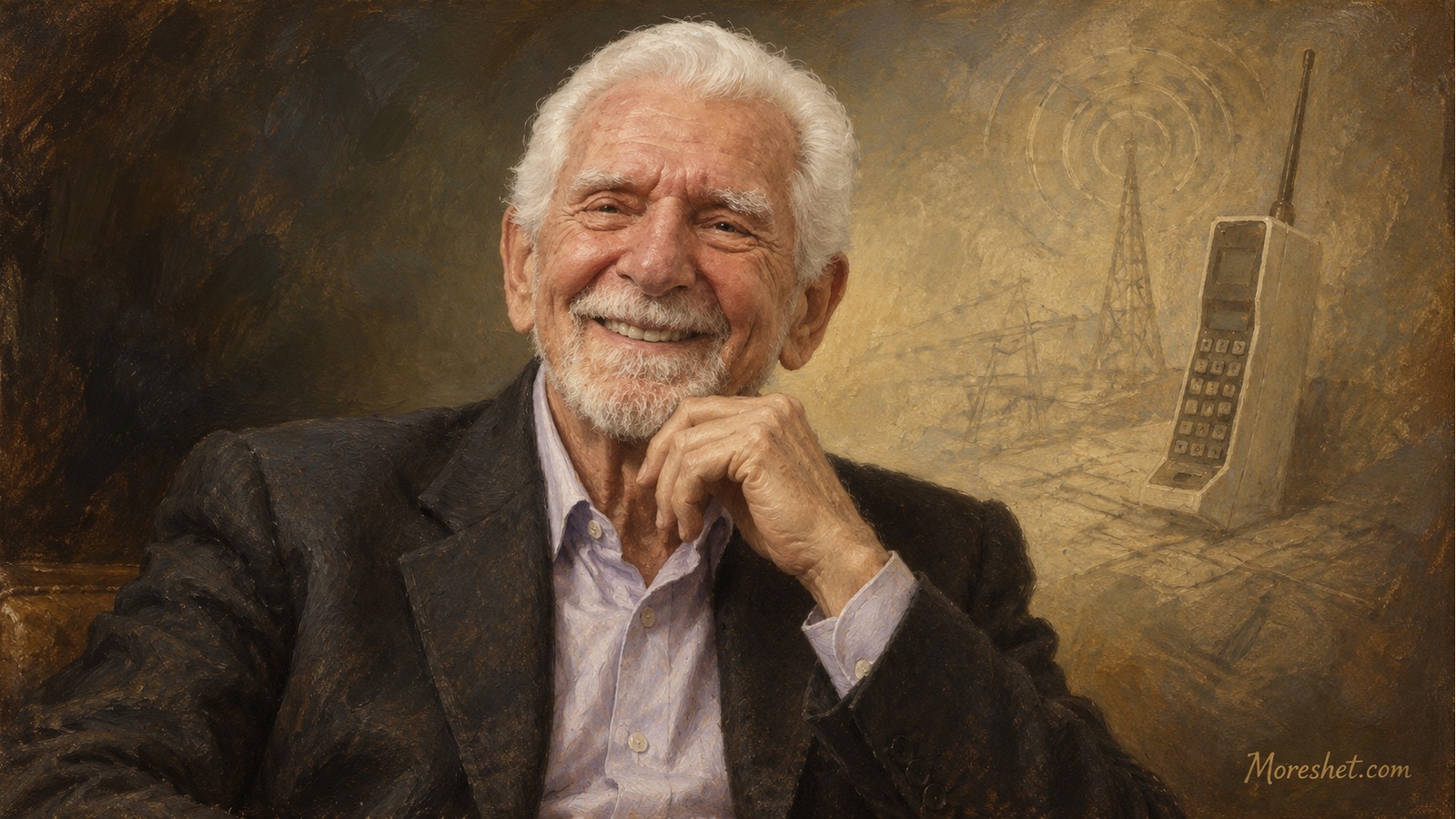
Martin Cooper — AI-generated artistic portrait · Moreshet.com
The Jewish American engineer who led the creation of the handheld cellular phone and helped transform the telephone from a fixed-place device into a personal companion
Martin Cooper is a Jewish American engineer, inventor, and entrepreneur whose work helped define the age of personal wireless communication. At Motorola, he conceived the handheld cellular telephone, assembled and led the team that built its first working prototype, and publicly demonstrated it on a New York City street on April 3, 1973. His achievement was larger than a single device: it helped shift the telephone from something connected to a home, office, or automobile into something associated with an individual.
The instrument Cooper carried through Manhattan that day was enormous by modern standards. Yet it embodied the principle behind the mobile world that followed. Today's smartphones, messaging platforms, applications, and wireless data networks are vastly removed from the 1973 prototype, but they all participate in the transition Cooper championed—communication with a person almost anywhere, rather than with a fixed location.
From Chicago to communications engineering
Cooper was born in Chicago on December 26, 1928, to a Jewish family that had immigrated from Ukraine. He earned a bachelor's degree in electrical engineering from the Illinois Institute of Technology in 1950 and served in the United States Navy during the Korean War era. He later returned to IIT, completing a master's degree in electrical engineering in 1957. The university awarded him an honorary doctorate in 2004, and he subsequently became a life trustee.
After working briefly for Teletype Corporation, Cooper joined Motorola in 1954 as a senior development engineer in its mobile equipment group. At a time when mobile telephones generally meant heavy systems installed in cars, he worked on smaller and more practical two-way radios. His projects included a portable radio system produced for the Chicago Police Department in 1967. Such work joined hands-on engineering to a consistent goal: allowing people to communicate while moving freely.
Making the cellular phone personal
A different vision for mobility
Cellular communication did not begin with Cooper. Bell Labs had introduced the cellular concept decades earlier and had conducted important research into network architecture. Early mobile systems, however, centered largely on car phones that required substantial equipment in the vehicle. Cooper argued for a different destination. A telephone number, in his view, should eventually identify a person—not a desk, house, or automobile.
By the early 1970s, Cooper was leading Motorola's communications systems division. With support from senior management, he assembled a team that produced a working handheld cellular prototype in less than three months. That rapid build rested on years of experience in portable radio, component design, antennas, batteries, and the infrastructure needed to connect a wireless handset to the established telephone network.
The call from a Manhattan sidewalk
On April 3, 1973, shortly before a press conference at the New York Hilton, Cooper stepped outside with Motorola's prototype. Standing on Sixth Avenue, he placed the first publicly demonstrated call from a handheld cellular telephone. He called Dr. Joel S. Engel of Bell Labs, a leading counterpart in the competition to develop cellular communications. The signal traveled through a Motorola base station installed on a nearby rooftop and then entered the AT&T landline network.
The sidewalk setting made the idea unmistakable. This was neither a car phone nor a laboratory installation, but a device that an individual could carry and use in public. Reporters and passersby watched the demonstration, and the prototype appeared on the July 1973 cover of Popular Science.
Motorola filed its application for the “radio telephone system” patent on October 17, 1973. Cooper was named as the lead inventor, together with John Francis Mitchell and other engineers who contributed to the project; it was later issued as U.S. Patent 3,906,166. This distinction matters to the history of the invention. Cooper supplied the vision and leadership most closely associated with the handheld cellular phone, while the functioning system was also a substantial team achievement.
From experimental handset to commercial product
The prototype from which the DynaTAC line emerged weighed about 2.5 pounds, or 1.1 kilograms, and measured roughly ten inches, or 25 centimeters, in length. It provided approximately 30 minutes of conversation before requiring a lengthy recharge. Those limitations reveal the scale of the engineering challenge in the early 1970s. The task was not merely to transmit a radio call, but to fit a battery, transmitter, receiver, controls, and dialing system into a handheld unit capable of operating as part of a cellular network.
The 1973 call was therefore a beginning rather than a finished consumer launch. Cooper led a long development process, while Motorola committed major resources to engineering and infrastructure before cellular service generated revenue. After several design generations, the DynaTAC 8000X received commercial approval and reached the market in 1983. It remained expensive and cumbersome, but it proved that a personal cellular telephone could become a product rather than remain a technical demonstration.
The consequences extended far beyond convenient conversation. Mobile communication eventually enabled people to summon help, conduct business away from an office, stay connected during travel, and obtain information without access to a fixed line. In Israel and Jewish communities throughout the world, cellular networks became part of the infrastructure linking families, communal institutions, medical services, emergency organizations, businesses, and public systems. Cooper did not single-handedly build the networks and services that followed, but his work marked a decisive step toward making them possible.
A broad career in innovation at Motorola
Cooper spent 29 years at Motorola and rose to become a vice president and corporate director of research and development. Beyond the cellular handset, he helped expand paging technology from systems confined to a single building into networks that operated across cities. His work and leadership also touched trunked mobile radio, quartz crystal oscillators, piezoelectric components, liquid-crystal displays, Motorola's AM stereo technology, and several lines of portable two-way radios.
A defining feature of his career was his ability to see both the component and the larger system. A useful wireless device required more than clever circuitry; it also depended on a network, antennas, available spectrum, regulatory approval, manufacturing, and a clear understanding of how people would use it. That systems perspective continued to shape his work after Motorola.
Building more accessible and efficient wireless services
In 1986, Cooper and his wife and business partner, Arlene Harris, established Dyna LLC as a base for developing and supporting new telecommunications ventures. Companies launched through this work included Subscriber Computing, Cellular Pay Phone, and SOS Wireless. These ventures reflected a move from creating a landmark device to developing services for particular groups of users.
Cooper co-founded Cellular Payphone, the parent enterprise from which GreatCall later developed. GreatCall became known for the Jitterbug phone and mobile services designed around simplicity, particularly for older adults. The work addressed a practical truth: wireless technology cannot help people if an unnecessarily complicated interface prevents them from using it. In this way, the idea of a personal telephone became connected to a wider question of accessibility.
In 1992, Cooper co-founded ArrayComm, a developer of software and technology for smart antennas. Instead of relying only on additional frequency allocations, smart antenna systems can direct signals and use existing spectrum more efficiently. ArrayComm accumulated hundreds of patents issued or pending around the world and addressed one of the central problems of the wireless age: serving rapidly increasing numbers of devices and users with finite spectrum resources.
Cooper's Law and the capacity of wireless networks
Cooper formulated an observation often called Cooper's Law, or the law of spectral efficiency. It proposes that the maximum number of simultaneous voice conversations or equivalent data transactions that can take place over useful radio spectrum in a given area doubles approximately every 30 months. The observation emphasizes that wireless capacity grows not only when more spectrum is assigned, but also through smaller cells, better antennas, improved signal processing, and more intelligent reuse of frequencies.
In articles and lectures, Cooper continued to address spectrum policy, research management, simplicity in product design, and the future of personal communication. He also served on advisory bodies concerned with technology and spectrum policy for the Federal Communications Commission and the United States Department of Commerce, bringing an inventor's and entrepreneur's experience to questions of public communications infrastructure.
Professional recognition
Leading scientific and engineering institutions have recognized Cooper's contributions. In 2010, he was elected to the U.S. National Academy of Engineering for his leadership in creating and deploying the portable handheld cellular telephone. In 2013, he received both the National Academy of Engineering's Charles Stark Draper Prize and the Marconi Prize, two major honors in engineering and communications. In 2015, the IEEE presented him with its Masaru Ibuka Consumer Electronics Award for his pioneering work on the portable cellular telephone.
His other distinctions include the IEEE Centennial Medal and election as an IEEE Fellow, the 1995 Wharton Infosys Business Transformation Award, the 2009 Prince of Asturias Award for Technical and Scientific Research, the 2012 Washington Award, and a Marconi Society Lifetime Achievement Award. Together, these honors recognize more than the famous 1973 call. They reflect decades of work on devices, networks, antennas, spectrum use, and the practical accessibility of personal communication.
The legacy of a powerful idea
Cooper's most enduring contribution is the movement from a telephone that served a place to one that served a person. The principle now seems self-evident, but pursuing it in the early 1970s demanded an unusually bold technical and business commitment. Motorola had to invest in a personal handset before there was a broad commercial network, a proven mass market, or components small enough to make the product truly convenient.
The mobile phone has since evolved into a platform for computing, navigation, photography, commerce, education, emergency response, and remote medicine. Those developments cannot all be credited to Cooper; they are the work of generations of engineers, researchers, companies, and public institutions. His distinctive place is at a critical turning point. He led the team that demonstrated, in working form, that cellular communication could leave the automobile and the laboratory and enter the hand of a person walking down the street.
Why this legacy belongs in Moreshet
Martin Cooper merits inclusion in Moreshet because his life connects the Jewish American experience of immigration and education with one of the most consequential technological advances of the twentieth century. The son of Jewish immigrants from Ukraine, he became an engineer, built and led industrial research teams, and turned a vision of personal freedom in communication into a working device and, ultimately, a commercial reality.
His importance to Moreshet.com does not depend on unverified claims of Jewish institutional philanthropy. It rests on a documented achievement by a Jewish inventor whose work changed Jewish and Israeli life as part of its worldwide impact. Cellular communication now supports family ties, community activity, education, medicine, business, and emergency assistance in Israel and across the Jewish diaspora. By preserving Cooper's story, Moreshet records how engineering knowledge, collaborative leadership, and sustained development can reshape the way billions of people remain connected.