Mark Elliot Zuckerberg
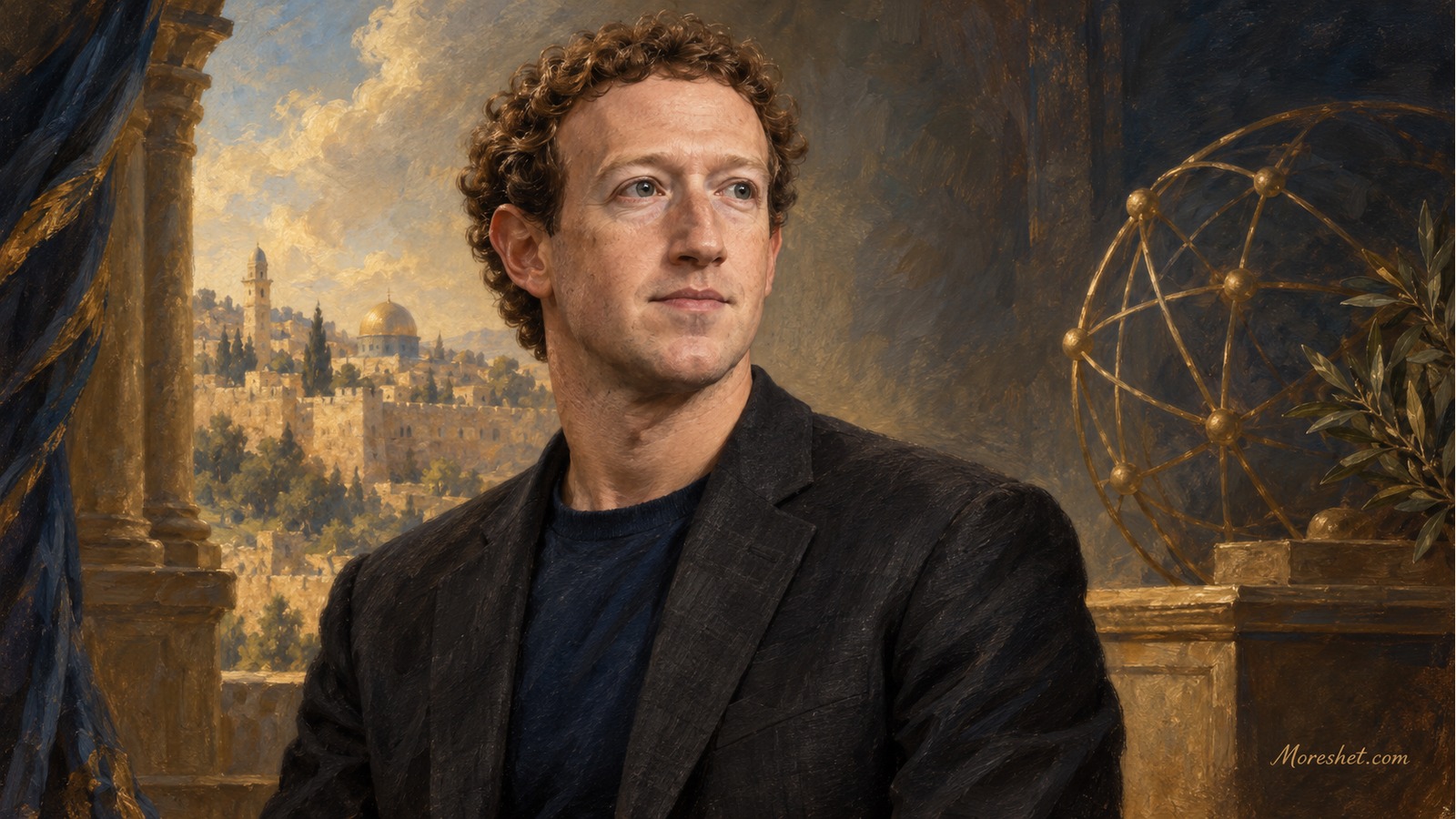
Mark Zuckerberg — AI-generated artistic portrait · Moreshet.com 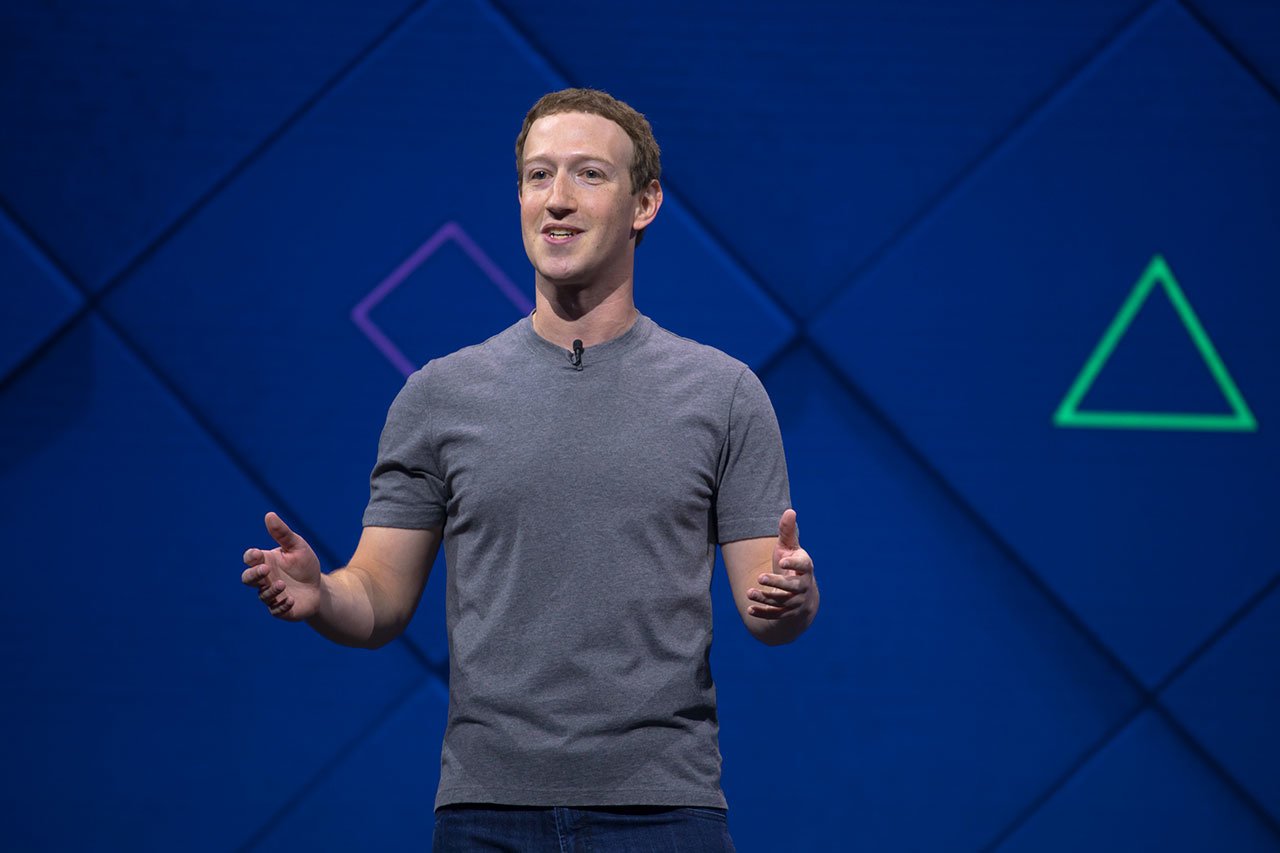
Mark Zuckerberg — image from the Moreshet archive
Jewish-American technology entrepreneur, Facebook co-founder, Meta chairman and CEO, philanthropist and central architect of the social-network, digital-community and AI era
Mark Elliot Zuckerberg is a Jewish-American technology entrepreneur, programmer, co-founder of Facebook, and chairman and chief executive officer of Meta Platforms. He is one of the people who most profoundly shaped how human beings communicate, share information, build communities, consume news and present identity in the digital age. The company he launched from a Harvard dorm room in 2004 became one of the world’s largest technology groups, including Facebook, Instagram, WhatsApp, Messenger, Threads, virtual and augmented reality products, and artificial-intelligence infrastructure.
Zuckerberg’s importance is not limited to the founding of a successful social network. Facebook and Meta changed the structure of global communication: friendship and family contact, community activity, advertising, small businesses, politics, social organizations, journalism, personal memory, marketing, popular culture and public discourse. For Jews and Israelis, these platforms also became tools of community, advocacy, fundraising, diaspora connection, the fight against antisemitism, memorialization, learning and the preservation of family ties across continents.
Jewish childhood in New York and early technological curiosity
Zuckerberg was born on May 14, 1984, in White Plains, New York, to a Reform Jewish family. His father, Edward Zuckerberg, is a dentist, and his mother, Karen Kempner, is a psychiatrist. He grew up in Dobbs Ferry, Westchester County, with his three sisters, Randi, Donna and Arielle. The family combined education, professional discipline, Jewish identity and openness to the new technological world developing in the 1990s.
From childhood Zuckerberg learned to program. At a young age he created ZuckNet, a system that allowed computers in the family home and his father’s dental office to communicate with each other. This was an early sign of the direction that would follow him throughout life: not only writing code, but building systems that connect people and information. During high school, he also developed Synapse Media Player, a music player that tried to learn a user’s listening preferences through machine-learning techniques.
Zuckerberg first attended Ardsley High School and later transferred to Phillips Exeter Academy, where he stood out academically and in fencing. Alongside technological ability, he showed interest in classical languages, psychology and the way human beings organize socially. This combination of programming, human behavior, language and social identity helps explain why Facebook became more than a technical product: it was an attempt to build a social map of the world.
Harvard and the birth of Facebook
In 2002 Zuckerberg began studying at Harvard University, where he studied psychology and computer science and joined the Jewish fraternity Alpha Epsilon Pi. Before Facebook, he created internal projects including CourseMatch, which allowed students to see which courses their friends had selected, and Facemash, a short-lived site that displayed student photos for comparison. Facemash was quickly shut down after complaints that student images had been used without permission, and the episode already revealed a tension that would follow his career: innovation, privacy, community and institutional rules.
On February 4, 2004, Zuckerberg launched Thefacebook, together with partners including Eduardo Saverin, Dustin Moskovitz, Chris Hughes and Andrew McCollum. It was initially a network for Harvard students, but quickly spread to other Ivy League universities, Stanford, Columbia, New York University and additional institutions. The idea was simple but powerful: real identity, social ties, photographs, personal profile, institutional community and the ability to see who was connected to whom.
Already in Facebook’s earliest days, legal disputes arose around claims by other Harvard students, including Cameron and Tyler Winklevoss and Divya Narendra, that Zuckerberg had used ideas connected to their own project. The lawsuits ended in settlement. Without reducing the entire story to litigation, it is clear that Facebook emerged at a moment when the idea of the social network was in the air, but Zuckerberg and his team were the ones who turned it into a fast-growing, simple, addictive and global product.
From Palo Alto to a network of billions
In 2004 Zuckerberg moved with part of the team to Palo Alto, California, and left Harvard to focus on the company. The decision to remain in Silicon Valley rather than return to school became a defining moment. He met Peter Thiel, who had the opportunity to invest in the young company, and Facebook later built a technical and business team that favored rapid growth, continuous experimentation and an engineering culture of fast building.
At first Facebook was a university network, but it later opened to a wider public and became a global social system. In 2010 the company announced that it had passed the mark of half a billion users. In 2012 Facebook went public in one of the most discussed technology IPOs in history. Zuckerberg, still very young, became founder-CEO of a public company with worldwide influence.
Facebook’s growth changed the internet. Instead of disconnected websites and separate forums, it offered a social layer linking people, groups, businesses, politicians, nonprofits, media outlets, creators and advertisers. The like button, the feed, photo sharing, groups, events and brand pages became part of the everyday language of the digital world.
Communication, communities and memory in the social-network era
Zuckerberg’s contribution to communication is double. On one hand, Facebook and Meta applications made personal communication and relationship management more accessible than ever. Families living on different continents, immigrant communities, interest groups, religious communities, social activists, small businesses and educational institutions received simple tools for distribution, conversation, organization and memory.
On the other hand, these platforms also changed the power structure of communication. They affected journalism, advertising, elections, marketing, protest movements, public campaigns and information distribution. Everyone could publish, but every community also had to confront questions of reliability, algorithms, privacy, radicalization, abusive speech and the difference between social connection and manipulation.
From a Jewish and Israeli perspective, this influence is especially tangible. Facebook, Instagram and WhatsApp are used by Jewish and Israeli communities to share information in emergencies, maintain family contact, memorialize the dead, organize events, support soldiers, teach Torah, run community activity, advocate for Israel, raise funds and fight antisemitism. This is not a Jewish contribution in a traditional institutional sense, but it is an everyday infrastructure of modern Jewish life.
Strategic acquisitions: Instagram and WhatsApp
One of Zuckerberg’s most important moves was the 2012 acquisition of Instagram. At the time Instagram was a young photo-sharing application, but under Meta it became one of the central platforms of visual culture, influencers, brands, small businesses, artists, content creators and personal communication. It changed how people tell the story of their lives through photos, short videos, stories and reels.
In 2014 Facebook acquired WhatsApp, which became one of the most important messaging applications in the world. In Israel, Europe, Latin America, India and many other places, WhatsApp became a basic communication tool for families, schools, businesses, neighborhood groups, religious communities, doctors, organizations and friends. For Israelis and Jews in the diaspora, it often functions as an immediate line of contact in emergency, celebration, mourning and communal action.
These acquisitions turned Zuckerberg from the founder of one social network into the leader of a broad communication system. Meta is not only Facebook; it is a set of platforms where people talk, watch, sell, learn, argue, present identity and build communities. This is one of the sources of his great influence, and also one of the sources of the heavy public responsibility carried by the company.
Meta, the metaverse and virtual reality
In 2021 Facebook Inc. changed its name to Meta Platforms. The name change expressed Zuckerberg’s ambition to lead the company beyond traditional social networks toward virtual reality, augmented reality and three-dimensional digital spaces. Through Reality Labs, Quest products and other developments, Meta invested large sums in building a new generation of human-computer interfaces.
The metaverse vision generated both interest and skepticism. On one hand, it proposed a future in which work, play, education, medicine, social meetings and creativity could take place in richer digital spaces. On the other hand, the market adopted the vision more slowly than some investors expected, and the heavy investments raised questions about priorities.
Even if the final form of the metaverse remains unclear, the move is important to understanding Zuckerberg. He does not see Meta only as a company of existing apps, but as a company seeking to influence the next generation of interfaces between people and computers. From the social feed to the virtual-reality headset, he repeatedly focuses on how people experience presence, connection and identity inside a digital system.
Artificial intelligence, Llama and future infrastructure
In recent years artificial intelligence has become central to Meta’s strategy. The company has developed AI models, tools and infrastructure, including the Llama model family, recommendation systems, creative tools, AI assistants and integrations across Facebook, Instagram, WhatsApp and hardware products. Zuckerberg has presented AI not only as a separate product, but as a new layer that will be integrated into all of the company’s services.
One of Meta’s important strategic choices has been the relatively broad release of Llama models through open or partly open models compared with the more closed approach of some competitors. This made Meta an important player for developers, researchers, companies and organizations that want to build applications on advanced models without depending entirely on a single closed service.
In 2026 Zuckerberg was appointed to the U.S. President’s Council of Advisors on Science and Technology, PCAST. The appointment reflects his status as one of the most influential technology leaders in the United States, especially in AI, technological competition, innovation, public policy and digital infrastructure. In that sense he moved from being only the founder of a social platform into a wider circle of national technology policy.
Privacy, public responsibility and controversy
It is impossible to understand Zuckerberg’s legacy without recognizing the scale of responsibility that accompanied Meta’s success. Over the years the company has stood at the center of debates and lawsuits over privacy, competition, data use, effects on children and teenagers, misinformation, hate speech, algorithmic transparency and the power of private platforms over a global public sphere.
In 2018 Zuckerberg testified before the United States Congress after the Cambridge Analytica affair, in which political use of user data was exposed. He later appeared in additional hearings on Section 230, platform responsibility, misinformation, children and online safety. In a 2024 Senate hearing, he apologized to families harmed by online abuse and platform-related harms, a moment that illustrated the gap between the connective vision of social networks and the risks they created.
The criticism does not erase his achievements, but it is inseparable from his historical importance. Zuckerberg helped build an infrastructure affecting billions of people, and therefore his actions, decisions and failures are judged at a near-institutional scale. He is a central example of a 21st-century question: how does one govern a private platform that has become part of the public life of humanity?
Jewish identity, religion and standing with communities
Zuckerberg grew up in a Reform Jewish household, and as a young man went through a period in which he identified as an atheist. He later said that religion is important, and in his 2017 Harvard commencement speech he mentioned the Jewish prayer Mi Shebeirach, which he said he says when facing challenges. The choice to mention a Jewish prayer before a broad Harvard audience became a symbolic moment connecting personal identity, tradition and meaning.
In 2015, after terrorist attacks and public hostility directed at Muslims, Zuckerberg wrote that as a Jew his parents had taught him to stand against attacks on all communities. That statement matters because it presents his Judaism not only as family identity, but as a source of civic ethics: responsibility toward minorities, defense of a targeted community and a historical understanding of collective vulnerability.
Zuckerberg’s Jewish connection is not mainly expressed through leadership of Jewish institutions, but through being a globally influential Jew whose systems are also used by Jewish and Israeli communities. In this sense, his legacy reflects Jewishness in the digital era: identity, prayer, family, community, memory, the fight against antisemitism and technological tools that change how Jews across the world remain connected.
Philanthropy and the Chan Zuckerberg Initiative
In 2012 Zuckerberg married Priscilla Chan, a pediatrician he met at Harvard. The couple has three daughters. In 2015, after the birth of their first daughter, Zuckerberg and Chan announced that they intended during their lifetimes to devote most of their wealth to social purposes. That year they founded the Chan Zuckerberg Initiative, a philanthropic and technology organization focused on science, education, community and technological tools for solving large problems.
Even before CZI, Zuckerberg donated 100 million dollars to the Newark public school system in New Jersey. The initiative drew both praise and criticism for how it was carried out, but it marked his desire to act at systemic scale. The couple later gave to Ebola response, the public hospital in San Francisco and science and medical initiatives.
One of CZI’s central projects is Biohub, intended to bring together researchers, engineers, physicians and technologists around large scientific goals, including understanding, preventing and treating disease. In recent years CZI has emphasized the use of artificial intelligence and computational tools to advance life science. In this way Zuckerberg’s influence extends beyond Meta: an attempt to use technological infrastructure, data and private capital to accelerate medical and educational research.
Personal life, family and public image
Zuckerberg and Priscilla Chan have been married since 2012 and have three daughters. Over the years Zuckerberg has shared parts of family life, hobbies, sports training, language learning and personal projects. He has studied Cantonese and Mandarin, trained in Brazilian jiu-jitsu and mixed martial arts, and at times presented a public figure different from the young founder in a gray T-shirt who was associated with his early years.
His public image has changed over time. At first he was seen as a brilliant young programmer who created a huge social network. Later he became a symbol of platform power, algorithmic responsibility, extreme wealth, innovation, privacy problems, regulation, philanthropy and the ambition to shape the next generation of computing. This shift reflects the change in the internet itself: from a place of open excitement into a central space of public, political and economic life.
Editorial note on inclusion
Mark Zuckerberg is included on the site even though this person and their public record are controversial among broad sections of the public. Inclusion does not determine whether the influence is positive or negative; it reflects the significant place this figure holds in shaping the lived experience, culture and way of life of the public. Naturally, some regard this activity as positive and even heroic, while others see it as contrary to their worldview. The very existence of opposing assessments is part of the historical record that justifies including this significant and influential figure in the heritage of the Jewish people.
Why this legacy belongs in Moreshet
Mark Elliot Zuckerberg merits inclusion in Moreshet because he is one of the Jewish entrepreneurs who most deeply influenced the everyday life of humanity in the digital age. His path connects a Jewish childhood in New York, early programming, Harvard, Facebook, Meta, social networks, instant messaging, virtual reality, artificial intelligence and scientific and educational philanthropy.
Moreshet.com documents Zuckerberg because Jewish and Israeli heritage also includes Jewish figures who acted on the world stage and changed the tools through which people connect, build community, manage memory, raise support, spread information and shape identity. Zuckerberg’s place in Moreshet rests on the enormous influence of the platforms he built on Jewish and Israeli communities, the global public sphere and the question of how private technology becomes social infrastructure for billions. This is a story of innovation, responsibility, power, community and Jewish identity inside the digital world of the 21st century.