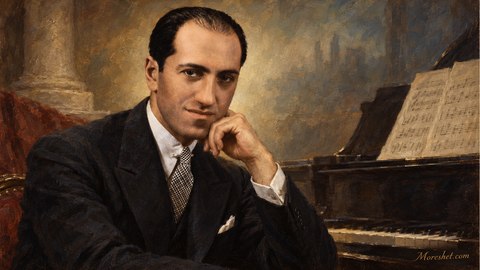
Leonard Bernstein
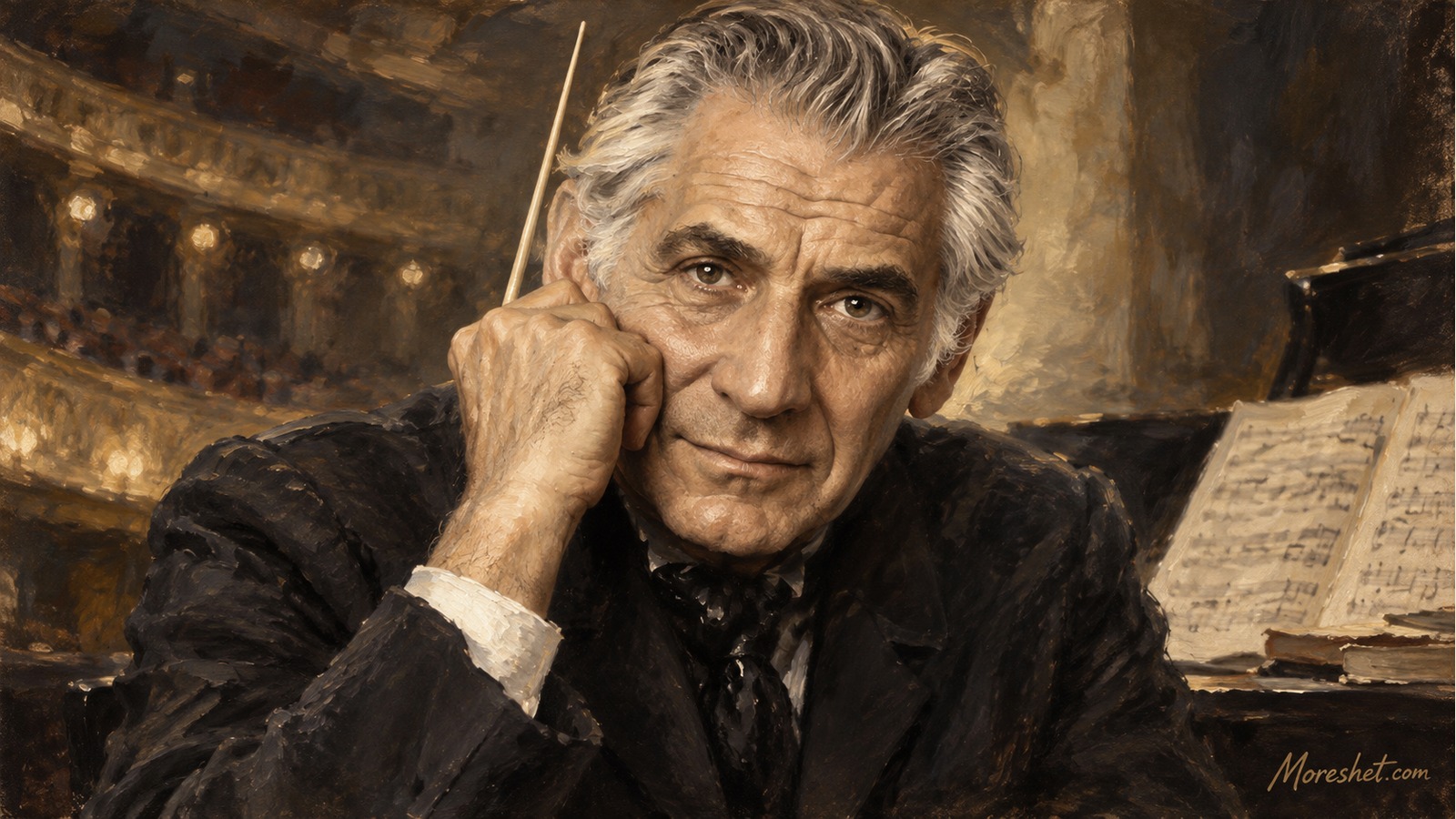
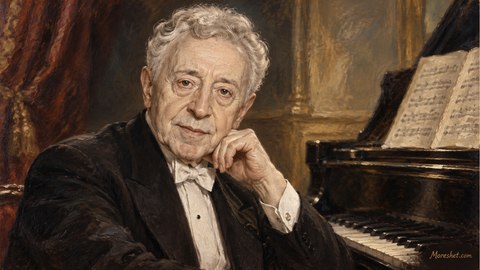
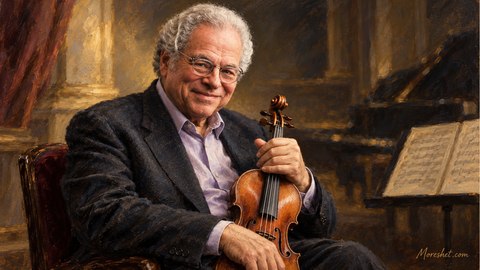
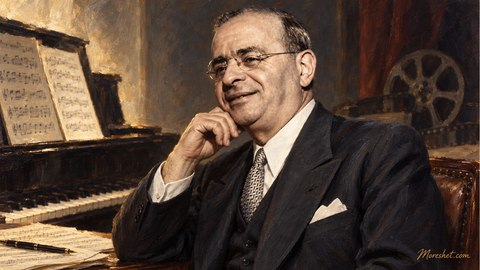
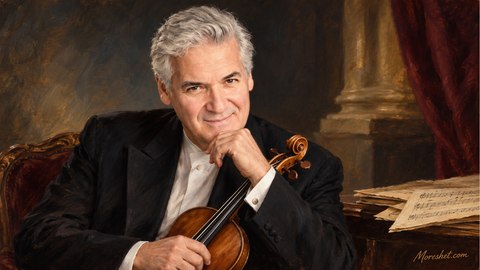
Leonard Bernstein — AI-generated artistic portrait · Moreshet.com
The Jewish-American composer, conductor and educator who connected the concert hall, Broadway, Israel and the wider public
Leonard Bernstein (August 25, 1918–October 14, 1990) was a Jewish-American composer, conductor, pianist and educator whose work helped define twentieth-century music. He moved fluently among the symphony hall, Broadway, opera, film and television, widening the audience for each. His music joined classical form with jazz, Latin rhythms, Jewish sources, popular song and theatrical drama. As a conductor and teacher, he made complex music vivid and accessible to millions.
From a Jewish childhood to a musical vocation
Bernstein was born in Lawrence, Massachusetts, to a Jewish family whose roots lay in Rovensky in present-day Ukraine. His birth name was Louis, but his parents called him Leonard, and he legally adopted that name at sixteen. His early musical world included Friday-night services at Congregation Mishkan Tefila, the voice of cantor Izso Glickstein, and orchestral concerts attended with his father. When his aunt Clara brought an upright piano into the family home, ten-year-old Leonard immediately asked for lessons. His father initially doubted that music could provide a stable profession, so Bernstein taught neighborhood children and played at weddings to pay for his training.
At Harvard, Bernstein studied with composer Walter Piston and wrote a senior thesis on the absorption of different racial elements into American music. At Philadelphia's Curtis Institute of Music, he studied conducting with Fritz Reiner, piano with Isabelle Vengerova, and orchestration and related disciplines with distinguished teachers. Two encounters were especially formative: meeting conductor Dimitri Mitropoulos, whose example helped turn conducting into Bernstein's vocation, and meeting Aaron Copland, who became his most important informal adviser in composition. At Tanglewood, Serge Koussevitzky became another decisive mentor and a lifelong influence.
The breakthrough conductor
On November 14, 1943, Bernstein was called upon at short notice to replace the ill Bruno Walter in a New York Philharmonic concert at Carnegie Hall. He conducted a demanding program without a rehearsal, and the performance was broadcast nationally. Its success made him famous almost overnight and launched an international career. In 1945 he became music director of the New York City Symphony, leading an orchestra known for modern programs and affordable tickets.
In 1958, Bernstein became the first American-born music director of the New York Philharmonic. He held the post until 1969 and continued to conduct and record with the orchestra afterward. He expanded its repertoire, supported American and contemporary composers, presented new works, and led international tours. He championed composers including Aaron Copland, Charles Ives, Dmitri Shostakovich, Jean Sibelius and Gustav Mahler, while also bringing jazz, musical theater and Latin American works into the concert environment. In 1965 he helped establish the orchestra's Concerts in the Parks, making symphonic music available to New Yorkers beyond the traditional concert audience.
Bernstein played a major role in the modern revival of Mahler. Through performances, recordings and broadcasts, he persuaded a broad American public to hear Mahler's symphonies as urgent, personal works rather than as a neglected nineteenth-century repertory. His conducting was physically expressive but never merely theatrical: gestures, facial expressions and movement served as precise forms of communication with the musicians.
A composer between Jewish identity and American culture
Bernstein wrote three symphonies, operas, ballets, orchestral and choral works, film scores and theater music. His best-known creation, West Side Story, brought together Bernstein, choreographer Jerome Robbins, librettist Arthur Laurents and lyricist Stephen Sondheim. Set amid racial tension and youth gangs in New York, the musical joined symphonic writing, jazz, Latin-American rhythms and popular song. Its 1957 Broadway production changed the possibilities of American musical theater, and its film adaptations carried the work to successive generations.
Other major works include On the Town, Wonderful Town, Candide, Fancy Free, Mass, the opera A Quiet Place, the ballet Dybbuk and the film score for On the Waterfront. Bernstein rejected a rigid division between “serious” and “popular” music. He believed that demanding ideas could reach a wide audience without being simplified.
Jewish identity was central to his musical imagination. His First Symphony, Jeremiah, incorporates the lament of the Book of Lamentations. His Third Symphony, Kaddish, uses a spoken text that stages a turbulent dialogue between human beings and God. Chichester Psalms sets Hebrew verses from the Book of Psalms, while works including Ḥalil, Four Sabras and Dybbuk engage Jewish memory, prayer, war and spiritual searching. His Jewish music is not a single, simplified statement of belief; it is questioning, dramatic and alive.
A lifelong relationship with Israel
In 1947, Bernstein conducted in Tel Aviv for the first time, beginning a relationship with the Israel Philharmonic Orchestra that lasted for the rest of his life. In 1948 he conducted an open-air concert for Israeli troops near Beersheba during the War of Independence. In 1957 he conducted the opening concert of Tel Aviv's Mann Auditorium and subsequently made many recordings with the Israel Philharmonic, becoming one of its most closely identified guest conductors.
On December 10, 1963, Israel hosted the world premiere of Kaddish, with Bernstein conducting the Israel Philharmonic, Hanna Rovina as narrator, Jennie Tourel as soloist and Israeli choirs. Dedicated to the memory of President John F. Kennedy, the work became one of Bernstein's most powerful statements about faith, grief and human responsibility. After the Six-Day War he conducted a concert on Mount Scopus. In 1981 he wrote Ḥalil in memory of Yadin Tannenbaum, a nineteen-year-old flutist killed in the Yom Kippur War. Tel Aviv later named Orchestra Plaza after him, and Beersheba also has a street bearing his name.
The educator who brought music into people's homes
Bernstein considered education inseparable from artistic leadership. In the television series Young People's Concerts, presented with the New York Philharmonic from 1958 to 1972, he explained composers, musical structures and individual works with clarity, humor and infectious excitement. Millions of children and adults encountered symphonic music through the programs. Several young performers featured on them later became leading musicians.
His Harvard Norton Lectures, published as The Unanswered Question, demonstrated the same gift for connecting music with language, philosophy and culture. Bernstein taught at Brandeis University, Tanglewood and other institutions, and helped found the Los Angeles Philharmonic Institute, the Schleswig-Holstein Music Festival Orchestra Academy and the Pacific Music Festival in Sapporo. These institutions extended his educational model: young musicians were trained not only in technique, but in listening, collaboration and artistic responsibility.
Music as a human responsibility
Bernstein used his public position to support civil rights, peace, nuclear disarmament and AIDS research and care. He participated in events supporting voting rights for African Americans, opposed the Vietnam War and assisted human-rights initiatives. On Christmas Day 1989, he conducted Beethoven's Ninth Symphony in East Berlin as part of the celebrations surrounding the fall of the Berlin Wall. For that occasion he substituted Freiheit, “freedom,” for Schiller's Freude, “joy,” in the famous text. The performance was broadcast in more than twenty countries and reached an estimated audience of one hundred million people.
He helped raise funds for AIDS research and patient care, and in 1990 used the prize money from Japan's Praemium Imperiale to establish an arts-based education initiative. Bernstein understood music not as an ornament to public life but as a means of connecting people and defending human dignity.
Final years and continuing influence
Bernstein continued to conduct, teach and compose until the end of his life. His final concert took place at Tanglewood on August 19, 1990. He died in New York on October 14, five days after announcing his retirement from conducting, and was buried at Green-Wood Cemetery in Brooklyn beside his wife, Felicia Montealegre. A copy of Mahler's Fifth Symphony was placed over his heart.
His recordings remain in circulation, his compositions are performed worldwide, and his books and broadcasts continue to shape music education. His Emmy, Grammy and Tony Awards recognize only part of his achievement. His deeper legacy lies in the continuing work of orchestras, teachers, performers and listeners who use his music and his example to discover how sound can carry memory, identity and ethical meaning.
Why this legacy belongs in Moreshet
Leonard Bernstein merits a central place in Moreshet because his influence crossed boundaries of style, country and audience. He brought Jewish themes and questions into the international symphonic repertory, strengthened the cultural relationship between Israel and the wider musical world, and made musical education a public experience. Kaddish, Jeremiah and Chichester Psalms continue to open conversations about faith, memory and Jewish identity. West Side Story continues to shape theater and cinema, while his recordings remain influential interpretations of Mahler and the symphonic canon.
At Moreshet and Moreshet.com, Bernstein is remembered not only as a musical genius but as a builder of bridges: between Jewish experience and universal culture, artistic excellence and public education, Israel and the world, and creative work and human responsibility. His legacy combines lasting artistic achievement with a demonstrable effect on musicians, students, audiences and Jewish communities in Israel and throughout the world.