Larry Page and Sergey Brin
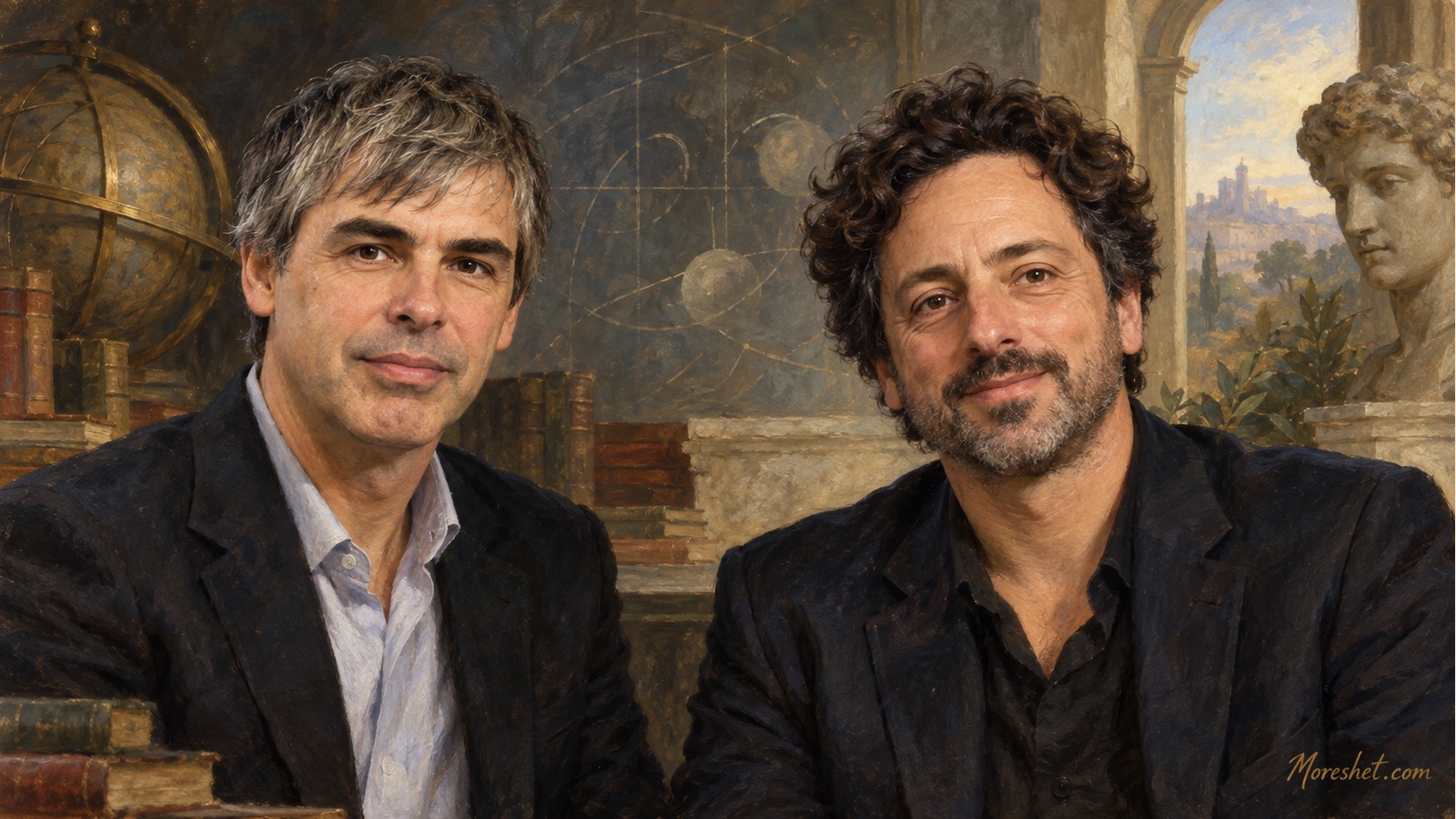
Larry Page and Sergey Brin — AI-generated artistic portrait · Moreshet.com
Jewish-American computer scientists and entrepreneurs, co-founders of Google, developers of PageRank, and architects of the search, information and internet revolution that changed how humanity finds and uses knowledge
Larry Page and Sergey Brin are computer scientists, entrepreneurs and the co-founders of Google, among the central figures of the internet revolution at the end of the 20th century and the beginning of the 21st. They met at Stanford University in the mid-1990s, developed the PageRank algorithm and the BackRub search system, and in 1998 founded Google Inc. around a simple but transformative idea: to organize the immense information of the web so that users could find answers that were relevant, fast and useful.
Their influence extends far beyond the creation of a successful company. Google changed the daily behavior of billions of people: search, learning, navigation, advertising, email, video, mobile operating systems, translation, maps, cloud services, research, artificial intelligence and the internet economy. From the perspective of Jewish and Israeli heritage, their story matters because it represents a generation of Jewish entrepreneurs and scientists who turned knowledge, mathematics, immigration, academic curiosity and systems thinking into global power. In Brin’s case, the journey from a Jewish family in the Soviet Union to the center of American innovation is also a modern Jewish story of freedom, science and opportunity.
Family background and education: two paths to Stanford
Lawrence Edward Page, known as Larry Page, was born on March 26, 1973, in Michigan. He grew up in a home where computers, teaching and research were part of everyday life. His father, Carl Victor Page, was a professor of computer science and artificial intelligence at the University of Michigan, and his mother, Gloria Page, taught computer programming. Through his mother, Page is connected to a Jewish family background, and his maternal grandfather immigrated to Israel. This childhood environment gave him a rare combination of engineering thinking, early exposure to computers and a belief that technological systems could change the world.
Page attended East Lansing High School and then graduated with honors from the University of Michigan with a bachelor’s degree in computer engineering. Already as a student he showed an interest in large systems, mechanical design, software and the way an engineering idea can become a product. He later moved to Stanford University for graduate work in computer science, where he met the person who would become his historic partner.
Sergey Mikhailovich Brin was born on August 21, 1973, in Moscow, then the capital of the Soviet Union, into an educated Russian-Jewish family. His father, Michael Brin, was a mathematician, and his mother, Eugenia Brin, worked in scientific research. The family emigrated to the United States in 1979, when Sergey was six. Their emigration was shaped partly by the restrictions and antisemitism Jews encountered in the Soviet system, especially in scientific study and employment. In the United States, Brin grew up in Maryland in a home that placed enormous value on mathematics, education and academic freedom.
Brin earned a bachelor’s degree with honors in mathematics and computer science from the University of Maryland, and then moved to Stanford for graduate study in computer science. At Stanford he found an environment suited to his character: intellectual freedom, advanced research, a link between theory and implementation, and proximity to Silicon Valley. There he met Page, not necessarily through immediate agreement; the two were known for arguing vigorously. The argument, curiosity and ability to challenge one another became the basis of an extraordinary partnership.
The Stanford meeting and the birth of BackRub
Brin and Page met in 1995 during an orientation event for prospective doctoral students at Stanford. According to the well-known story, Page was one of the students showing the campus to prospective students, and Brin was among the visitors. Their relationship was not built on identical personalities, but on shared intellectual force: both loved big questions, data, algorithms and ideas that challenged existing systems.
At the time, the World Wide Web was growing quickly, but existing search engines struggled to provide accurate and relevant results. Page began thinking about another way to understand the internet: not only by reading page content, but by analyzing the structure of links among pages. If many pages linked to a particular page, and especially if important pages linked to it, that page might itself be important. Brin, interested in data mining and large information collections, joined the project.
The project was first called BackRub because it analyzed backlinks among web pages. They ran it on Stanford servers, using inexpensive computers and improvised hardware, and began building an index of the web. What started as a research project quickly became useful to students and researchers because its results were better, more precise and less dependent on superficial keyword manipulation.
PageRank: a mathematical idea that changed the internet
The central technological contribution of Page and Brin was PageRank, an algorithm that estimated the importance of web pages according to the link structure of the internet. The idea was partly inspired by the way academic research uses citations: a paper cited by many important papers receives special weight. Page and Brin translated a similar principle into the world of web pages, but at a vast and dynamic scale.
PageRank was not merely a technical tool. It changed the understanding of the web as a living graph of relationships, trust, reference and authority. Instead of treating each page as an isolated unit, the algorithm saw the internet as a system of connections. It turned search from a mechanical sorting of keywords into an analysis of the structure of knowledge. This breakthrough allowed Google to deliver results that users found more relevant than those of competitors.
The historical importance of PageRank lies in the problem it solved, a problem that grew more severe as the web expanded: how to find meaning inside information overload. In an age when the number of pages was growing at extraordinary speed, a good algorithm for organizing information became not only a convenience, but a cultural and economic infrastructure. Google was built on that understanding.
Founding Google: from laboratory to global company
In 1998 Page and Brin founded Google Inc. The name emerged from a play on the mathematical word googol, an enormous number, expressing the ambition to organize an almost unimaginable quantity of information. At first the company operated modestly, between Stanford servers, a rented garage and the support of early investors. One famous moment in the founding story was the $100,000 check from Andy Bechtolsheim, co-founder of Sun Microsystems, before the company had even been formally incorporated.
Google grew quickly because it offered users a clean, fast and focused experience. At a time when many portals tried to fill home pages with services, advertising and content, Google presented an almost empty search box. That simplicity carried a deep idea: the user did not come to remain on Google’s homepage, but to reach the information he or she needed. In that sense, the design served an entire institutional concept about access to knowledge.
Page and Brin initially ran the company as co-presidents, and then recruited Eric Schmidt as CEO in 2001. For years, Google operated under a three-part leadership structure of Page, Brin and Schmidt. This model allowed the two founders to preserve technological and cultural vision while adding experienced business management. In 2004 Google went public and became one of the most influential and valuable technology companies in the world.
From Google Search to an information empire
Google’s initial success in search was only the beginning. The company expanded into online advertising, email, maps, browsers, mobile operating systems, video, cloud computing, documents, translation, digital books, hardware, artificial intelligence research and more. The acquisition of YouTube, the development of Android, the launch of Gmail, Google Maps, Chrome and many other services turned Google from a search box into part of the daily infrastructure of digital life.
Google’s advertising model changed the economics of the internet. Instead of broad, general advertising, the company developed a system based on user intent, search, keywords and performance measurement. This created a new industry of digital marketing, allowed small businesses to reach customers, and at the same time made data collection, user privacy and platform power central public issues.
Page and Brin did not manage only a single product but a culture of experimentation, scale and large ambition. The term moonshots became associated with part of that spirit: attempts to address large problems through technology, even when the path was uncertain. Over time, projects within and around Google emerged in autonomous vehicles, health, artificial intelligence, internet infrastructure, translation and cloud services.
Alphabet and the transition away from daily management
In 2015 Page and Brin created Alphabet as a holding company above Google and other projects. Page served as Alphabet’s CEO and Brin as its president. The new structure was intended to separate Google’s core businesses from more experimental and long-term ventures, and to allow clearer management of different activities.
In December 2019 Page and Brin announced that they were leaving the CEO and president roles at Alphabet, and Sundar Pichai, already the CEO of Google, became CEO of Alphabet as well. The move marked a transition from the founder generation to more professionalized management, but it did not detach Page and Brin from the company. They remained founders, significant shareholders and influential board members.
As of 2026, according to Alphabet’s public filings, Page and Brin still serve as directors of the company. Page is listed as co-founder and director since 1998 and chair of the Executive Committee, while Brin is listed as co-founder and director since 1998 and a member of the Executive Committee. In recent years, Brin has also been reported as more involved again in Google’s artificial-intelligence efforts, especially amid global AI competition, though without returning to a formal CEO role.
Innovation, artificial intelligence and influence on computer science
Google was born from academic research and continued to influence computer science far beyond search. The culture Page and Brin created encouraged work at enormous scale: distributed systems, data centers, language processing, machine learning, computer vision, advertising systems, translation, browsers, operating systems and cloud technologies. Many of the problems Google had to solve became foundational problems for the software industry as a whole.
Their influence is also visible in the way Google became a training ground for researchers, engineers and entrepreneurs who went on to shape the technology world. The company published important research, developed open infrastructure and influenced how organizations think about data, scale, search, software and AI. Even when particular technologies were created by large teams, the ambition and organizational culture were shaped by the founders’ vision.
In the age of artificial intelligence, their legacy takes on new meaning. The original vision of organizing the world’s information now meets systems able to generate, summarize, translate and infer information. This underlines both the scale of their contribution and the responsibility attached to it: whoever organizes knowledge at global scale also influences trust, language, education, economics and democracy.
Jewish identity, migration and the Israeli connection
The Jewish connection of Page and Brin differs in character. Page grew up in an American scientific home, with Jewish background through his mother and a family story that includes his maternal grandfather’s immigration to Israel. Brin, by contrast, was born into a Jewish family in Moscow and emigrated as a child to the United States against the background of Soviet restrictions and antisemitism that limited Jews in study and employment. Brin’s story is a striking example of how freedom, education and migration can release extraordinary human ability.
Brin has spoken over the years about the meaning of immigration and his Soviet-Jewish background. For his family, America was not merely a new country, but a space in which a talented Jew could study, research, compete and build. In Jewish historical terms, that movement — from limitation to possibility, from fear to academic freedom — is an important part of why his life belongs to a broader Jewish legacy.
Google itself has also been a significant tool for Israelis and Jews around the world. It changed access to Jewish sources, Hebrew learning, genealogical research, communication among communities, Israeli entrepreneurship and the connection between Israel’s technology sector and the wider world. Although Page and Brin are not Israeli public-political figures, the effect of their work on Jewish and Israeli life is daily, deep and continuing.
Philanthropy, health and social initiatives
The wealth created by Google’s success enabled Page and Brin to act in philanthropy and research as well. Over the years, their names have been connected with family foundations, medical research, health efforts, energy, the environment and future-oriented technologies. Brin has given particular support to research connected with Parkinson’s disease, a subject with personal meaning because of family genetic background.
Google itself created philanthropic and social arms, especially Google.org, working in education, crisis response, technology for society, climate and accessibility. It is important to distinguish between the company’s actions and the personal actions of the founders, but Google’s early culture included the idea that technology could also be used to address broad public problems.
Like every platform of immense power, Google has also raised questions about privacy, competition, advertising, information and market power. A contribution-focused profile does not make these questions the center of the discussion, but it need not ignore the fact that the influence of Page and Brin is so large that it created a whole field of new public questions. The need to regulate, understand and critique the power of information platforms is itself part of the historical legacy of the revolution they led.
Why this legacy belongs in Moreshet
Larry Page and Sergey Brin merit inclusion in Moreshet because they profoundly changed how human beings reach knowledge. From their meeting at Stanford, through PageRank and BackRub to the founding of Google and Alphabet, they created infrastructure that made web search a central part of everyday life around the world. Their contribution is not only technological or commercial; it touches education, memory, research, communication, language, economics and the organization of human knowledge.
Moreshet.com documents Page and Brin because Jewish and Israeli heritage includes Jewish figures in the Diaspora who contributed to the wider world through science, entrepreneurship and invention. Larry Page and Sergey Brin’s place in Moreshet rests on the combination of mathematical thinking, academic freedom, technological entrepreneurship and global influence, and on the wider Jewish story of knowledge, migration, excellence, opened gates and the use of technology to make information more accessible to humanity as a whole.