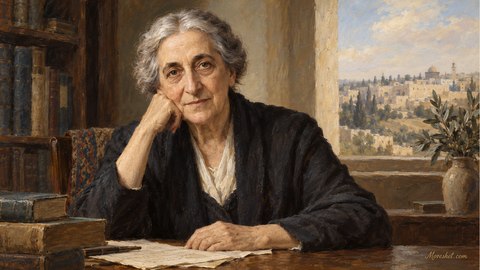
Jill Ellen Abramson
American journalist of Jewish heritage and the first woman to serve as executive editor of The New York Times
Jill Ellen Abramson is an American journalist and editor whose career took her through some of the most influential newsrooms in the United States. In 2011, she became the first woman appointed executive editor of The New York Times, a milestone in the history of American journalism and in the advancement of women into senior positions of institutional authority. Of Jewish heritage, Abramson also belongs to the broader story of Jewish participation in American intellectual, cultural and public life.
Education and the beginning of a journalism career
Abramson grew up in Manhattan and studied at Harvard University, where she earned a bachelor's degree in History and Literature in 1976. She began building her professional identity while still a student. She served as arts editor of The Harvard Independent and, from 1973 to 1976, worked as a writer for Time magazine. Her early combination of humanities education and newsroom experience became the foundation for a career that joined reporting, editing and institutional leadership.
Experience in major news organizations
After Harvard, Abramson worked as a senior reporter at The American Lawyer. In 1986, she became editor-in-chief of Legal Times, remaining in that position until 1988. Legal journalism required close attention to courts, public institutions, regulation and the people who shape them. That experience helped develop the precision and persistence that later characterized her work in national news.
From 1988 to 1997, Abramson reported from the Washington bureau of The Wall Street Journal. The period strengthened her reputation as a determined and capable journalist with experience covering American government and public affairs. In 1997, she joined The New York Times, where she moved into increasingly senior editorial responsibilities at one of the world's most influential newspapers.
Breaking the highest editorial barrier at The New York Times
In September 2011, Abramson was appointed executive editor of The New York Times. She was the first woman to hold the position since the newspaper's founding. Her appointment therefore meant more than a personal career achievement. It marked a significant opening of one of American journalism's most powerful leadership roles to women, after decades in which senior decision-making positions at major news organizations had been held predominantly by men.
As executive editor, Abramson led a newsroom with substantial influence in the United States and abroad. The position required setting editorial priorities, directing editors and reporters, and overseeing the work of a newspaper whose journalism helped shape public understanding of national and international events. She led during a period when established news organizations were also confronting major technological and economic changes.
Her tenure ended in May 2014, when she was succeeded by Dean Baquet. Her departure took place amid a dispute concerning her compensation and employment terms, bringing renewed public attention to equal pay and gender equality in senior leadership. Regardless of the circumstances surrounding the end of her tenure, her appointment remained a landmark in the history of American journalism and in the continuing effort to broaden women's representation in positions of influence.
Teaching and professional recognition
Abramson has also carried her experience into higher education. She taught at Princeton University from 2000 to 2001 and at Yale University from 2007 to 2011. Beginning in 2014, she served as a visiting professor at Harvard University. These academic roles enabled her to pass on practical knowledge of reporting, editing and newsroom management to new generations of students.
In 2001, Abramson was elected to the American Academy of Arts and Sciences. The recognition reflected her standing as a journalist whose work had made a substantial contribution to American public and intellectual life.
Why this legacy belongs in Moreshet
Jill Ellen Abramson merits inclusion in Moreshet because her career documents an important transformation in the leadership of major media institutions. She did not merely report on centers of power; she reached a position from which she led one of the world's most influential newspapers. Her path—from student journalism and legal reporting to the Washington bureau of The Wall Street Journal and ultimately the executive editorship of The New York Times—shows how professional skill, persistence and broad newsroom experience can open institutions that were once largely closed to women.
Her story also has significance for Jewish heritage. As an American journalist of Jewish heritage, Abramson represents the contribution of Jews to the intellectual, cultural and civic institutions of the United States. Her legacy combines a personal breakthrough in gender representation with a professional example for journalists, editors and students who followed. For Moreshet and Moreshet.com, preserving that story means recording not only who held an important title, but how a career in journalism helped reshape expectations about who could lead a major public institution.