Hanoch Marmari
Journalist, editor, author and cultural leader who helped shape Israeli public discourse
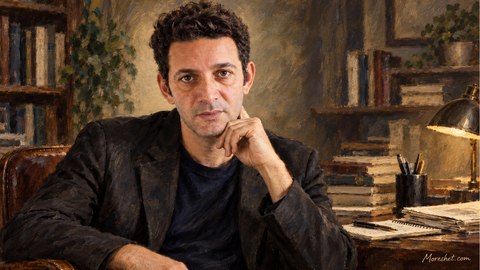
Hanoch Marmari (born December 30, 1948) is an Israeli journalist, editor, author and cultural figure. Over more than five decades, he has worked across several of the institutions that shape public life in Israel: he helped establish the Tel Aviv local newspaper Ha'Ir, served as editor-in-chief of Haaretz for approximately fourteen years, contributed to the creation of the satirical television program Nikui Rosh, led the Visual Communications Department at Bezalel, edited The Seventh Eye, and headed the Culture and Education Division of the National Library of Israel. He has also written books, columns and topical verse, and taken part in civic initiatives devoted to Israeli democracy.
Beginnings in Design, Satire and Journalism
Marmari was born in Haifa and grew up in the Ahuza neighborhood. He was the only child of a schoolteacher and a Histadrut employee who died when Marmari was young. After attending the Hebrew Reali School, he served in the Research Division of the Israel Defense Intelligence Directorate. In the 1970s he studied graphic design at Bezalel in Jerusalem, where the combination of visual design, writing and current affairs became central to his professional life.
At Bezalel he joined forces with Ephraim Sidon, B. Michael and Kobi Niv. Together they became part of the satirical "Zuares Group," writing a column for the student newspaper Pi Ha'aton and later for the weekly HaOlam HaZeh. After the Yom Kippur War, the group published the satirical book Zo Eretz Zo, illustrated by Dudu Geva. Its mixture of humor, illustration and political observation captured the unease of a generation shaken by war and showed how satire could become a form of public reflection.
The group's success led television producer Mordechai Kirshenbaum to invite Niv, Marmari, Sidon and Michael to create a satirical magazine program. The result, Nikui Rosh, first broadcast in 1974, became a landmark of Israeli satire. Marmari helped develop a format that brought political and social criticism into popular culture, demonstrating that television could be entertaining while also giving citizens a sharp language with which to examine their society.
Ha'Ir and the Rise of the Israeli Local Paper
In 1980 Marmari founded the Tel Aviv local newspaper Ha'Ir and edited it until 1984. The paper belonged to a new generation of Israeli journalism: urban, fast-moving and willing to focus on daily life, culture, municipal politics and voices that did not always receive sustained attention in national newspapers. His work helped establish local journalism as an important arena for reporting, cultural criticism and civic debate.
He later wrote for the newspaper Hadashot until it closed. In April 1988 he became deputy editor of Haaretz, serving under Gershom Schocken. After Schocken's death, Marmari was appointed editor-in-chief in January 1991. He remained in the position until the end of 2004, during a period in which Israeli journalism was undergoing major technological, economic and institutional change.
As editor of Haaretz, Marmari guided a newspaper with a significant influence on Israeli public discourse. His work involved setting editorial priorities, developing reporting and commentary, and maintaining a forum for critical discussion of society, government, culture and the economy. He left the position after disagreements with publisher Amos Schocken over the independence of the paper's economic supplement, which later became TheMarker.
Public Writing, Books and Israeli Life
In the winter of 1994, Marmari published a proposal to limit the application of Israel's Law of Return to a defined period. The proposal formed part of a broader discussion about the character of the State of Israel, Zionism, and the relationship between Jewish identity, citizenship and the state. Whatever one's view of the proposal, it illustrates his willingness to place fundamental questions before the public through journalism and argument.
In 2005 he published On Bicycles, a book about road cycling, one of his major personal interests. A second book on the subject, Still on Bicycles, appeared in 2020. In 2022 Keter published his novel Teeth Marks. These works broadened his contribution beyond daily journalism into personal and literary writing.
Marmari has been a columnist for Time Out Tel Aviv since 2005. Since November 2017, he has also published a weekly topical poem in the Friday edition of Haaretz, under the pen name "Alter-Man." The poems connect the traditions of Hebrew verse and satire with an immediate response to current events, extending his lifelong engagement with language, humor and public life.
Education, Culture and Civic Responsibility
From 2005 to 2008, Marmari headed the Visual Communications Department at Bezalel Academy of Arts and Design Jerusalem. He brought practical experience in journalism, editing and design into an academic environment, helping students understand visual communication as both an artistic discipline and a public medium. In 2006–2007 he also served as co-director-general of the Jewish-Arab Center for Economic Development, linking his cultural work with an effort to promote cooperation and development.
In 2008 he was appointed editor-in-chief of Kinneret Zmora-Bitan publishing house and left the position later that year. His work across newspapers, publishing and education reflects the breadth of his contribution to Israel's written culture: he has reported and commented, edited other writers, developed institutions and published books of his own.
Marmari was among the founders of Israelis for Saving Democracy, an organization established in 2010 to strengthen Israel's parliamentary democracy. He served as its director from its establishment. This civic work continued his long-standing concern with freedom of the press, institutional accountability and the importance of open public argument.
Since 2009 he has written a column for The Seventh Eye on journalism and the media. In September 2012 he became the site's editor, serving until early 2015. The publication's focus on examining Israeli journalism and media institutions made it an important forum for discussions of professional standards, editorial independence, accuracy and ethics.
From May 2015 through 2018, Marmari headed the Culture and Education Division of the National Library of Israel. The position placed his editorial and cultural experience within an institution devoted to preserving and making accessible the intellectual and cultural resources of Israel and the Jewish people. His work there formed part of his broader contribution to the institutions through which collective memory and knowledge are transmitted.
Recognition
In 2004 Marmari received the Sokolov Award for Written Journalism. The award recognized his journalistic work and his contribution to the professional and public stature of Israeli journalism.
Why Hanoch Marmari’s Legacy Belongs in Moreshet
Hanoch Marmari merits inclusion in Moreshet because he worked for decades at the points where Israeli culture is produced, challenged and preserved: newspapers, local journalism, television, books, educational institutions, the National Library and civic organizations. He did more than occupy editorial positions. He helped create settings in which journalists, writers, artists and readers could participate in a broader public conversation.
His contribution to Jewish and Israeli heritage is especially visible in the connection he forged between Hebrew, satire, criticism and civic responsibility. From Nikui Rosh and Ha'Ir, through his editorship of Haaretz and The Seventh Eye, to his work at Bezalel and the National Library, he influenced how Israelis encounter news, interpret their society and tell the story of their own time. Moreshet.com preserves that significance not as a list of titles, but as part of the living history of Israeli journalism, culture and democracy.