Jerome Allen Seinfeld
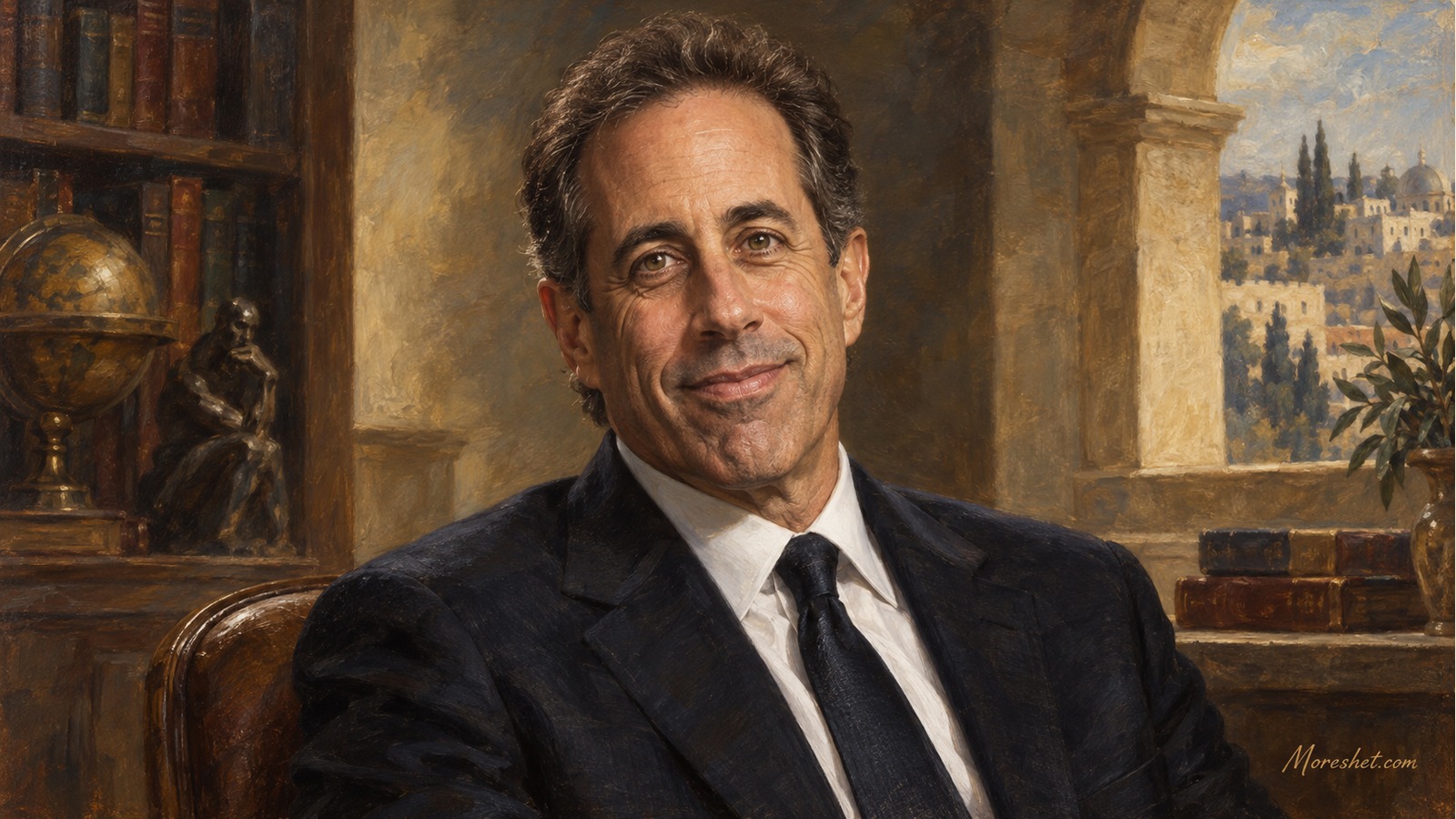
Jerry Seinfeld — AI-generated artistic portrait · Moreshet.com 
Jerry Seinfeld — image from the Moreshet archive
Jewish-American comedian, actor, writer, producer and director, co-creator and star of Seinfeld, who turned Jewish-New York observational comedy into a global language of popular culture
Jerome Allen Seinfeld, known worldwide as Jerry Seinfeld, is a Jewish-American comedian, stand-up performer, actor, writer, producer and director. He is one of the most influential figures in modern American comedy, above all because of the television series Seinfeld, which he created with Larry David and in which he played a fictionalized version of himself. The series, broadcast on NBC from 1989 to 1998, became one of the most important and quotable comedies in television history, changing how American television looked at everyday life, conversation, social awkwardness, city living and the supposedly small details of human behavior.
Seinfeld’s importance is not limited to one television success. He built a long career in stand-up comedy that is relatively clean, precise, observational and powerful precisely because it deals with small things: a line, a restaurant, a phone call, a date, an apartment, friends, objects, social rules and the moments when a person feels that the world has been designed strangely. As a New York Jew from a family that connects Ashkenazi and Syrian-Aleppan Jewish roots, he brought into popular culture a rhythm of speech, humor, skepticism, neurosis, urbanity and Jewish-American memory — without turning Jewish identity into a lesson, manifesto or slogan.
Jewish roots in Brooklyn, Syria, Hungary and Long Island
Seinfeld was born in Brooklyn, New York, on April 29, 1954. His father, Kalmen Seinfeld, came from a Jewish family of European background and served in the United States Army during the Second World War. His mother, Betty Hosni, came from a Syrian Jewish family with roots in Aleppo. This family story matters in understanding him: he was born not merely into generic American Jewish life, but into a meeting of Jewish communities, accents, traditions, migration memories and family stories inside mid-20th-century New York.
The family moved to Massapequa on Long Island, where Seinfeld grew up and attended local school. Suburban Long Island, urban New York, informal family Jewishness, American television culture of the 1960s and 1970s, and the verbal rhythm of Jewish-New York humor all became part of the background from which his comedy emerged.
At 16 he traveled to Israel and spent time volunteering at Kibbutz Sa’ar. The experience did not make him an Israeli public figure, but it added an early layer to his personal relationship with Israel. Later in life, especially after October 7, 2023, that connection would become more visible and central to his public identity.
Queens College and entry into stand-up
Seinfeld first attended the State University of New York at Oswego and later transferred to Queens College of the City University of New York. In 1976 he graduated with a degree in communications and theater. During his studies he began performing at open-mic nights and discovered that comedy was not only a hobby but a way of thinking aloud in front of people.
After graduation he began performing in New York comedy clubs, including Catch a Rising Star and The Improv. Like many comedians of his generation, he learned the craft not in a classroom but in front of audiences: write a line, test it, feel the silence, change a word, return again, and understand when a small observation becomes a large laugh.
His style formed early around observational comedy. Unlike comedians who focused mainly on politics, social rage, obscenity or personal confession, Seinfeld focused on the small mechanisms of life. He asked why things work the way they do, why human beings perform strange rituals, and why everyday objects, phrases and manners seem normal until someone describes them precisely enough.
The breakthrough through Carson, Letterman and American television
In 1981 Seinfeld appeared on The Tonight Show Starring Johnny Carson. The appearance was a turning point. Carson, the most important gateway through which American comedians entered the mainstream, was impressed, and Seinfeld began appearing repeatedly on late-night programs, including those hosted by David Letterman. His voice moved from New York comedy clubs to national television.
He also had early acting attempts, including a short role in the sitcom Benson, but that was not where his central vocation lay. He understood that his strength was not necessarily dramatic acting or a character far removed from himself, but the ability to bring the person telling the joke onto the screen: a dry, precise, slightly detached, almost scientific presence that dismantles human behavior as if it were a small machine.
In 1987 his first stand-up special, Stand-Up Confidential, aired on HBO. By the end of the 1980s Seinfeld was already a known and respected comedian, but not yet a global cultural figure. That would change when he revisited the possibility of turning stand-up into an entire television structure.
The birth of Seinfeld: a show about nothing that was about everything
In 1988 Seinfeld and Larry David created a pilot for NBC first called The Seinfeld Chronicles. The idea was unusual: a comedy series based on the life of a New York stand-up comedian, with stand-up segments echoing the themes of the episodes. The title was later shortened to Seinfeld, and the series developed around four characters: Jerry, George Costanza, Elaine Benes and Cosmo Kramer.
The popular phrase ‘a show about nothing’ captured only part of the truth. Seinfeld was not truly about nothing; it was about the unwritten rules of social life. How to break up with someone, what to say in a restaurant, how to behave in line, what a gift means, how a small lie becomes a maze, and how an urban person tries to preserve independence inside a network of friends, neighbors, partners, parents and acquaintances.
The series succeeded because it made the tiny dramatic. It did not try to teach moral lessons, soften its characters or give them traditional emotional growth. On the contrary, the characters often remained selfish, petty, brilliant and ridiculous. Precisely for that reason, they felt true in their own way. Seinfeld and David understood that in late-20th-century comedy, audiences did not always want a hug; sometimes they wanted a ruthless precision about social absurdity.
Jewish-New York rhythm and global popular culture
One reason Seinfeld became so important was the way it brought Jewish-New York rhythm into the center of American television without explaining it. The series is full of family, food, coffee shops, neuroses, arguments, linguistic jokes, guilt, embarrassment, social grammar and unforgettable parents. It is Jewish in rhythm, viewpoint and intonation even when an episode is not directly about Judaism.
Jerry’s character in the series is not an educational or folkloric Jewish figure. He is a modern, single, urban, skeptical, very clean, very orderly man who measures the world through details. In that way the series helped normalize a Jewish-American voice at the center of global popular culture: not as an outsider, not as a guest, but as part of the language through which the world laughs at itself.
The effect on language was enormous. Phrases, situations and characters from the series became cultural codes. Episodes such as ‘The Chinese Restaurant,’ ‘The Puffy Shirt,’ ‘The Soup Nazi,’ ‘The Contest,’ ‘The Parking Garage,’ ‘The Library’ and many others created an archive of situations people use to describe their lives. Comedy became a form of memory: a way for a society to remember its embarrassments.
Success, the end of the series and the return to stand-up
Seinfeld grew gradually until it became one of the most watched and influential series in the United States. It won Emmy, Golden Globe and Screen Actors Guild awards, and continued to live for decades through reruns, syndication, DVD and streaming. For generations who did not watch it in real time, it remains a school for comic writing, scene structure, interwoven plots and dialogue.
In the late 1990s, Seinfeld was offered an enormous sum to continue for a tenth season, but he chose to end the series. That decision became part of his professional stature: he preferred to leave the work at its height rather than extend it only because it was profitable. He then returned to stand-up, largely discarded his old material and began building a new act from the ground up.
The special I'm Telling You for the Last Time and the documentary Comedian captured that moment: a very rich and famous comedian returning to clubs to try a new joke in front of a small audience. In doing so, Seinfeld demonstrated the professional principle he values most: comedy is a daily craft, not only fame.
Books, films and comic writing
Seinfeld has written several books, most notably SeinLanguage, published in 1993, which was based on stand-up material and became a bestseller. In 2002 he published the children’s book Halloween, and in 2020 he published Is This Anything?, a wide-ranging collection of stand-up material from different periods of his career. The last book is especially important because it presents his comedy as a working archive: sentences, formulations, ideas, attempts and lines built over decades.
In 2007 he co-wrote, produced and starred in the animated film Bee Movie, voicing Barry B. Benson, a bee who challenges the existing order of the world of bees and honey. The film later became an internet phenomenon and a part of popular culture beyond its original release.
In 2024 he directed, wrote, produced and starred in the Netflix film Unfrosted, a satirical comedy about the corporate and cultural battle around the invention of the Pop-Tart. Even though the film received mixed responses, it showed Seinfeld’s continuing interest in Americana, advertising, consumer products, small mythologies and the way an entire society can treat an industrial pastry as if it were a historic event.
Comedians in Cars Getting Coffee
In 2012 Seinfeld created Comedians in Cars Getting Coffee, a series in which he drives vintage cars with comedians, actors and entertainers to talk over coffee about craft, memory and comedy. The format looks simple, but it reveals what truly interests Seinfeld: funny people discussing how humor works, how a career is built, how a joke is born and how a personality becomes a style.
The series hosted major figures in American comedy and culture, including Mel Brooks, Carl Reiner, David Letterman, Julia Louis-Dreyfus, Larry David, Eddie Murphy, Chris Rock, Tina Fey, Steve Martin, Sarah Jessica Parker, John Mulaney, Ellen DeGeneres, Jon Stewart and Barack Obama. Its move from Crackle to Netflix expanded the audience and turned it into a filmed archive of comedians speaking about their profession.
The cars in the series are not merely decoration. They express Seinfeld’s love of design, mechanics, detail, classic form, movement and style. Like a good joke, a good car is built from a balance among form, function, rhythm and sound. The series connected his love of comedy with his love for the aesthetics of machines.
Cars and the aesthetics of detail
Seinfeld is known as one of the major car collectors in entertainment, especially as a collector of Porsche models. His love of cars is not only a matter of display. It connects to the same eye that characterizes his comedy: attention to detail, mechanism, the relationship between use and form, and the way an object can contain an entire culture.
His collection, appearances in the automotive world, writing about cars and the format of Comedians in Cars Getting Coffee present another side of him: a comedian who respects craft. Whether the subject is an engine, a comic sentence or the structure of a television episode, Seinfeld is interested in how something is built, why it works and what makes it elegant.
Philanthropy, family and Good+Foundation
In 1999 Seinfeld married Jessica Seinfeld, an author and philanthropist, and the couple has three children. In 2001 Jessica Seinfeld founded Good+Foundation, originally Baby Buggy, and Seinfeld has long been part of the family’s public support for its work. The foundation helps families living in poverty through a combination of essential goods, services and partnerships with community organizations.
The importance of this activity is not only financial. It presents a model of family philanthropy focused on the basic needs of parents, children and babies: strollers, cribs, equipment, diapers, community services and support during the sensitive early stages of life. Seinfeld himself has also participated over the years in charity events and giving connected with health, education and support for families.
From a heritage perspective, this philanthropy reminds us that humor is not separate from social responsibility. A person who turned everyday life into comic material has also participated in efforts designed to ease the everyday life of families in need.
Jewishness, Israel and public support after October 7
Seinfeld identifies as Jewish, though he does not present himself as religious. His Jewishness appears in his work mainly as cultural, familial and linguistic rhythm, but in recent years it has also received clearer public expression. He has spoken about his connection to Israel, visited Israel several times, performed there for large audiences and maintained an emotional relationship with the country and the Jewish community.
After the Hamas attack of October 7, 2023, Seinfeld traveled to Israel with his family on a solidarity visit. He met families of hostages and hostages released from Hamas captivity, visited Kibbutz Be’eri, and wore a symbol of support for the effort to bring the hostages home. During this visit, his connection to Israel moved from cultural or biographical affection into public standing at a moment of deep Jewish and Israeli crisis.
Seinfeld later described his post-attack visit to Israel as one of the most powerful experiences of his life. For Jewish and Israeli audiences, the meaning was clear: one of the comedians most identified with America chose, at a difficult moment, to stand with Israel, the families of the hostages and the Jewish community. Even when such positions generate debate in the world, they are inseparable from how his public life is understood in contemporary Jewish heritage.
Influence on comedians and the language of comedy
Seinfeld’s influence on younger comedians is immense. He established a model of the comedian based on precise formulation, clean language, daily discipline and the confidence that even the smallest material can become large if viewed from the right angle. Many comedians learned from him that a joke does not have to shout in order to remain in memory; sometimes it only has to be perfectly built.
He also influenced sitcom structure. Seinfeld taught writers how to weave several small plotlines until they collide at the end of an episode, how to turn an object or phrase into a dramatic center, and how to build a world in which every detail returns and pays off. That influence is visible in many comedies that followed, both in the United States and beyond.
In many ways, Seinfeld turned social awkwardness into an international language. He showed that a person can speak about New York, Jews, dating, apartments and friends, and still touch something universal: the feeling that all of us are trying to understand rules that nobody wrote down.
Why this legacy belongs in Moreshet
Jerome Allen Seinfeld merits inclusion in Moreshet because he is one of the Jewish-American creators who most deeply influenced global popular culture. His path connects New York Jewish life, Syrian and European Jewish roots, stand-up, television, writing, film, philanthropy and visible support for Israel. He turned everyday life into artistic material and made the urban Jewish-American comic voice into a language understood around the world.
Moreshet.com documents Seinfeld because Jewish and Israeli heritage includes not only leaders, rabbis, statesmen and scientists, but also cultural creators who shaped the way human beings laugh, speak, remember and understand themselves. Jerry Seinfeld’s place in Moreshet rests on the lasting influence of his work on comedy, television, Jewish-American identity, Israeli and Jewish audiences, and the fact that in moments of crisis he chose to associate his name and voice with support for Israel and the families of hostages. This is a legacy of precise humor, living identity, cultural responsibility and Jewish memory inside global entertainment.