Israel Galili
A founder of the Working Youth and Na'an, a Haganah commander, architect of Israel's early defense institutions, and influential political leader
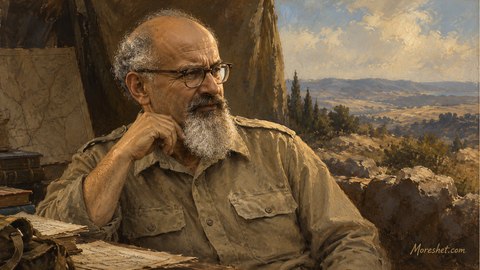
Israel Galili (10 February 1911 – 8 February 1986) helped shape the transformation of the Jewish community in Palestine from a self-organized national movement into a state with a standing army, public institutions, and sovereign responsibilities. He was a founder of the Working Youth movement and Kibbutz Na'an, a senior commander of the Haganah and its chief of staff on the eve of independence, a Knesset member, a government minister, and one of the most influential advisers and intermediaries in Israel's early political leadership.
Galili's importance cannot be reduced to a single office. For decades he worked at the intersection of settlement, labor Zionism, defense, party politics, and government. He helped create the organizational frameworks and human networks that affected thousands of members of the Yishuv and influenced the institutions of the new State of Israel.
From immigration to the labor movement
Galili was born Israel Berchenko in Brailiv, in the Podolia region of the Russian Empire, now in Ukraine. In 1914, when he was three, his family immigrated to Palestine and settled in Tel Aviv. He attended elementary school and later trained as a printer, a practical profession that connected naturally with the political, educational, and publishing circles in which he became active.
In 1924 he helped found the Working Youth movement and became its first secretary. The movement sought to give working adolescents a framework of education, training, belonging, and public responsibility. Galili's role in its creation was part of a broader effort to build a Hebrew workers' society in which young people were not merely laborers but members of a developing national and communal enterprise.
In 1930 he was among the founders of Kibbutz Na'an, where he remained a member until his death. Na'an was not only his home but also a base for his political, organizational, and defense activity. The connection between collective settlement and defense shaped his outlook: building the land, creating a cooperative society, and preparing a protective force were complementary parts of one national undertaking.
In the Haganah: building the foundations of an army
Galili joined the Haganah in 1927. In 1935 he was appointed to its central leadership and later placed in charge of acquisitions and armaments. These responsibilities were crucial for an organization operating under British rule, with limited resources and growing threats. The work of obtaining weapons, equipment, and logistical capacity helped create the practical foundation for the Yishuv's defense.
In 1939, after Haganah members were imprisoned by the British in Acre Prison, Galili entered the prison disguised as a plumber. His purpose was to discourage the prisoners from attempting an escape. The episode captures a characteristic combination of personal daring and organizational responsibility: he acted boldly, but in the service of a calculated objective.
During the Second World War he participated in preparations to meet the possibility of a German invasion of Palestine. During the period of the Jewish Resistance Movement, an umbrella framework for the Jewish underground organizations, he represented the Haganah in its leadership together with Moshe Sneh. On 16 June 1947 he became head of the Haganah's National Command, or Ramat, making him one of the central figures responsible for converting an underground defense organization into the core of a future national military.
Galili opposed making cooperation with the British in the pursuit of Irgun and Lehi members an obligation imposed by the Haganah during the Saison. He argued that participation should be a matter of individual choice. Even where his position was disputed, it reflected his concern that the Haganah remain accountable to the wider Jewish community and capable of serving as the foundation of a state army.
Creating Israel's defense institutions
At the beginning of the 1948 War of Independence, before the declaration of statehood, Galili helped organize the air service that became the Israel Air Force. He also worked on the services that later developed into the armored, naval, and artillery corps. These were not merely new military units; they were the first infrastructure of Israeli sovereignty, built during wartime and before the state had fully established its institutions.
In May 1948 David Ben-Gurion abolished the position of chief of staff of the Haganah's National Command and assumed its powers. The heads of the Haganah's staff branches demanded Galili's return in an episode later known as the Generals' Revolt. Ben-Gurion agreed to restore him temporarily until procedures and standards for wartime command could be established. The episode revealed the tension between centralized political authority and the experience of Haganah commanders, while also demonstrating the authority Galili had acquired as an organizer and coordinator.
On the eve of the declaration of independence, Galili took part in the People's Administration meeting that debated whether to establish the state. Before the declaration, Ben-Gurion offered him the position of defense minister, but Galili believed that, in the circumstances of the approaching war, the prime minister should also hold the defense portfolio. In June 1948 he negotiated with the Irgun and Lehi over their dissolution and integration into the Israel Defense Forces. He also negotiated with Menachem Begin over the fate of the arms ship Altalena, and worked on obtaining weapons from abroad. When the IDF was formally established, he joined Ben-Gurion in administering the oath to its senior command.
Galili opposed the decision to dismantle the Palmach. He believed that preserving its framework during the army's formative period could help retain its fighting spirit and contribute to the construction of the new force. His position reflected a broader understanding of military institutions: an army is built not only from commands and equipment, but also from memory, values, and public purpose.
A legislator, minister, and trusted intermediary
Galili served in the First Knesset and then again from the Third through the Eighth Knesset, first representing Mapam and later Ahdut HaAvoda–Poale Zion and the Alignment. In 1949 he became the first head of the Gezer Regional Council, serving until 1951. This placed him among the people who helped establish local and regional government in the young state.
In the Thirteenth Government he was responsible for the Information Center during the Six-Day War and later served several times as a minister without portfolio, in the Thirteenth through Seventeenth Governments. Although the title did not always include an independent ministry, his influence was far greater than the formal designation suggested. He was an important influence on Prime Minister Levi Eshkol and later one of Golda Meir's closest ministers. He was a regular member of the informal kitchen cabinet, wrote speeches for Meir, served on the Foreign Affairs and Defense Committee, and chaired the Ministerial Committee on Settlement.
Galili's influence rested largely on his ability to build agreement among competing positions, understand the practical consequences of decisions, and coordinate between institutions and individuals. He was not simply an officeholder but also a counselor, intermediary, and political craftsman who could translate movement ideas into government policy. His work affected decisions on defense, settlement, and national strategy during formative decades.
Settlement, writing, and the preservation of memory
Galili supported the settlement movement, wrote the Galili Document, and was among the initiators of the establishment of the Yamit region. His position combined the socialist-Zionist ideology in which he had grown up with his view of settlement as a national and security instrument. The Galili Document and the debates surrounding it expressed an effort by Israeli governments to connect control of territory, the creation of settlements, and the state's security outlook.
He also left a substantial body of public and political writing. Books published after his death include At the Centers of Action and Decision, a selection of his speeches and essays; The Taste of the Campaign; and To and Upon: Letters and Figures. These writings offer insight into his political language, his thinking about defense and settlement, and his understanding of leadership during the transition from the Yishuv to statehood.
In 1982 Galili initiated the establishment of the Center for the Study of the Haganah at Ramat Ef'al. After his death, the center was named for him. Its creation reflected his belief that the history of the defense organizations should be documented, studied, and debated. Galili therefore contributed not only to making history but also to creating an institution through which future generations could examine it.
Family and remembrance
In 1963 Galili's son Yonatan died by suicide. A collection of his letters, Yonatan Galili: A Short Spring, was published afterward. Galili himself died in 1986, two days before his seventy-fifth birthday. He was survived by his wife and his son Shlomo. His family was also connected to Israeli culture and media: his granddaughter is media personality Einav Galili, and his sister Esther Berchenko Shaul was the grandmother of filmmaker Dror Shaul.
Why this legacy belongs in Moreshet
Israel Galili merits inclusion in Moreshet because he worked at several decisive points in the history of the Jewish community in Palestine and the State of Israel. He helped build a youth movement and a kibbutz, organized the Haganah's defense capacity, contributed to the foundations of the IDF, and negotiated the integration of Jewish armed forces during the establishment of the state.
His influence continued in public life. As a Knesset member, minister, adviser, and intermediary, he helped shape defense and settlement policy and contributed to the functioning of Israel's early governments. His initiative in creating the Center for the Study of the Haganah ensured that the experience, debates, and achievements of the founding generation would remain available to scholarship and public memory.
Galili's story adds to Moreshet.com a figure who cannot be reduced to one title: movement leader, kibbutz member, commander, politician, adviser, and founder of a heritage institution. His life helps explain how Israel's defense systems were built and how communal responsibility, Jewish nation-building, settlement, and state sovereignty became connected in the experience of a single generation.