Isaac Ben-Israel
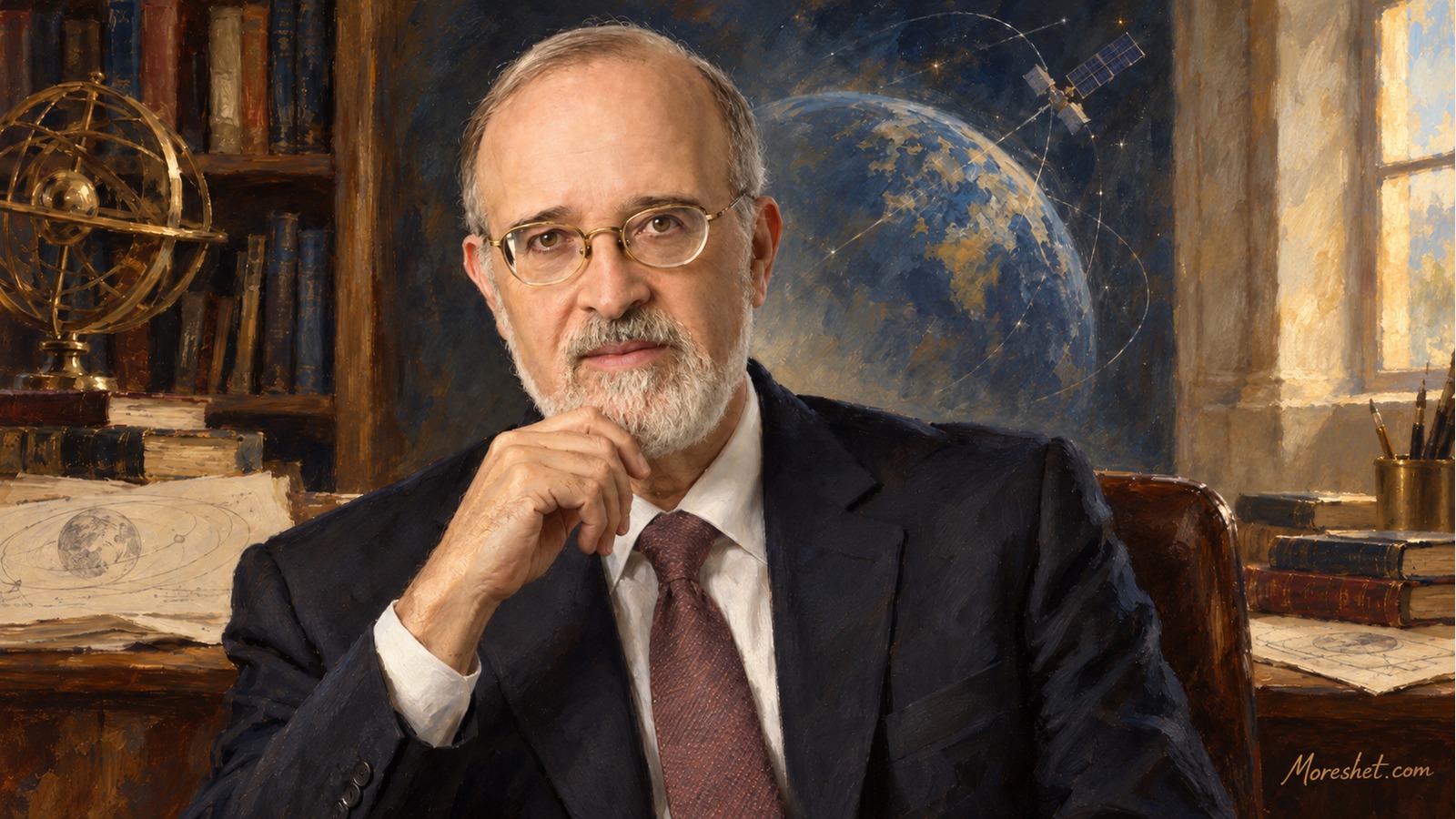
Isaac Ben Israel — AI-generated artistic portrait · Moreshet.com
A military scientist and national leader in Israel’s security, space and cyber capabilities
Isaac Aryeh Ben-Israel is an Israeli military scientist, retired general, philosopher of intelligence, academic and public official whose career helped shape the country’s response to technological change. His work has connected military research with national policy, university scholarship with practical innovation, and Israel’s security institutions with its emerging space and cyber sectors. He has served in senior positions in the Israel Defense Forces and Ministry of Defense, led national bodies concerned with space and research, helped establish Israel’s national cyber framework, and represented the country in the Knesset.
From academic reserve service to military technology
Ben-Israel was born in Tel Aviv on 26 July 1949. His parents, Haim Ben-Israel (Goldberg) and Sarah Babiov, had both been members of the Lehi underground; his father also served as a lieutenant colonel in the Israeli Air Force. After graduating from Herzliya Hebrew High School in 1967, Ben-Israel entered the IDF through its Academic Reserve program. He earned a BSc in mathematics and physics at Tel Aviv University while building a military career in operations, intelligence, research and development.
In the Air Force, he served on a team headed by Aviahu Sela that developed Periscope, a computerized command-and-control system, and received the Air Force Prize for that work. He later headed the Air Force Operations Research Branch and took part in planning Operation Opera, the 1981 mission that destroyed Iraq’s nuclear reactor. His final Air Force post was head of the Research Department in the Air Intelligence Directorate.
In 1992 he became head of research and development in the General Staff. In 1998 he was promoted to major general and appointed head of the Ministry of Defense Directorate of Defense Research and Development, known as MAFAT. The position placed him at the center of Israel’s effort to build long-term technological strength. Initiatives associated with his period of leadership included work on unmanned systems and the planning of satellite constellations connected with the Ofek reconnaissance-satellite series.
Ben-Israel received the Israel Defense Prize twice: in 1972 for developing a bombing system for F-4 Phantom aircraft, and in 2001 for a project reflecting a new conception of the future battlefield. He also received the Israeli Air Force Prize for the computerized control system and the head of Military Intelligence’s award for creative thinking.
Science, philosophy and the theory of intelligence
Ben-Israel’s military work was accompanied by a serious academic engagement with philosophy. He completed a master’s degree in philosophy in 1985 and received his PhD from Tel Aviv University in 1988. His philosophical training became an important part of his approach to intelligence and national security: he treated intelligence not as a source of absolute certainty, but as a disciplined process of testing competing explanations.
In Dialogues on Science and Defense, which won the Yitzhak Sadeh Prize for Military Literature, and in The Philosophy of Intelligence, he argued that intelligence analysis, like science, must recognize the limits of available knowledge. Influenced by the critical philosophy of Karl Popper, he emphasized presenting alternative possibilities, attempting to disprove them, and retaining those that could not yet be rejected. Although this approach was not adopted as a universal method throughout the intelligence community, it enriched Israeli thinking about uncertainty, evidence and the responsibilities of analysis.
His later books, including Science, Technology and Security: From the Individual Soldier to Outer Space and Israel’s Security Conception, widened the discussion to include force planning, innovation, space, economics and public policy. They also helped bring complex questions of national security into academic and public debate.
Space, cyber and national research
After leaving the IDF, Ben-Israel joined Tel Aviv University, where he became professor emeritus and headed the Security Studies program in the School of Government. He also led the Yuval Ne’eman Workshop for Science, Technology and Security and the university’s Cyber Center. Through teaching, research and international conferences, he helped train and connect researchers, policymakers and technology professionals working on rapidly changing security challenges.
Ben-Israel chaired the Israel Space Agency from 2005 to 2022. In that role he helped advance Israel’s position as a space-capable country and strengthened the links among research, industry, defense and public policy. He also chaired the National Council for Research and Development from 2010 to 2017, contributing to the national conversation about research priorities, innovation and the relationship between government and the scientific community.
In 2011 Prime Minister Benjamin Netanyahu appointed him to lead the national cyber initiative. The expert committee he headed laid the groundwork for the National Cyber Bureau in the Prime Minister’s Office and for a broader national cyber strategy. This helped move cyber defense from a specialized technical concern into a national policy field involving infrastructure protection, education, research, industry and government coordination.
From 2017 to 2019, Ben-Israel served on the Global Commission on the Stability of Cyberspace and participated in drafting its eight norms concerning non-aggression in cyberspace. In 2018, he and Professor Eviatar Matania were appointed to lead an expert committee on making Israel a global center for artificial intelligence. Both assignments reflected his continuing interest in how a relatively small country can turn scientific expertise and entrepreneurship into national capability and international influence.
Public service and professional leadership
Ben-Israel served in the Seventeenth Knesset as a member of Kadima. He entered parliament on 25 June 2007 after Shimon Peres resigned his seat upon becoming president of Israel, and served until 2009. Although his parliamentary service was brief, it formed part of a wider public career in which he brought scientific and technological perspectives into national institutions.
Alongside his academic and public work, he served on research and development committees, advisory councils and boards connected with universities, industry and strategic studies. In 2003 he founded RAY-TOP, a defense technology consultancy. He was involved with the Fisher Institute for Air and Space Strategic Studies, bodies associated with the Technion and other academic institutions, and research and development structures linked to Teva Pharmaceutical Industries and Israel Corporation. In 2012 he was elected a lifelong member of the International Academy of Astronautics and joined Singapore’s National Research, Innovation and Enterprise Council.
Why this legacy belongs in Moreshet
Isaac Ben-Israel merits inclusion because his work has left a direct mark on the institutions through which Israel protects itself, develops technology and plans for the future. He contributed to military systems, led MAFAT during a formative period in the development of Israel’s technological infrastructure, guided national work in space and cyber, and shaped the country’s intellectual discussion of intelligence and security.
His significance also lies in the bridges he built among the IDF, the Ministry of Defense, universities, industry, government and the public. Those connections helped turn research into policy, policy into capability, and specialized knowledge into a broader national conversation. Moreshet and Moreshet.com preserve his story as part of the heritage of Israeli innovation: not simply a record of offices and awards, but an account of institution-building, professional education and sustained public service whose effects reach Jewish and Israeli life as well as the wider international discussion of science, security and cyberspace.