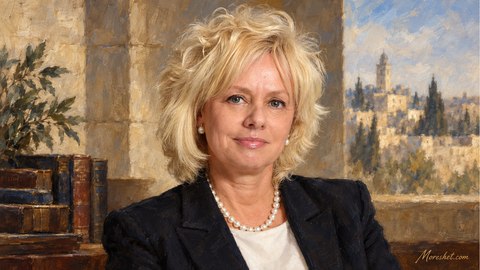
Hila Gerstel
The Israeli judge and institution-builder who founded the Central District Court and established a new framework for oversight of state prosecutors
Hila Gerstel is an Israeli jurist who served on the bench for more than two decades, founded the Central District Court and became its first president, and later established and led Israel’s commission for reviewing the state prosecution and the government’s legal representatives in court. Her career joined adjudication with institution-building: recruiting and preparing the staff of a new court, examining how future lawyers should enter the profession, and creating an oversight body for one of the legal system’s most consequential centers of public power.
Gerstel’s importance lies not simply in the senior offices she held, but in the practical assignments entrusted to her. She turned plans for a new district court into a functioning institution, led a detailed review of legal training and bar examinations, and helped make external scrutiny of prosecutors an operational public function. Each undertaking affected the quality of justice available to Israelis and the relationship between citizens and the state.
From a survivor family to the legal profession
Gerstel was born Hila Fox in Herzliya in 1955. Her parents were Holocaust survivors from Poland who reached Mandatory Palestine in 1946 aboard an immigrant ship. Her family story therefore belongs to the larger history of survivors who rebuilt their lives in the Jewish homeland and whose children took part in developing the institutions of the State of Israel.
After attending a municipal high school in Herzliya, she served in the Israel Defense Forces from 1973 to 1975. She graduated from Tel Aviv University’s Faculty of Law in 1978. Between 1977 and 1979, she completed her legal internship at the Tel Aviv District Court and in a law office, then received her license to practice. She spent four years as a salaried attorney before entering independent practice. That early experience exposed her to both the internal work of a court and the practical responsibilities of representing clients.
More than two decades on the bench
Gerstel was appointed to the Tel Aviv Magistrate’s Court in 1990. She began serving temporarily on the Tel Aviv District Court in 1996 and received a permanent appointment in 1997. In 2006 she became a deputy president of the District Court, where her responsibilities included leading its appeals division and presiding over judicial panels, including one with Judges Uzi Vogelman and Ilan S. Shilo.
Her work across the magistrate and district levels combined the hearing of cases, appellate review and judicial administration. Gerstel was considered for appointment to the Supreme Court more than once, although she withdrew her candidacy in 2004 for personal reasons. Her most distinctive contribution would ultimately come through the senior judicial and institutional responsibilities she assumed within the district court system.
Raising questions about preparation for legal practice
In 2000, Gerstel was appointed to chair a committee examining legal internships and the examinations required for admission to the Israel Bar Association. The committee addressed a question with consequences far beyond the profession itself: how to ensure that new lawyers possess sufficient knowledge and practical preparation before they begin advising clients and appearing in court.
The committee’s 2002 report recommended, among other measures, considering a longer internship, introducing a two-stage examination, requiring a practical course and changing the composition of the examining body. Its work influenced subsequent government proposals. A Ministry of Justice legislative memorandum published in 2010 adopted central principles from the report, while another memorandum in 2014 incorporated parts of its approach to the examination format. The committee thereby helped shape Israel’s continuing debate over professional standards, practical competence and fair access to the legal profession.
Building the Central District Court
In May 2007, Justice Minister Daniel Friedmann asked Gerstel, with the agreement of Supreme Court President Dorit Beinisch, to establish the Central District Court and serve as its first president. This was not an appointment to a fully formed institution. Gerstel had to help create the court’s working structure, select and train its personnel, and turn a new administrative framework into an operating court.
The court opened in Petah Tikva in September 2007. Its creation adjusted Israel’s judicial map to the population and caseload of the country’s central region, giving residents, attorneys and public authorities a dedicated district-level forum for civil, criminal and administrative proceedings. In September 2012, the court moved to its permanent home in Lod. That transition marked the consolidation of an institution Gerstel had guided from recruitment and preparation to stable, long-term operation.
Founding an oversight body for the state prosecution
In November 2013, a search committee headed by Attorney General Yehuda Weinstein recommended Gerstel to establish and lead the Commission for Review of the State Prosecution and Legal Representation in Court. The government approved her appointment the following month, and she entered office on April 1, 2014.
As with the Central District Court, Gerstel was asked both to lead and to build. The new commission was intended to review the conduct of prosecutors and other lawyers representing the state, address complaints and establish an organized mechanism of professional accountability. Because prosecutorial decisions can affect liberty, reputation, property and access to justice, the development of credible oversight had significance for every part of Israeli society.
During her tenure, Gerstel handled hundreds of matters. Prominent reviews included the conduct of former Tel Aviv District Attorney Ruth David in the context of the Ronel Fisher affair, and the prosecution’s representation of the Ministry of Health and the National Center of Forensic Medicine in matters concerning Dr. Maya Forman. Such cases required the commission to confront difficult questions about the boundaries of its mandate and the extent to which individual prosecutorial decisions could be reviewed.
The commission’s early years involved sustained institutional disagreement over its powers and operating framework. Gerstel announced her resignation in April 2016, effective that July. She cited conditions that she believed impeded the commission’s work, including questions surrounding her legal representation in a High Court proceeding and proposed legislation that would have excluded police prosecutors from the body’s jurisdiction. Although her tenure was brief, she helped establish prosecutorial oversight as a concrete institutional issue rather than an abstract principle.
Public trust, the attorney general candidacy and mediation
Gerstel was a prominent candidate for attorney general in 2016, although the search committee ultimately recommended Avichai Mandelblit. Her consideration for the post reflected the breadth of her experience as a trial and appellate judge, a court president and the founding head of a national oversight body.
A later police investigation examined a suspicion that an intermediary had conveyed a message suggesting that a possible appointment could be tied to intervention in the investigation of the prime minister’s residences. According to the available record, Gerstel rejected the approach and told her friend, Supreme Court Justice Esther Hayut, about it. In January 2019, prosecutors closed the case against communications adviser Eli Kamir because the evidence did not establish a basis for criminal charges. Both facts are essential to an accurate account: Gerstel’s reported response and the investigators’ ultimate evidentiary conclusion.
After leaving public office, Gerstel moved into private mediation, applying judicial experience through a process designed to help parties reach an agreed resolution rather than receive an imposed judgment. In 2017, for example, she served as a mediator in Sara Netanyahu’s defamation action against journalist Ben Caspit. The transition preserved the central theme of her professional life—resolving disputes—while employing more flexible and collaborative methods.
Gerstel is married to Reuven, and they have two children.
Why Hila Gerstel’s legacy belongs in Moreshet
Hila Gerstel merits inclusion in Moreshet because her work shaped institutions that serve Israelis every day. She did more than occupy established offices: she founded the Central District Court, recruited and prepared its staff, and guided it toward permanent operation. She later built an oversight commission that translated the principle of accountability for state prosecutors into an active framework that handled hundreds of matters.
Her committee work also contributed to the long-term discussion about the competence and practical preparation expected of Israeli lawyers. As the daughter of Holocaust survivors who rebuilt their lives in the Jewish homeland, Gerstel represents a generation that carried a family history of destruction and renewal into the public institutions of the State of Israel.
Moreshet and Moreshet.com preserve her story because it demonstrates how public legacy is made through sustained institutional work: creating courts, setting professional standards and insisting that bodies wielding state authority remain open to examination. Gerstel’s contribution to law, public administration and the culture of accountability gives her career significance beyond the courtroom. It speaks to the durability of democratic institutions and to the trust on which the relationship between citizens and government depends.