Giora Godik
The impresario who made musical theater a defining force in Israeli popular culture
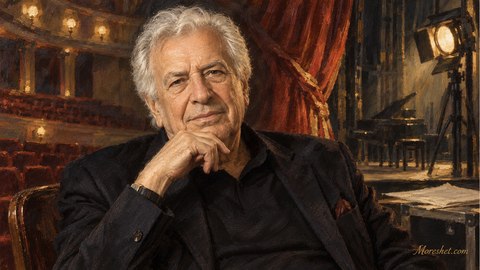
Giora Godik (May 15, 1921–September 5, 1977) was a Polish-born Jewish Israeli impresario and theater producer who helped shape the performing arts of Israel during its formative decades. He brought internationally known entertainers to the country, mounted ambitious Hebrew-language musicals, founded his own theater, and created a professional platform for hundreds of actors, musicians, dancers, directors, technicians, and other theater workers. At the height of his career, he was widely regarded as the “king of musicals.”
Godik’s importance lies not only in the size and glamour of his productions. He helped build a bridge between international popular culture and an emerging Israeli identity. His productions introduced audiences to major works of the international musical theater repertoire, while projects such as Kazablan gave local and distinctly Israeli experiences a powerful place on the stage.
From a theatrical family to Israel
Godik was born in Warsaw into a Jewish family with three generations of actors in Poland and Russia. His father, Wladyslaw Godik, was an actor. Giora studied at Magnus Krinski’s Jewish school in Warsaw and later read law at the University of Vilnius. During the Second World War he served in the Polish artillery.
He immigrated to Israel in April 1948. Soon after arriving, he joined the Israel Defense Forces and served in the Artillery Corps, including during the fighting around Jerusalem. He was discharged in 1955 with the rank of major. With a loan of 1,000 Israeli pounds, he opened a small entertainment agency in a rented room on Tel Aviv’s Shinkin Street. One of his first clients was the popular singer Yaffa Yarkoni. The business initially struggled: during its first month, Godik lost the entire loan. He nevertheless persisted and gradually established himself as an important figure in Israeli entertainment.
Bringing the world to Israeli audiences
Beginning in the mid-1950s, Godik specialized in bringing successful foreign performers to Israel. His bookings included Imma Sumac, the Golden Gate Quartet, the Platters, Amália Rodrigues, Louis Armstrong, Joselito, Marlene Dietrich, Harry Belafonte, Frank Sinatra, Jan Peerce, and Cliff Richard. These appearances gave Israeli audiences access to international stars at a time when the country’s cultural infrastructure was still developing, and they helped place Tel Aviv on the itinerary of major performers.
Marlene Dietrich’s 1960 appearance was particularly memorable. The performance ended with fourteen curtain calls. Dietrich spoke to the audience about the suffering endured by both Jews and Germans during the Holocaust and about the warmth she had received in Israel. The event demonstrated Godik’s ability to turn an imported performance into a shared cultural and emotional occasion.
Godik also worked beyond live entertainment. In 1969 he signed an agreement with the Polish-Jewish director Aleksander Ford to produce three films. His father had appeared in one of Ford’s earlier films, creating a personal as well as professional link between the two men.
In 1961, Godik achieved an important early success with a partly imported production of West Side Story, staged in cooperation with Habima Theatre. The production convinced him that Israeli audiences were ready for large-scale musical theater and encouraged him to establish a theater of his own.
The Godik Theater and the rise of the Israeli musical
In 1964, Godik founded the Godik Theater. Its first major production was My Fair Lady, starring Rivka Raz. Presented in a lavish, quasi-American style, the show became a major success and established Godik as Israel’s leading producer of musicals. It also demonstrated that a commercial production could become a central cultural event rather than a marginal form of entertainment.
Godik’s career included failures as well as triumphs. His 1965 production of How to Succeed in Business Without Really Trying required an investment of 500,000 Israeli pounds but closed after only seventy performances without recovering its costs. Godik moved quickly to his next project. In June 1965 he premiered Fiddler on the Roof, which became one of his greatest successes.
The Hebrew production of Fiddler on the Roof brought the world of Sholem Aleichem to a broad Israeli audience. Godik later produced a Yiddish version, allowing Tevye to return to the language in which the original stories had been written. This was more than a linguistic variation: it placed Eastern European Jewish memory and humor within the lively, modern Israeli theater scene.
Godik leased the Alhambra Cinema in Jaffa and transformed it into a major theatrical venue. From there he presented productions including The King and I, Man of La Mancha, I Like Mike, Hello, Dolly!, The Witch, and In Luck, alongside other plays and musicals. Some became major hits, while others failed to find an audience.
Kazablan and a new Israeli stage identity
Godik did not limit himself to importing successful foreign musicals. He also sought original Israeli material. His most influential local production was Kazablan, based on Yigal Mossinson’s play and starring Yehoram Gaon. The musical ran 606 performances, a record for its period, and made Gaon an overnight star.
Kazablan mattered because it placed a Jerusalem-born, Sephardi and working-class Israeli character at the center of a large popular production. For many members of Israel’s Sephardi and Mizrahi communities, the show offered an unusually visible representation of their experience and pride. Its success helped broaden the social reach of Israeli theater, bringing audiences to the stage who had not necessarily viewed the theater as their own cultural space. Gaon later reprised the role in the film adaptation.
A theater that created careers
Godik’s theater was also a large employment and talent-development enterprise. At its peak, it employed approximately 200 people and paid unusually high salaries to actors, singers, musicians, directors, and dancers. Godik had an eye for performers who had not yet become household names. He recruited some from repertory theaters and turned them into stars through the visibility and scale of his productions.
Those associated with his productions included Rivka Raz, Shmuel Rodensky, Tiki Dayan, Bomba Tzur, Shula Chen, Yehoram Gaon, and Haim Topol. Godik’s opening nights became glittering social events, but the deeper significance of his enterprise was practical: he assembled translators, composers, conductors, designers, performers, stage managers, and technicians into a working theatrical industry at a time when Israel’s cultural institutions were still young.
His productions also helped normalize the musical as a serious and popular form of Israeli entertainment. They gave audiences opportunities to hear Hebrew adaptations of international works, encounter Jewish stories in new forms, and see local performers occupy the same theatrical space as the stars of the international repertoire.
Collapse and the final years
The scale of Godik’s success depended on large investments and substantial risk. As several later productions failed, his debts grew. When the production of Father’s Day encountered difficulties, Godik directed it himself, but harsh reviews led to its early closure.
In 1972, shortly before the planned premiere of Honey, I Can’t Hear the Faucet, directed by Edna Shavit and already cast with Oded Teomi and Miriam Gavrieli, Godik unexpectedly left Israel for Frankfurt. He left behind creditors, employees, and performers who were shocked by the sudden closure of his theater. His wife, Emma, followed him, while their two children, Edith and Zeev, remained in Israel.
In Frankfurt, the couple sold sausages from a stand near the central railway station. Godik worked long hours and eventually acquired additional restaurants, earning enough to repay most of his debts. He remained in contact with Israel and considered returning, but he never resumed the theatrical career that had made him famous. In 1977 he was diagnosed with advanced intestinal cancer. He died in Germany on September 5, 1977, at the age of 56, and was buried in Gedera. A memorial ceremony at Habima Theatre drew a large audience of actors and theater professionals.
Remembering Godik
Godik’s daughter, Edith, was an artist who worked with her partner, Ernesto Levy. His son Zeev became a restaurateur in London and helped repay much of his father’s debt. Godik’s later reputation became closely tied to his dramatic financial collapse, but the documentary Waiting for Godik, completed by Ari Davidovich in 2007, restored attention to his cultural contribution and to the remarkable period in which musical theater seemed to dominate the Israeli stage. The film premiered in the Wolgin Competition at the Jerusalem Film Festival.
A permanent photographic exhibition dedicated to Godik is displayed in the restored Alhambra building. It preserves not only the memory of one producer, but also the atmosphere of Israeli theater in the 1960s: ambitious translations, new local works, rising stars, large ensembles, and the belief that a young country could build a major performing-arts culture of its own.
Why Giora Godik’s legacy belongs in Moreshet
Giora Godik merits inclusion in Moreshet because he changed the practical and cultural possibilities of theater in Israel. He brought world-famous performers to Israeli audiences, created large-scale musical productions, founded a theater that employed approximately 200 people, and gave lasting opportunities to performers who became central figures in Israeli theater, cinema, music, and entertainment.
His contribution is especially significant in the way he connected international culture with local identity. The Hebrew and Yiddish productions of Fiddler on the Roof brought Jewish Eastern European stories into the Israeli mainstream, while Kazablan gave a Mizrahi Israeli character a major popular platform and helped new audiences see themselves represented on stage. Godik’s work therefore belongs not only to theater history, but also to the history of Jewish cultural memory and the formation of Israeli society.
For Moreshet and Moreshet.com, Godik’s story offers a concrete way to understand how culture is built: through venues, productions, translations, employment, artistic collaboration, and audiences. His rise and fall illuminate both the possibilities and the risks of creating cultural institutions in a young state. The lasting memory of his work is found in the careers he launched, the productions audiences remember, and the place he helped give musical theater in Israel’s cultural heritage.