Fred Astaire
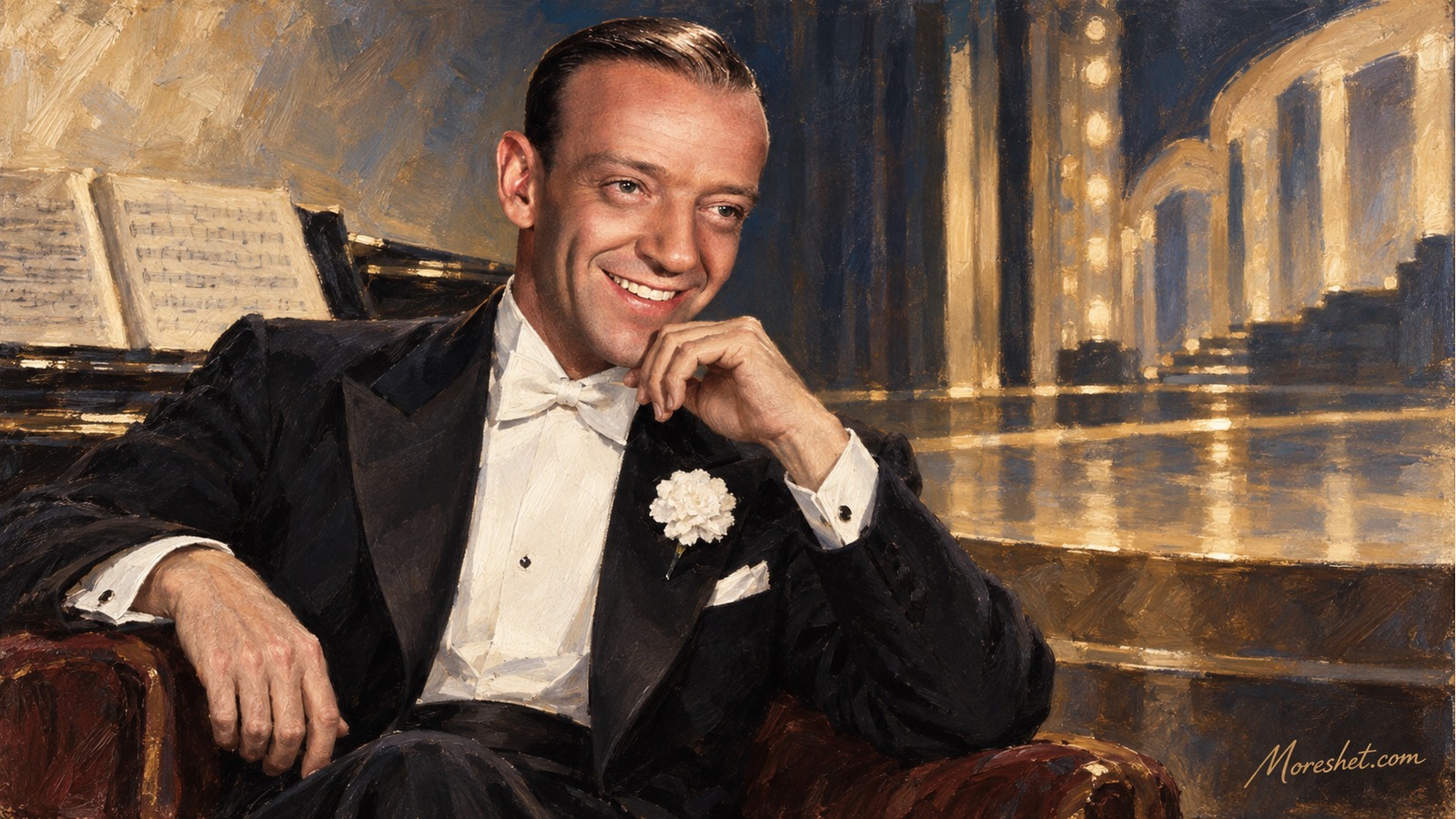
Fred Astaire — AI-generated artistic portrait · Moreshet.com
The American dancer, choreographer, singer, and actor who transformed filmed dance and made movement integral to the storytelling of the Hollywood musical
Fred Astaire (May 10, 1899 – June 22, 1987) was an American dancer, choreographer, singer, and actor whose work helped define both the stage musical and its Hollywood successor. Across a career of more than seven decades, he brought tap, ballroom dance, acting, and popular song into a remarkably unified form. The apparent ease of his performances rested on exacting preparation, rhythmic intelligence, and a sophisticated understanding of how movement could reveal character and advance a story.
Astaire did more than dance in front of a camera. He took a leading role in shaping choreography, rehearsals, musical arrangements, and the filming of his numbers. His dances were generally photographed in relatively long passages, with the performer's full body visible and the editing kept from obscuring the steps. That approach established an enduring standard for screen dance and influenced generations of performers, choreographers, and filmmakers.
From Frederick Austerlitz to vaudeville
Astaire was born Frederick Austerlitz in Omaha, Nebraska. His father, Friedrich Emanuel Austerlitz, was born in Linz in Austria-Hungary to Catholic parents who had converted from Judaism. His mother, Johanna, was born in the United States to Lutheran German immigrant parents. This paternal history connects Astaire to the complicated experience of Central European Jewish ancestry, conversion, and migration, although he was raised as a Christian and became an Episcopalian while young.
His older sister, Adele, showed an early gift for singing and dancing. In 1905 the family moved to New York so that both children could train for the stage. Fred and Adele studied dance, singing, and speech and began touring together as a child vaudeville act. Around this time they adopted the stage name Astaire, traditionally said within the family to have been derived from a relative's surname, L'Astaire.
The partnership became Fred's professional education. He also studied piano, accordion, and clarinet, and while still young assumed increasing responsibility for choosing music and constructing their routines. He blended tap with the waltz, tango, and other ballroom forms, gradually developing the precise rhythm and visual lightness that would become his signature.
Broadway, London, and the partnership with Adele
The Astaires reached Broadway in 1917 and also performed for American and Allied troops during the First World War. By the 1920s they were stars on both sides of the Atlantic. Their notable productions included George and Ira Gershwin's Lady, Be Good! and Funny Face, as well as the stage version of The Band Wagon.
Adele possessed an instinctive theatrical presence, while Fred contributed much of the choreographic planning and practical organization behind the act. Together they helped introduce songs that entered the American musical canon, including “Fascinating Rhythm” and “Funny Face.” These years also established Astaire's creative relationships with leading composers and lyricists such as the Gershwins, Cole Porter, and Irving Berlin.
The partnership ended in 1932, when Adele married and retired from performing. Fred continued alone in Gay Divorce, dancing to Cole Porter's “Night and Day.” The number was conceived not merely as an exhibition but as a romantic exchange between characters. Its success pointed toward one of Astaire's central achievements: making dance carry narrative and emotional meaning.
Hollywood and Ginger Rogers
Astaire made his significant Hollywood debut as himself in Dancing Lady in 1933 and then appeared in RKO's Flying Down to Rio. That film initiated his screen partnership with Ginger Rogers. Their chemistry quickly persuaded the studio that it had found an exceptional team, and the pair became defining figures of the 1930s Hollywood musical.
Astaire and Rogers made nine films together at RKO: Flying Down to Rio, The Gay Divorcee, Roberta, Top Hat, Follow the Fleet, Swing Time, Shall We Dance, Carefree, and The Story of Vernon and Irene Castle. They reunited at MGM for the Technicolor production The Barkleys of Broadway in 1949, bringing their total to ten.
The partnership's power cannot be explained by Astaire's technique alone. Rogers was a gifted comic and dramatic actor who sustained characterization while dancing. She brought spontaneity, emotional tension, and accessibility to the routines; Astaire supplied musical precision and meticulous choreographic structure. Together they turned numbers such as “Cheek to Cheek” in Top Hat and “Never Gonna Dance” in Swing Time into complete dramatic scenes rather than decorative interludes.
Changing the language of filmed dance
Astaire's most consequential contribution to cinema lay in the presentation of dance. At a time when many musicals relied on rapid editing, close-ups, and spectacular overhead compositions, he wanted the audience to see the movement clearly. The camera followed the dancers without hiding their footwork, and cuts were limited so that a performance retained continuity.
This method demonstrated the dancers' genuine skill and respected the architecture of the choreography. It also allowed sets, props, and cinematography to become creative partners. In Royal Wedding, Astaire appeared to dance on walls and a ceiling through the use of a rotating set. In Swing Time, he conducted a rhythmic dialogue with his own shadows. In Holiday Inn, his steps were coordinated with exploding firecrackers. The devices did not replace dancing; they grew from choreographic ideas.
Astaire was the leading choreographic force behind his routines, but his art was collaborative. His most important long-term collaborator was Hermes Pan, and he also worked with figures such as Michael Kidd. Their process involved weeks of secluded rehearsal, experimentation, and adjustment of musical arrangements to the steps. Astaire's control was so exact that separately filmed versions of the same routine could align almost movement for movement.
New partners and further creative peaks
Astaire refused to let his career depend on a single screen partnership. After the RKO period he danced with many of American cinema's most accomplished performers. With Eleanor Powell he delivered the celebrated “Begin the Beguine” tap sequence in Broadway Melody of 1940. You'll Never Get Rich and You Were Never Lovelier helped establish Rita Hayworth as a major star. He later appeared with Judy Garland in Easter Parade, Cyd Charisse in The Band Wagon and Silk Stockings, and Audrey Hepburn in Funny Face.
After announcing his retirement in the mid-1940s, Astaire returned to replace an injured Gene Kelly in Easter Parade in 1948. The film's success renewed his career. During the 1950s he created some of his most recognizable work, including the ceiling dance in Royal Wedding and his performance in The Band Wagon as a veteran entertainer attempting to reinvent himself.
In 1947 he founded the Fred Astaire Dance Studios. Although he sold his interest in the business in 1966, the schools bearing his name carried his cultural influence beyond stage and screen into the teaching of ballroom dance to a broad public.
An essential interpreter of American song
Astaire had a light rather than powerful singing voice, but he excelled in diction, timing, phrasing, and understanding of a lyric. Instead of competing with vocal showmen, he delivered a song much as he built a dance: with intimacy, rhythmic precision, and an apparently conversational ease. This made him one of the most important interpreters of the Great American Songbook.
He introduced or first brought wide attention to a remarkable body of standards, among them Cole Porter's “Night and Day”; Irving Berlin's “Cheek to Cheek,” “Top Hat, White Tie and Tails,” and “Let's Face the Music and Dance”; Jerome Kern's “The Way You Look Tonight”; and the Gershwins' “They Can't Take That Away from Me,” “A Foggy Day,” and “Nice Work If You Can Get It.” His performances helped bind these songs to character, gesture, and cinematic memory.
Astaire was also a songwriter and an instrumentalist. In 1952 he recorded The Astaire Story, a four-volume survey of his musical career accompanied by a quintet led by pianist Oscar Peterson. The recording was later admitted to the Grammy Hall of Fame in recognition of its artistic and historical importance.
Television, dramatic acting, and professional recognition
When he reduced his film dancing, Astaire found a new creative medium in television. The 1958 special An Evening with Fred Astaire was a landmark entertainment production prerecorded on color videotape and won nine Emmy Awards. Astaire received three Primetime Emmys during his career, including one for his performance opposite Helen Hayes in the 1978 television film A Family Upside Down.
He also demonstrated that his acting could stand apart from musical performance. In the 1959 drama On the Beach, he played a serious, non-dancing role. His work in the 1974 disaster film The Towering Inferno brought him his only competitive Academy Award nomination, for Best Supporting Actor. He did not win the Oscar, but the performance earned him Golden Globe and BAFTA awards. His final feature film was Ghost Story in 1981.
Astaire's major honors included an Honorary Academy Award, presented at the 1950 ceremony for his unique artistry and contributions to the technique of musical pictures; the Golden Globe Cecil B. DeMille Award; the Kennedy Center Honors in 1978; and the American Film Institute's Life Achievement Award in 1981. He published his autobiography, Steps in Time, in 1959.
Private life and final years
Astaire married Phyllis Livingston Potter in 1933. They had two children, Fred Jr. and Ava, and Astaire was also stepfather to Phyllis's son from an earlier marriage. Her death from cancer in 1954 devastated him. In 1980 he married Robyn Smith, a professional jockey.
Away from work, Astaire guarded his privacy. His interests included horse racing, golf, drumming, and songwriting, and he remained physically active into old age. He died of pneumonia in Los Angeles on June 22, 1987, at the age of 88, and was buried at Oakwood Memorial Park Cemetery in Chatsworth, California.
Why Fred Astaire's legacy belongs in Moreshet
Fred Astaire's importance cannot be measured simply by the number of films he made or the ease he projected on screen. He altered the professional language of the musical: how a moving body should be photographed, how dance could become part of a plot, and how one performer could interpret music through acting, voice, and rhythm at the same time. His collaborations with Ginger Rogers, Hermes Pan, and many other major artists produced scenes that remain objects of study, recreation, and pleasure, setting a standard for dancers and filmmakers around the world.
His inclusion in Moreshet also recognizes his Austrian Jewish family roots on his father's side and their place within the broader history of migration, conversion, and assimilation. This is not a claim that Astaire was a Jewish artist in a religious sense or that he worked through Jewish institutions; his direct contribution was to American and global culture. That distinction allows Moreshet.com to document his story responsibly: as the life of an artist whose ancestry touches Jewish history and whose work became part of the shared cultural inheritance of the twentieth century, including for Jewish and Israeli audiences.