Eva Gaëlle Green
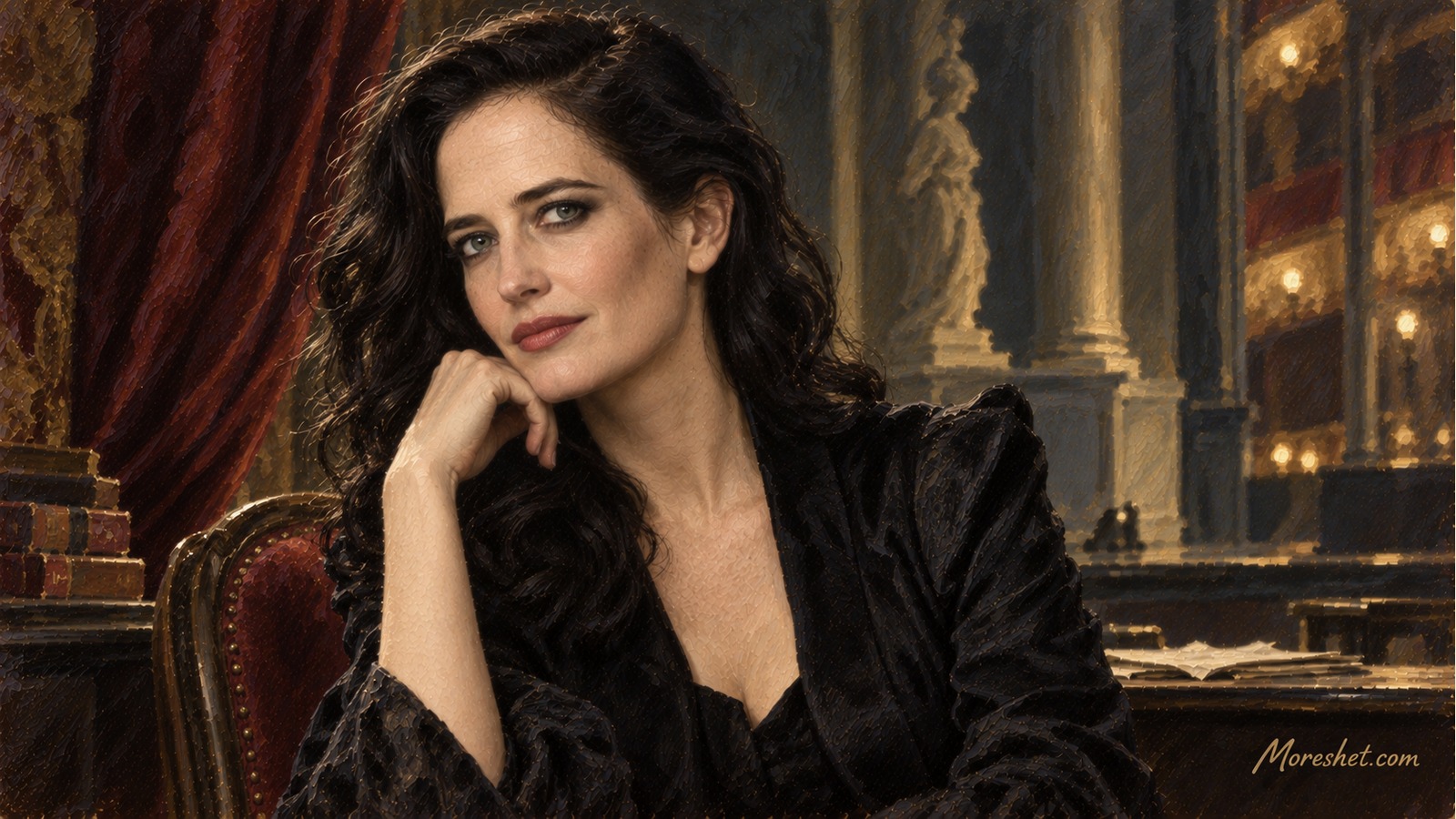
Eva Gaëlle Green — AI-generated artistic portrait · Moreshet.com
A French actress whose complex, fearless performances have bridged European cinema, Hollywood and prestige television
Eva Gaëlle Green, born on 6 July 1980 in Paris, is a French actress and model of Jewish descent. Over more than two decades, she has built an international career across European art cinema, major Hollywood productions and ambitious television drama. She is known especially for The Dreamers, Kingdom of Heaven, Casino Royale, 300: Rise of an Empire and the television series Penny Dreadful. Her distinctive contribution lies in the way she gives intelligence, danger, vulnerability and emotional depth to women who might otherwise be reduced to familiar types.
Early life and the decision to act
Green was born in Paris to Marlène Jobert, a French actress born in Algeria and descended through her family from Sephardic Jewish roots, and Walter Green, a Swedish- and French-descended dental surgeon. She grew up in Paris's seventeenth arrondissement with her non-identical twin sister, Joy. Green has described herself as secular and non-religious Jewish. That family background connects her personal story to the diverse Jewish history of France, North Africa and Europe.
As a child, Green developed an interest in Egyptology after visiting the Louvre. At fourteen, after seeing Isabelle Adjani in The Story of Adele H., she decided to pursue acting. She studied at the American University of Paris, an English-language institution, and continued her training at the Cours Eva Saint Paul drama school in Paris and the Webber Douglas Academy of Dramatic Art in London. She returned to Paris to work in theatre, building a professional foundation before moving into film.
Even in drama school, Green was drawn to characters that were not simple or conventionally sympathetic. She later said that she often chose the genuinely evil roles because they gave her a way to work through everyday emotions. That early preference became a defining feature of her screen career: she repeatedly chose women who possess authority, contradictions, hidden pain and the capacity to alter the course of a story.
From the Paris stage to international cinema
Green began her professional acting career on the Paris stage in 2001, appearing in Esther Villar's Jalousie en trois fax, for which she received a Molière Award nomination. She also appeared in Turcaret in 2002. Her film breakthrough came in 2003, when Bernardo Bertolucci cast her as Isabelle in The Dreamers. The performance immediately attracted attention. Green brought together sensuality, innocence, emotional exposure and independence, establishing a screen presence that critics recognized as unusually assured for a debut.
After appearing in Arsène Lupin in 2004, Green was cast by Ridley Scott as Sibylla, Princess of Jerusalem, in Kingdom of Heaven (2005). The historical epic introduced her to a worldwide audience and placed a young French actress at the center of a major international production about the Crusades and the medieval kingdom of Jerusalem. Much of Sibylla's material was removed from the theatrical release, but the director's cut restored the character's more complex story and gave audiences a fuller understanding of her family, political position and personal choices.
Vesper Lynd and international recognition
In 2006, Green was cast as Vesper Lynd in the James Bond film Casino Royale. The role was important because Vesper was not presented merely as a glamorous companion to Bond. She is intelligent, guarded and emotionally consequential, with motives and secrets that shape the film's central relationship. Green played her with restraint, irony and vulnerability, helping make Vesper one of the most memorable women in the Bond series.
For the performance, Green won the BAFTA Rising Star Award and an Empire Award for Best Female Newcomer. Both awards were voted for by the British public. Critical recognition and audience response confirmed that she could transform a high-profile commercial role into a psychologically substantial performance. Her Vesper became a reference point for the changing representation of women in a long-running action franchise.
In 2007, Green played the witch Serafina Pekkala in the film adaptation of The Golden Compass. She subsequently pursued a varied selection of projects, including Franklyn, in which she played two distinct characters, Cracks, in which she portrayed an enigmatic teacher at an elite girls' school, and Womb, a science-fiction drama about grief, memory and cloning. These films showed her willingness to work outside conventional studio formulas and to explore questions of identity, morality and human attachment.
Powerful women, fantasy and television
Green continued to establish herself as an actress with a singular presence through collaborations with major filmmakers. She played the witch Angelique Bouchard in Tim Burton's Dark Shadows, naval commander Artemisia in 300: Rise of an Empire, and Miss Alma Peregrine in Miss Peregrine's Home for Peculiar Children. As Artemisia, she played a ruthless and ambitious commander whose force of personality became one of the film's principal attractions. Reviews frequently identified Green's performance as the film's standout element.
From 2014 to 2016, Green starred as Vanessa Ives in Showtime's Penny Dreadful. It became one of the most important roles of her career. Vanessa is a woman struggling with supernatural forces, trauma, faith and the limits of her own identity. Green moved convincingly between terror, self-control, passion, spiritual conflict and psychological collapse. Critics widely praised the performance, and she received a Golden Globe nomination for Best Actress in a Television Series – Drama.
The series also demonstrated her ability to sustain a demanding character over an extended narrative rather than making an impression in a single film. Alongside Penny Dreadful, she appeared in Sin City: A Dame to Kill For, White Bird in a Blizzard, Based on a True Story, Dumbo and Proxima.
In Proxima, Alice Winocour's French drama, Green played an astronaut and mother confronting the tension between professional vocation and family responsibility. The performance revealed a quieter, more naturalistic register and earned her a César Award nomination for Best Actress. It was an important reminder that her range extends beyond gothic and fantastical roles.
Recent work across film and television
Green has continued to move between European and international productions. She played Lydia Wells in the miniseries The Luminaries, based on Eleanor Catton's novel, and portrayed Milady de Winter in the two-part French adaptation of Alexandre Dumas's The Three Musketeers, released in 2023. She also led the Apple TV+ thriller series Liaison, appeared in the psychological film Nocebo and starred in the action film Dirty Angels, released in 2024.
Her body of work encompasses historical drama, spy cinema, fantasy, horror, science fiction, psychological thrillers and family-oriented adventure. She has not confined herself to a single national industry or a single screen persona. Instead, she has repeatedly sought roles that involve fear, desire, loss, power, memory and difficult moral choices. That consistency gives her career a clear artistic identity even as the genres change.
Fashion, modeling and public image
Alongside acting, Green has worked as a model and international brand ambassador. She has collaborated with Emporio Armani, Breil, Lancôme, Dior and other luxury brands, and was the face of Dior's Midnight Poison fragrance. She later became associated with Bulgari and Roger Vivier. Her personal style, often described as gothic, dramatic and highly controlled, has become part of her public image and has influenced the way fashion media present the relationship between cinematic character and personal style.
Green is also known for protecting her privacy and for maintaining a limited presence on social media. Fluent in French and English, she has worked across French- and English-language productions. That cultural and linguistic mobility has helped her build a career that is not confined to one country, audience or cinematic tradition.
Jewish identity and social engagement
Green's Jewish ancestry comes through her mother's family, and she has described herself as secular and non-religious Jewish. Although she is not primarily known for religious or institutional Jewish activity, her career reflects the cultural diversity of Jewish life in France and Europe. Her story is one of a Jewish identity rooted in family history and cultural memory rather than formal religious observance.
Green has supported UNICEF and charitable work focused on children. She has also participated in environmental and conservation initiatives, including work connected with the Singita Grumeti Fund in Tanzania and an environmental education center that promotes sustainability and the protection of natural resources among local students. These activities extend her public influence beyond entertainment and connect her visibility with educational, humanitarian and environmental concerns.
Why Eva Gaëlle Green belongs in Moreshet
Eva Gaëlle Green merits inclusion in Moreshet because her international career illustrates how a French actress of Jewish descent can move between theatre, European cinema, Hollywood, prestige television and global popular culture while retaining a distinctive artistic voice. She has worked across languages, industries and genres, bringing complex women to audiences around the world.
Her achievement is not simply the number of films and series in which she has appeared. As Vesper Lynd, she brought emotional and psychological weight to a major action franchise. As Vanessa Ives, she demonstrated that a woman could anchor an ambitious horror series through sustained, demanding performance. In roles such as Sibylla, Artemisia, Miss Peregrine and Milady, she gave female characters authority, danger and ambiguity rather than reducing them to decoration or convention.
Her story also belongs within Jewish and French cultural memory. Her Sephardic Jewish family background reflects the intertwined histories of North African and European Jewry, while her secular identity shows that Jewish heritage can remain meaningful outside religious practice. Moreshet.com documents not only religious leaders, political figures and communal institutions, but also artists whose work shapes the imagination and cultural vocabulary of millions. Green's performances, international reach and connection to Jewish-French heritage make her a significant part of that wider story.