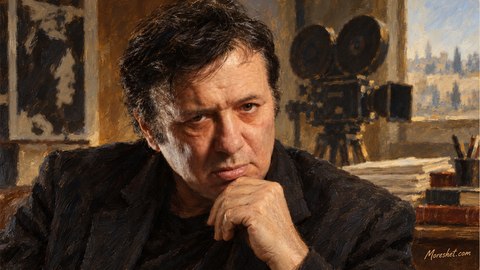
Dan Elmagor
A lyricist, playwright, translator and cultural historian who helped shape Hebrew song and Israeli theatre
Dan Elmagor, born Dan Elblinger in Ramat Gan on July 13, 1935, is one of Israel’s most wide-ranging cultural figures. Across more than six decades he wrote hundreds of songs, translated and adapted approximately one hundred plays, created musicals and operas, researched Hebrew literature and song, and presented influential radio and television programs. His work joins wit, exacting wordplay, historical knowledge, love of Hebrew and a persistent willingness to examine Israeli society critically.
Early journalism and education
Elmagor grew up in Rehovot, the son of Ze’ev Elblinger, a Warsaw-born agronomist and member of the Hashomer Hatzair Ariel group, and Zehava Katzenellenbogen of Lublin. He began writing for children’s and youth newspapers while still young, contributing to Davar LaYeladim, HaBoker LaYeladim and Mishmar LaYeladim. He later served as a young listeners’ representative on Kol Yerushalayim, wrote a youth segment for Kol Yisrael, and reported on sports in Rehovot for radio and newspapers.
In 1951, while in tenth grade, he and his friend Shabtai Ziv founded a national council of secondary-school students that later became Israel’s national student council. During his Israel Defense Forces service, from 1953 to 1955, he worked as a military correspondent and editor for BaMahane Gadna. Alongside his early journalism, he studied political science in evening courses in Tel Aviv, then literature and Bible studies at Tel Aviv University and Hebrew and English literature at the Hebrew University of Jerusalem.
He received a master’s degree in 1963 for research on Spain’s Golden Age poetry and Hebrew poetry in Renaissance Italy, focusing on the work of Joseph Zarphati. His teachers included Shimon Halkin, Leah Goldberg, Dov Noy and Hayyim Schirmann. From 1963 to 1968 he pursued doctoral studies at UCLA as a Fulbright scholar, writing under Avraham Band on the narrative art of the Hebrew writer Micha Yosef Berdyczewski.
A scholar of Hebrew literature and language
Alongside his creative work, Elmagor published numerous studies of Hebrew literature from the medieval, Renaissance and modern periods. He wrote on Bialik, Agnon and Berdyczewski; on the history of Hebrew drama; on Judah Sommo, regarded as the first Hebrew playwright; and on the satirical poetry of Nathan Alterman and other writers in the Hebrew press. He also contributed entries to the Encyclopaedia Hebraica, including entries on Immanuel of Rome and Joseph Zarphati, and edited the bibliography Nahalat Mi-Yod-Bet with Shmuel Fishman.
Between 1964 and 1974, he published hundreds of essays and articles in the literary supplements of Maariv and Yedioth Ahronoth, writing about literature, art, Hebrew, slang, popular songs and current affairs. He also devoted decades to Shakespeare. From 1964 to 2010 he served as the Israeli correspondent for the Shakespeare Quarterly, assembled the bibliographic collection Shakespeare—from Right to Left, and studied Shakespeare’s place in Hebrew writing during the Enlightenment and revival periods. This scholarship preserved connections, names and works that might otherwise have faded from public memory, and situated Hebrew song, theatre and literature within a much longer cultural continuum.
Translation, adaptation and original theatre
Elmagor translated and adapted approximately one hundred plays into Hebrew. His repertoire includes Euripides’ The Phoenician Women; Shakespeare’s The Comedy of Errors, As You Like It, Hamlet and A Midsummer Night’s Dream; Ben Jonson’s The Alchemist; Thomas Dekker’s The Shoemaker’s Holiday; Heinrich von Kleist’s The Broken Jug; Arthur Miller’s A View from the Bridge and Death of a Salesman; and One Flew Over the Cuckoo’s Nest.
He translated and adapted works by Bertolt Brecht, including Brecht on Brecht, The Small Pleasures of Life and songs for Schweik in the Second World War. His musical-theatre translations include My Fair Lady, Fiddler on the Roof, The King and I, Guys and Dolls, A Funny Thing Happened on the Way to the Forum, Yentl, The Producers and Stop the World—I Want to Get Off. He also translated and adapted operettas including Abu Hassan, The Deceived Kadi, Die Fledermaus and Sylva, the Csárdás Princess.
His original work brought Jewish tradition, Israeli history, popular music and theatre together. The 1968 musical Once There Was a Hasid drew on Hasidic songs, melodies and stories, bringing Jewish folk material to the Israeli stage. My Jerusalem, written in 1969, was among the early plays to address Jerusalem and its inhabitants after the Six-Day War, presenting the city through several perspectives. Guys’ City, from 1971, was influenced by Damon Runyon, while Don’t Call Me Black, from 1972, connected biblical stories with the American civil-rights movement and soul music, then still unfamiliar to much of the Israeli public. The show, with music by Benny Nagri and direction by Danny Litai, won commercial and critical success and received the Kinor David Award.
In 1982 he wrote Children of the City, a play about the lives of Yemenite Jews in Israel. Starring Nissim Garama and directed by Tzadi Tzarfati, it toured the country approximately 250 times. Elmagor also wrote the opera The Wind’s Hideout and the children’s opera Max and Moritz, as well as songs for the play Scandal at the Gymnasium.
Songs that entered Israeli memory
Elmagor wrote his first song at fifteen and went on to create hundreds of songs for military ensembles, singers, musicals and plays. His lyrics are marked by wit, precise rhyme and the ability to turn historical knowledge or an everyday scene into memorable popular song. Composers who set his words include Moshe Wilensky, Alexander Argov, Dov Seltzer, Yair Rosenblum, Meir Noy and Matti Caspi.
For the Batzal Yarok ensemble he wrote Venezuela; for the Ayalon Ensemble he wrote Romia and Yoel and Falafel Song. For the early programs of the Theatre Club Quartet he wrote songs including France–Israel Alliance, Sabbath Gentile and Why Didn’t Schubert Finish the Symphony? He wrote The Orchestra of Rishon and The Theory of Relationships for Shimon Israeli, and Human Life for Benny Berman. His songs for military ensembles include Come to the Sea, Let the Sea Be Calm and Guardian of the Walls, alongside the comic song My Hayimke.
In 1966 he wrote lyrics for the musical Kasablan. After a dispute over credit, Judge Yosef Michael Lam determined that All the Best and Get Off My Back, Kasablan were his work, and Elmagor was added to the song credits. All the Best, performed by Yehoram Gaon, became a major hit. In 1969 Ballad of a Medic, with lyrics by Elmagor and music by Efi Netzer, won first place at the Israel Song and Chorus Festival.
Other notable songs include Little Pink Notebook, Abraham’le the Teacher, One Day, Black-and-White Calypso and My Jerusalem. He translated French chansons including Who Likes Dirty Words? and The Bourgeois, and created Hebrew adaptations of songs from musicals such as If I Were a Rich Man, Rain Will Fall in Southern Spain and This Morning I’m Going to the Gallows. In 2006 the double album Besides That, Everything Is Fine collected 43 of his songs. In 2012, The Spout of the Kettle presented 300 of his song lyrics.
Radio, television and the history of Hebrew song
Elmagor was also an influential radio and television writer and presenter. Beginning in 1956, he wrote a weekly topical song for the Kol Yisrael program Noah’s Ark. He contributed to Three in a Boat and other radio programs, and in the 1970s edited and hosted the Galatz series The Songwriters of Yesterday, devoted to figures including Alterman, Mordechai Zeira, Immanuel the Russian and Yaakov Orland. In 1972 he wrote the station’s first radio play created specifically for it, Thus Spoke Immanuel, based on the notebooks of Immanuel of Rome.
On Israeli television he edited and hosted the musical entertainment series The Whistling Gypsy, which presented Hebrew translations of folk songs performed by leading Israeli singers. After the Yom Kippur War he hosted I Sang to You, My Country, a series about a century of Hebrew song. The first five programs were prepared and hosted with Eliyahu Hacohen; Elmagor then continued on his own. The series featured singers such as Shoshana Damari, Shimon Israeli, Yehoram Gaon and Hava Alberstein, as well as figures who embodied the periods under discussion, including Golda Meir, Rachel Yanait Ben-Zvi, Baruch Agadati, Daniel Sambursky and Immanuel the Russian. He helped make the history of Hebrew song not merely an academic subject, but a shared cultural experience.
Satire, protest and moral responsibility
Throughout his career Elmagor also wrote satirical and political songs, influenced by Nathan Alterman’s Seventh Column. His 1958 song The Beret, about the Kafr Qasim massacre, was the first song in Israel to be rejected by the theatre censorship authorities. He wrote critical songs for the Theatre Club and for the Yossi–Hizki–Yona trio, including The Little Citizen, as well as protest songs for Shimon Israeli.
In My Jerusalem he included a Palestinian perspective on the city, widening the cultural conversation about Jerusalem. In 1976 he published Silver Platter, 1976, a protest song concerning the awarding of the Yom Kippur War decoration to Moshe Dayan. During the First Intifada he published satirical columns and protest poetry, including We Shoot Children Too. In 1989 he wrote Human Image, a call to preserve human dignity even during war. The song was broadcast live and later adopted by Central Command chief Amram Mitzna for performance and recording by the Central Command Ensemble.
This public engagement brought personal costs. During that period he was suspended from the IDF and received threats; in 1989 his car was set on fire. His protest work nevertheless demonstrates the role he assigned to Hebrew creativity: not only entertainment and commemoration, but also a means of examining society’s moral responsibilities and its treatment of others.
A creative and educational legacy
Elmagor’s distinctiveness lies in his ability to connect worlds that are often kept apart: academic research and popular culture, medieval Hebrew poetry and radio song, classical theatre and contemporary Israeli questions, Hasidic tradition and soul music. His translations gave Israeli audiences accessible Hebrew versions of major works from world theatre, while his songs transformed historical ideas, characters and events into part of the country’s collective memory.
As a writer, researcher, broadcaster and collector, Elmagor has also served as a cultural archivist. Through essays, programs, plays, songs and books, he helped generations of Israelis encounter the creators and sources of Hebrew song, understand the development of the Hebrew language, and see Israeli culture as part of a long Jewish story.
Why Dan Elmagor’s legacy belongs in Moreshet
Dan Elmagor merits inclusion in Moreshet because his work documents and shapes several essential languages of Jewish and Israeli life in the twentieth century: Hebrew, popular song, theatre, radio and television. He did not merely write hits. He connected Jewish sources with modern culture, translated world theatre into living Hebrew, researched Hebrew literature across the centuries, and brought the history of Israeli song to a broad public.
His influence can be heard in songs that remain part of Israel’s cultural memory and seen in works such as Once There Was a Hasid, My Jerusalem and Children of the City. It also lives in his sustained effort to preserve the names, words and contexts behind Hebrew culture. For Moreshet.com, Elmagor represents the cultural mediator who can be a creator, translator, scholar and broadcaster at once—and whose work has shaped the experiences of audiences, artists and generations in Israel.