Ayala Hasson
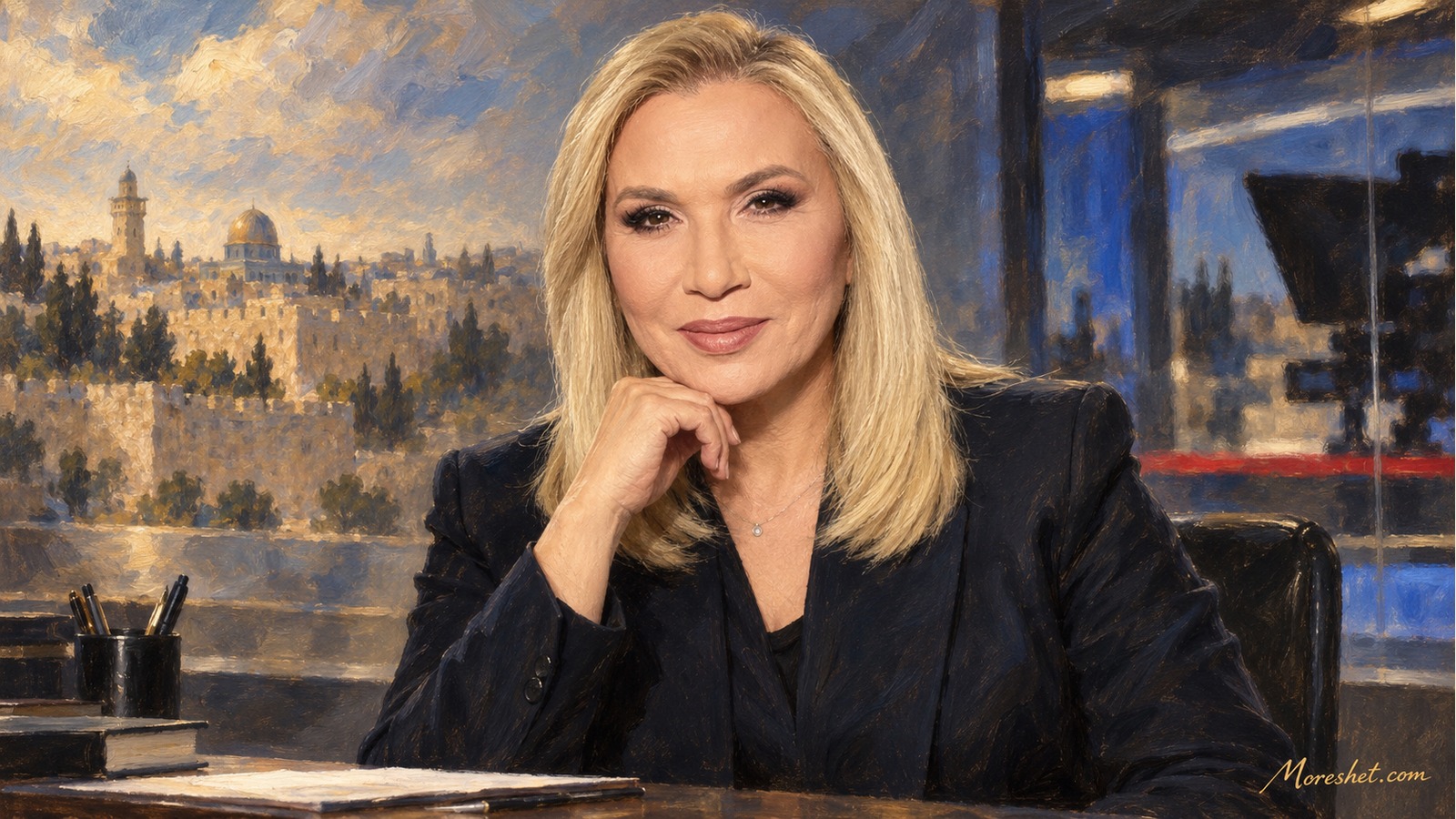
Ayelet Hasson - The Israeli Journalist — AI-generated artistic portrait · Moreshet.com
Israeli investigative journalist, television and radio presenter and political commentator, whose reporting has shaped public debate on government, law, policing, security and accountability in Israel
Ayala Hasson is an Israeli journalist, presenter and commentator, one of the figures most closely associated with investigative journalism on Israeli television and radio. Since the early 1990s she has worked at the Israel Broadcasting Authority, Kol Israel, Channel 1, News 10, News 13 and the Israeli Public Broadcasting Corporation. Across her career she has covered crime, law, police, politics, security, government and public corruption, and has been responsible for a long series of reports that influenced Israel’s public agenda.
Hasson built a distinctive place in Israeli media because she has not limited herself to presenting the news. Her work has often involved documents, recordings, witnesses and unanswered questions. She became the first woman to head Channel 1’s news division, presented major programs including Yoman, Shishi, HaMate HaMerkazi, Sheva with Ayala Hasson and Hadashot HaShabbat, and received public recognition for investigations involving political, legal, security and social centers of power. Her importance to Israeli heritage lies in the essential democratic function she represents: journalism that asks, checks, disturbs, reopens forgotten files and demands accountability from powerful institutions.
Jerusalem childhood and communication studies
Ayala Hasson was born on September 28, 1961, in Israel. She is the fourth of five children of Rina and Salomon, Shlomo, Hayun, and grew up in the Talpiot neighborhood of Jerusalem. The city in which she was raised — a place of government institutions, social tensions, communities, politics and identity — placed her from an early age inside a dense and significant Israeli environment. She later studied at Gymnasia Rehavia and, after her military service, turned toward communication and journalism.
Hasson studied at the Koteret School of Journalism and Communication and at Tel Aviv University, where she completed a bachelor’s degree in social sciences. Professional training gave her a foundation, but her career was built mainly through field work: cultivating sources, dealing with pressure, understanding law-enforcement systems, and sustaining complicated stories over time even when they provoked resistance.
Over the years Hasson has connected personal experience with her choice of journalism. She has described a traumatic event from childhood as one of the forces that pushed her toward exposing injustice and giving voice to people who were harmed. Without reducing her biography to a single explanation, one can see in her career a consistent concern with people who challenge an official version, demand that a case be reopened or bring to the screen a story pushed to the margins.
Early career: Maariv, public broadcasting and crime reporting
Hasson’s professional path began at Maariv, after which she joined the Israel Broadcasting Authority in 1993. At Channel 1 she first worked as a legal and police affairs reporter, a role that placed her in contact with crime scenes, courts, police, prosecutors, victims’ families, lawyers and law-enforcement officials. Crime reporting gave her the ability to recognize gaps in official versions and to ask how a case is built, how evidence is gathered, and who is left outside the story.
In 1994 she became known for her intensive coverage of the armed standoff involving Rabbi Uzi Meshulam and his campaign concerning the Yemenite Children affair. Hasson was among the journalists closest to the event and became known as the only journalist who entered Meshulam’s house. Those early years connected her to the kind of journalism that would accompany her career: not only studio reporting, but being present where reality is unfolding, even when it is dangerous, charged and uncertain.
From crime reporting she gradually moved to political and diplomatic coverage. The transition was natural. In Israel, criminal investigations, politics, senior appointments, prosecutors, police and relations between money and government often intersect. Hasson became Channel 1’s political reporter and later a diplomatic commentator, bringing to the political arena the tools of a crime reporter: skepticism, documents, recordings, confrontation with power and persistence under pressure.
The Bar-On–Hebron affair and national recognition
The report that placed Hasson at the center of Israeli journalism was the Bar-On–Hebron affair in 1997. She reported that the appointment of Roni Bar-On as Attorney General was allegedly linked to a political arrangement involving Shas support for the Hebron agreement and the legal situation of Aryeh Deri. The report created a major public storm, led to a broad police investigation, and for the first time in Israel a sitting prime minister was questioned under caution.
Although no indictments were ultimately filed in the affair, the exposure led to the establishment of the Shamgar Committee and to changes in the method of appointing the Attorney General. It therefore showed the ability of investigative journalism to affect not only headlines, but governmental procedures. One report opened a deep discussion about senior appointments, the relationship between politics and law, the independence of the Attorney General and the transparency required in government.
The importance of this affair in Israeli media heritage is considerable. It sharpened the role of a single reporter facing an entire governing system, and showed that a journalist can bring information to the public that forces state institutions to respond. For Hasson, it was a turning point that made her one of the journalists most identified with political exposés in Israel.
Channel 1: Yoman, HaKol Diburim and news leadership
During her years at the Israel Broadcasting Authority, Hasson expanded her work beyond individual investigations. She presented the radio program HaKol Diburim on Kol Israel, hosted Channel 1’s Yoman, and in 2006, ahead of the elections to the seventeenth Knesset, presented Israel Chooses alongside Ben Caspit. The two later co-hosted Yoman, and Hasson continued presenting it after Caspit left the program.
Yoman was for years one of the important platforms of Israeli television journalism. For Hasson it was not only a magazine program, but a space in which reporting, investigation, commentary and interviews could be joined. She worked in a period when Channel 1 still carried the memory of national public broadcasting, while facing growing competition from commercial channels. In that arena she remained prominent as reporter, presenter and commentator.
In 2014 she was appointed acting head of Channel 1’s news division, becoming the first woman to hold that role. The appointment was both a personal and institutional achievement: a woman journalist who came from field reporting, investigations and presentation to lead a central news division in public broadcasting. Even if that period was relatively short and charged, it illustrates Hasson’s role in breaking professional and gender boundaries in a media world long dominated by men.
News 10, News 13 and the commercial television arena
At the end of 2015 Hasson left the Israel Broadcasting Authority and moved to News 10, later News 13. There she presented the weekend magazine Shishi, the interviews and current affairs program HaMate HaMerkazi, and served as a senior commentator. The move into commercial television expanded her audience and placed her in the center of Israel’s competitive television news arena.
At News 13 she continued to develop a journalistic line identified with document-based reporting, criticism of public systems and attention to stories that resonated in the political and legal spheres. She dealt with the Harpaz affair, the Gal Beck case, conduct of the police and prosecution, Prime Minister Naftali Bennett’s household expenses, the National Library affair, allegations concerning Avi Himi, and other stories that became part of national debate.
Alongside television, she continued working in radio. In 2017 she began broadcasting a current-affairs program on 103FM, later expanding to a daily slot and to a program with Golan Yochpaz. Radio strengthened the direct conversational dimension of her work: less television editing, more live speech, rapid response, interviews and daily commentary.
Return to public broadcasting at Kan
In 2023 Hasson joined the Israeli Public Broadcasting Corporation. She began presenting Sheva with Ayala Hasson on Kan 11, broadcasting HaBoker HaZeh on Kan Bet on Thursdays, and serving as a commentator on the evening news. During the Swords of Iron War, her presence in news programming expanded, and in 2025 her weekday hosting was reduced alongside a significant move to presenting Hadashot HaShabbat on Kan 11.
Her return to public broadcasting was symbolic. Hasson’s major career began at the Israel Broadcasting Authority, moved into commercial television, and then returned to a new public broadcaster built after the old authority was closed. In that sense, her career also reflects the history of Israeli media itself: the move from public monopoly to commercial channels, struggles over editorial independence, crisis of trust in journalism, and the search for the role of public broadcasting in a polarized digital age.
At Kan 11, Hasson continued to combine presentation, commentary and investigative work. Her programs deal with current affairs, politics, the legal system, security, bereaved families, war, social investigations and field stories. Her presence links the studio format with a personal, direct and often combative journalistic style.
Political and diplomatic exposés
Across her career, Hasson has published a series of influential political and diplomatic stories. Alongside Bar-On–Hebron, in 2002 she exposed the bribery affair involving minister Shlomo Benizri, alleging that he received benefits in return for assisting contractor Moshe Sela. The affair led to Benizri’s conviction and imprisonment, and became an example of the influence of investigative reporting on a wider legal and public process.
In 2004 she exposed recordings involving Energy Minister Yosef Paritzky and his political rival Avraham Poraz in the Shinui party. Following publication, Paritzky was dismissed from the government. She later dealt with additional stories involving appointments, power relations, funding, suspected corruption and the connections between politics and law-enforcement systems.
In 2021 she reported information concerning Razi Issa, a Ra’am list member and one of the drafters of the coalition agreement for Israel’s thirty-sixth government, in connection with a meeting in Gaza in which he took part as director general of the Aid 48 association with senior Hamas figure Ghazi Hamad. The report drew public attention and a lawsuit from the Islamic Movement, which ended without an apology or compensation by Hasson. In 2024, further public reports described action by the Corporations Authority concerning associations connected to the matter following suspicions of funds reaching Hamas-linked bodies.
The legal system, police and prosecution
A major part of Hasson’s work has focused on the meeting point between journalism, law and enforcement. She published revelations in the Harpaz affair, dealing with relations among former IDF Chief of Staff Gabi Ashkenazi, the political echelon, Avichai Mandelblit and Boaz Harpaz, and returned to the affair years after it first became public. Her reports were fiercely debated, but contributed to keeping the affair central to discussions about the relationship among the military, law and politics in Israel.
In October 2020 she exposed the arrest of Shira Spitz, an observant lawyer, after she directed the phrase Parashat Mishpatim is a disgrace at Attorney General Avichai Mandelblit as he was on his way to synagogue on Shabbat. Following the report, the criminal case against Spitz was closed, the Public Complaints Commissioner on State Representatives in the Courts determined that the investigation had no basis, and compensation was later awarded in her favor. The affair showed the power of journalistic reporting when a single citizen faces the police and prosecution.
Hasson also dealt with cases involving allegations of improper conduct, selective enforcement or unanswered questions in criminal files. These included the Gal Beck case, investigations concerning victims of crime, defamation suits dismissed after courts accepted the responsible nature or public importance of her reporting, and stories in which she presented new documents or testimony that led to renewed examination.
Security, the military and the Swords of Iron War
Security and military issues have accompanied Hasson’s work for many years. She dealt with the Harpaz affair, IDF-related matters, failures and military investigations, and in 2022 broadcast the film His Life’s Battle concerning Brigadier General (res.) Gal Hirsch and the process through which his candidacy for Police Commissioner was removed after investigations, some of which were later closed for lack of guilt or lack of evidence.
After the October 7 massacre and during the Swords of Iron War, Hasson published material concerning the Jericho Wall presentation, which according to her reports was prepared by Gaza Division intelligence and presented in 2022 to senior Military Intelligence and Southern Command officers. The presentation reportedly described scenarios and plans for taking control of communities and bases in southern Israel. The report resonated beyond Israel when international newspapers later dealt with similar information.
During the war she continued covering failures, leaks, law-enforcement conduct and questions of public responsibility. She also reported on sensitive matters such as the Captain X affair, failures around the Nova festival, the Sde Teiman affair and the leaking of a video connected to it. These subjects touch the core of accountability in wartime: what the public has a right to know, how to balance security and secrecy against transparency, and what journalism must do when state systems seek to limit publication.
Civic and social stories
Alongside politics and security, Hasson has reported civic and social stories. She published investigations concerning Holocaust survivor Ruti Spitz and the alleged takeover of her assets, a taxi driver sued over a tiny overcharge, rape victims and police handling of their cases, and Esti Weinstein, a former Gur Hasidic woman who faced severe harm and family rupture.
These stories matter because they place at the center not only ministers, generals and attorneys general, but also people without public power. In her television work, Hasson gave a platform to citizens harmed by systems larger than themselves: an elderly woman alone, an ordinary driver, a bereaved family, a crime victim, soldiers, naval-unit divers and people who felt their voices were not being heard.
In several cases, the reports led to practical results. Following her reporting about naval-unit divers who became ill after training in the polluted Kishon River, Defense Minister Benny Gantz approved in 2022 their recognition as disabled IDF veterans, many years after the Kishon affair. This is a clear example of the journalistic mechanism through which a human story becomes an institutional question, and the institutional question forces the state to reexamine its responsibility.
Interviews, appearances and media language
In addition to investigations, Hasson conducted high-profile interviews. Among the figures who stood out in her career were Geula Amir, mother of Yitzhak Rabin’s assassin; Russian President Vladimir Putin in the Kremlin; and U.S. Secretary of State Condoleezza Rice. These interviews showed her ability to reach figures of public importance and to operate beyond the immediate Israeli arena.
Hasson speaks Hebrew, Arabic, English and French, and has knowledge of additional languages. This linguistic capacity is important for an Israeli journalist dealing with the Middle East, diplomacy and Israel’s connections to the world. It allows an understanding of sources, contexts and nuances that do not always pass through official translation.
Her media style is direct, forceful, sometimes confrontational and marked by urgency. Supporters see this as journalistic courage and willingness to confront centers of power; critics see it as too sharp or selective. A contribution-focused profile need not make disagreement the center of the person, but it is important to understand that Hasson works inside a polarized Israeli media environment in which senior journalists themselves become part of the public debate they cover.
Recognition, awards and public influence
Hasson has received several honors for her journalistic work. In 1998 she was among the recipients of the Knight of Quality Government award from the Movement for Quality Government in Israel. In 2009 she became the first woman to receive the Queen of the Desert Empowerment Award. In 2014 she received the Ometz award for work on civil rights, correction of social injustices and exposure of governmental corruption.
In 2015 she received the Israeli Prize for Media Criticism named for Abramowitz from Israel’s Media Watch. In 2017 she received Onlife’s Women Making Change award, and in 2024 she received the Jerusalem Prize for Media from the newspaper Besheva. She also appeared over the years in lists of influential women and influential journalists in Israel, and in 2022 Forbes Israel ranked her among the country’s influential women and as the leading journalist in that ranking.
The public recognition of Hasson reflects not only longevity in media but real influence. Her reports led to investigations, renewed examinations, dismissals, closure of cases, changes in procedures, legal criticism and public debate. In a country where the media is often the central arena through which citizens learn about power, responsibility and corruption, such influence is part of democratic history.
Family and private life
Ayala Hasson is married to television producer and talent agent Shai Nesher. The couple have a daughter, and Hasson has a son from her first marriage. She lives in Tel Aviv. Although her career is highly public, Hasson generally keeps a separation between professional life and family life, except where personal or family matters have been mentioned in public contexts.
Her long presence on screen has made her a familiar figure in Israeli homes. For many viewers she is associated with the weekend, the news studio, the opening of major affairs and confrontation with powerful people. For others, she represents the debate over the direction of Israeli media, public trust in journalism and the question of whether a journalist should appear neutral or be committed above all to a determined search for truth.
Either way, Israeli media over the past three decades cannot be told without Ayala Hasson. She moved among institutions, channels and platforms, but preserved a consistent professional core: investigation, publication, persistence and willingness to bear the public cost of stories that touch powerful people.
Why this legacy belongs in Moreshet
Ayala Hasson merits inclusion in Moreshet because she represents a major chapter in the development of investigative broadcast journalism in Israel. From her work as a police and crime reporter to her role as a senior presenter in public broadcasting, she has shown how journalism can affect state institutions, trigger investigations, bring about procedural change, defend citizens facing powerful systems and create public memory around affairs that might otherwise have been forgotten.
Moreshet.com documents Hasson because Jewish and Israeli heritage includes not only leaders, soldiers and formal institutions, but also those who investigate those institutions, reveal their conduct and remind a democratic society that power requires oversight. Ayala Hasson’s place in Moreshet rests on her influence on television and radio journalism, the way she broke professional and gender barriers, and her continuing contribution to Israeli debate about transparency, public responsibility, justice and trust in state systems.