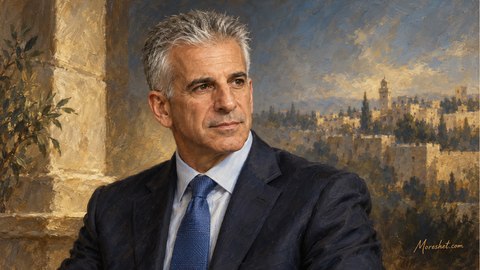
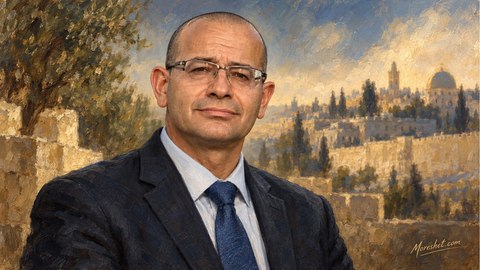
Amos Gilad
A senior Israeli intelligence and defense official who helped shape security policy, strategic assessment and regional coordination
Amos Gilad is a retired Israel Defense Forces major general and one of the prominent Israeli security officials of his generation. Over more than four decades, he held senior positions in Military Intelligence, the IDF Spokesperson’s Unit, the Ministry of Defense and the mechanisms responsible for security and political coordination. His work touched some of Israel’s most sensitive national questions: intelligence warning, the relationship between the military and the public, regional threats, contacts with the Palestinian Authority, negotiations involving Hamas, and efforts to bring captives and hostages home.
Gilad’s importance lies not only in the offices he held, but in the way he connected intelligence, decision-making, public communication and diplomacy. In different capacities, he translated security assessments into practical policy, coordinated among Israeli and foreign institutions, and explained Israel’s positions during periods of war and crisis.
From Kiryat Motzkin to Middle Eastern studies
Gilad was born in Jerusalem to Hava and Yitzhak Gilad. His mother was a Holocaust survivor, while his father immigrated to Mandatory Palestine from Czechoslovakia in 1939. The family lived in Kiryat Motzkin, where Gilad attended the Weinreich High School; his father was a teacher and principal there. This family and historical background formed part of the world from which he entered public service focused on Israel’s security and future.
After high school, he joined the IDF’s academic reserve program and earned a bachelor’s degree in Middle Eastern studies from the University of Haifa. The combination of academic training and long military service provided the foundation for his later work in intelligence analysis, strategic assessment and regional affairs.
Military Intelligence and the Lebanon warning
Gilad enlisted in the IDF in 1972 and served in a series of positions in the Research Division of Military Intelligence. His work involved analyzing regional developments and assessing risks—an occupation that requires separating fragmentary information from a broader strategic picture and presenting that picture to national decision-makers.
During the First Lebanon War, while serving as an Aman representative in Northern Command in 1982–1983, Gilad warned of the possibility that the Phalange militia might carry out a massacre. Following the Sabra and Shatila massacre, he was among the witnesses who appeared before the Kahan Commission, the state commission of inquiry established to examine the events and Israel’s responsibility for them. His testimony became part of the public and professional record of warnings issued in real time and of the difficulty of turning warning into timely military and political action.
According to the biographical material, this period also caused him substantial physical and psychological strain. In 2004, it was reported that he sought recognition from the Ministry of Defense for health damage associated with his service. Beyond the personal dimension, the episode reflects the burden that intelligence and security personnel may carry when they work for years under pressure, uncertainty and grave responsibility.
At the center of Israel’s security and policy establishment
Gilad later served as aide to Azriel Nevo, the military secretary to Prime Minister Yitzhak Shamir, and then as aide to Dani Yatom, the military secretary to Prime Minister Yitzhak Rabin. These positions placed him at the intersection of intelligence, the armed forces, the Prime Minister’s Office and national policy.
In 1994, IDF Chief of Staff Ehud Barak appointed him IDF Spokesperson. In that role, Gilad communicated the army’s activities to the Israeli public and to audiences abroad, at a time when explaining a country’s actions had become an integral part of the security campaign. In 1996, he returned to Military Intelligence and became head of its Research Division, one of the central positions in Israel’s warning and strategic-assessment system.
In 2001, Gilad was promoted to major general and appointed Coordinator of Government Activities in the Territories. The position required daily coordination among Israeli agencies, Palestinian bodies and international organizations, combining security concerns with questions of movement, commerce, civilian life and humanitarian conditions.
In 2002, he was also appointed head of the National Public Information Directorate, established amid concern about possible missile attacks on Israel during the Iraq War. He therefore took part in building a system designed to provide the public with a clear picture of events and prepare it for a developing threat. On March 7, approximately two weeks before the war began, he told Yedioth Ahronoth that the Americans would discover things in Iraq that would “shake the world.” The statement illustrates the way Gilad combined intelligence assessment with the public responsibility of explaining threats.
Regional contacts and the effort to bring captives home
After leaving the IDF in July 2003, Gilad became director of the Defense-Political Branch at the Ministry of Defense, a position he held until March 2017. The branch operates at the intersection of the Ministry of Defense, the Foreign Ministry, the IDF, intelligence agencies and foreign governments. For years, Gilad was one of the most senior and visible Israeli officials working in this arena, dealing with issues in which security and diplomacy could not be separated.
As part of his responsibilities, he was appointed by the prime minister to oversee the issue of Israeli captives and hostages. He was involved in contacts aimed at securing the release of captured IDF soldier Gilad Shalit. Such negotiations require patience, secrecy, close coordination, an understanding of the parties’ motivations and the ability to maintain communication during an active conflict. His role placed him at the center of one of Israel’s most complex national and humanitarian efforts of the period.
Beginning in September 2008, Gilad also served concurrently as acting Coordinator of Government Activities in the Territories, following the retirement of Yosef Mishlev. During this period, he was involved in security contacts and coordination with the Palestinian Authority, in formulating the June 2008 tahdiya arrangement with Hamas in Gaza, and in various aspects of Israeli foreign policy. On November 26, 2009, he was replaced in that role by Eitan Dangot.
Turning accumulated experience into public knowledge
After leaving the Ministry of Defense, Gilad continued to participate in research, teaching and public discussion on security and strategy. He taught at the Interdisciplinary Center Herzliya and, according to the biographical material, headed the Institute for Policy and Strategy and served as chair of the Herzliya Conference. These settings enabled him to pass his experience to students, policy professionals and decision-makers while contributing to broader discussion of Israel’s strategic challenges.
In 2019, journalist Shimon Shiffer conducted a series of conversations with Gilad about his different positions and about a range of Israeli security issues. The conversations were collected in the book Ha-Matri’a—“The One Who Warns”—published in September 2019 by Yedioth Books. The book presents, through a personal and professional lens, the worlds of intelligence, decision-making and threat assessment, making experience normally accumulated behind closed doors accessible to a wider readership.
In 2020, Gilad received the Knight of Quality Government Award in the military and security category from the Movement for Quality Government in Israel. The award represented public recognition of his long service to the state and its security institutions.
Why this legacy belongs in Moreshet
Amos Gilad merits inclusion in Moreshet because his career documents a central chapter in the development of Israel as a Jewish state with sophisticated security, intelligence and diplomatic institutions. He worked in settings where professional judgments could affect human lives, public safety and Israel’s relations with neighboring societies and the international community.
His contribution is especially significant in the connection between intelligence warning and public responsibility: his testimony before the Kahan Commission, his leadership of the Research Division, his work in national public information and his involvement in efforts to secure Gilad Shalit’s release. His career also demonstrates the importance of state institutions and of the professionals who sustain them over time, often far from public view.
The profile on Moreshet.com preserves the memory of a security and public official whose work affected institutions, decision-makers and the lives of Israelis. It gives future generations a way to understand not only the positions he held, but also the responsibility, complexity and human cost involved in serving the State of Israel and the Jewish people.