Amnon Abramovich
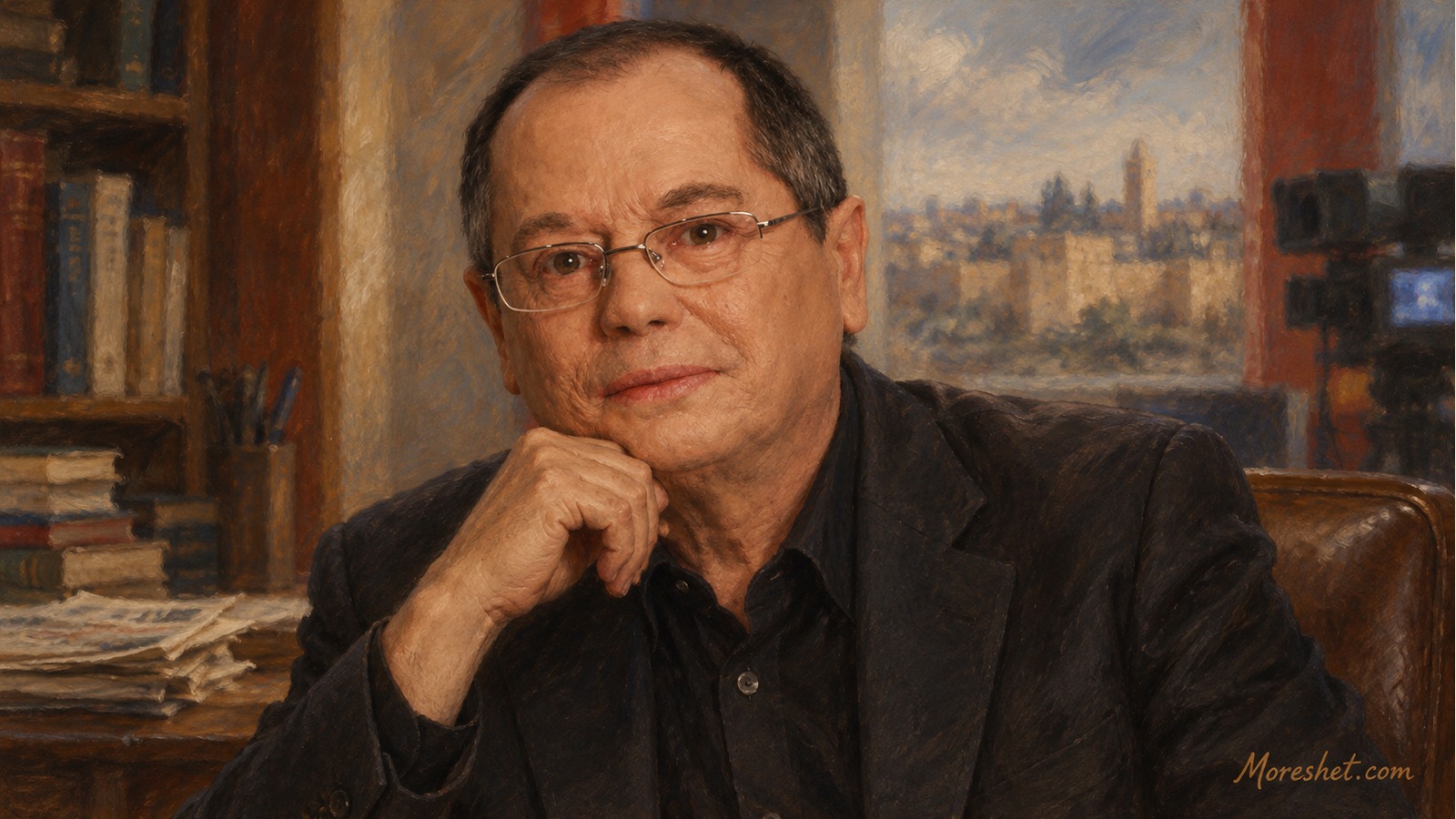
Amnon Abramovich — AI-generated artistic portrait · Moreshet.com
An Israeli journalist and commentator whose reporting and analysis helped shape the country’s public conversation
Amnon Abramovich is an Israeli journalist, publicist and political commentator, and one of the most recognizable figures in Israeli news media since the 1970s. Over a career spanning newspapers and television, he worked as a political correspondent, foreign correspondent, senior commentator and investigative reporter. His subjects have included government, national security, intelligence services, law enforcement, corruption investigations and the relationship between political power and the media.
His life story combines exceptional military courage with professional persistence and a sustained ability to influence the public agenda. Seriously wounded during the Yom Kippur War, he underwent approximately 60 operations before returning to his studies and beginning a new professional path. He later became one of Israel’s most prominent voices in political and security commentary.
From the kibbutz and armored corps to journalism
Abramovich was born on September 15, 1951, at Kibbutz Nir Am to parents who were among the kibbutz’s founders. His family later moved to Kiryat Ata. He enlisted in the Israel Defense Forces in 1969 and served in the Armored Corps. In 1972, he began studying law at Tel Aviv University.
During the Yom Kippur War, he was called up to the reserves and served as the tank driver for the commander of the 409th Battalion in the 600th Brigade, Lieutenant Colonel Uzi Ben-Yitzhak. On October 9, 1973, during fighting near the Suez Canal, the tank was hit and Abramovich was severely wounded in the face and body. Although his hands and clothing were burning, he continued operating the tank because he believed that soldiers remained inside. He received the Chief of Staff Medal of Courage for his devotion to duty and bravery.
After a long rehabilitation that included approximately 60 operations, he returned to law school. He interned at the Tel Aviv District Prosecutor’s Office in criminal law and with a private attorney in civil law, receiving his law license in 1978. This legal background later gave him useful insight into investigations, law enforcement institutions and the workings of government.
Building a career in Israeli journalism
Abramovich began working in journalism while still a student. He joined the editorial board of the university newspaper Yitush and wrote for Yedioth Ahronoth’s weekly supplement Darban. In 1977, he joined Al HaMishmar; the following year he became deputy editor of its supplement Hotem. From 1979, he also contributed to the monthly magazine Monitin.
In 1981, Abramovich moved to Maariv, where he served as political correspondent, the newspaper’s London correspondent and a senior commentator. His work covered domestic politics, foreign policy, security, Israel’s wars and the relationship between elected leaders and the security establishment. According to the supplied biographical material, he published a report in 1984, in deliberately indirect language, about a planned operation against Abu Jihad; the operation was subsequently postponed. He was also among the journalists who reported on Shin Bet involvement in the Kav 300 affair and disclosed information relating to the Jonathan Pollard and Lakam affairs.
In 1994, he left Maariv in protest over the newspaper’s wiretapping affair, in which he himself had been recorded without his knowledge, and became a commentator on Israel’s Channel 1. Since 2003, he has served as a commentator for the Channel 2 news company and later for Channel 12 News, appearing for many years on the regular panel of the Friday program Ulpan Shishi. His sustained television presence helped make political analysis a central part of how large Israeli audiences experienced the news.
Reporting that shaped public debate
Abramovich established his reputation not only through commentary but also through reports that brought new information into the center of public discussion. After the assassination of Yitzhak Rabin, he disclosed testimony connected with Yigal Amir, his brother Hagai Amir and Margalit Har-Shefi, and repeated the report that Avishai Raviv was a Shin Bet agent whose code name was “Champagne.” The episode illustrated the continuing tension between the public’s right to know, journalistic responsibility and national-security restrictions.
In 2006, Abramovich reported on a meeting between President Moshe Katsav and Attorney General Meni Mazuz, during which Katsav raised allegations concerning his former bureau chief. The affair later developed into criminal proceedings that ended with Katsav’s conviction and imprisonment. The report helped place the accountability of senior officeholders at the center of public attention.
In August 2010, Abramovich and fellow journalist Roni Daniel revealed the “Galant Document,” which was investigated as an attempt to discredit Chief of Staff Gabi Ashkenazi amid the struggle over the next chief of staff. The report caused a political and military storm and led to a police investigation. The document was subsequently found to be forged. The affair nevertheless demonstrated the role of political and defense journalists in exposing power struggles behind Israel’s most consequential decisions.
In 2017, Abramovich reported information connected with investigations involving Prime Minister Benjamin Netanyahu, including matters concerning testimony by Ron Lauder and a change in Arnon Milchan’s initial testimony. At the same time, a report he published in December 2012 about an alleged secret rotation agreement between Netanyahu and Avigdor Lieberman proved false. That outcome is an important qualification in any account of his work: investigative journalism based on sources can have major public consequences, and it requires continual verification and accountability.
Commentary, language and political culture
Abramovich’s commentary has generally been associated with the Israeli left and with a critical approach to centers of power. In 1995, an organization petitioned Israel’s Supreme Court, arguing that his political views were evident in his broadcasts and seeking representation for other positions. Following the petition, Channel 1 undertook to provide space for additional perspectives. The episode reflected a broader debate about the boundaries of commentary, the responsibilities of public broadcasting and the meaning of balance in news coverage.
One of the words most closely associated with Abramovich is etrog. During a February 2005 discussion at the Van Leer Jerusalem Institute, he said that Ariel Sharon, then prime minister and the principal political figure behind the disengagement plan, should be protected so that the plan could be completed. His use of the term turned it into a lasting expression in Israeli political and media vocabulary: a description of the claim that journalists or commentators may go easy on a leader whom they regard as essential to advancing a political process. Abramovich therefore left a mark not only as a reporter of events but also as a contributor to the language through which Israelis discuss media, politics and power.
In a 2013 interview, he described two central aims of his journalism as addressing the occupation and its cost, and persuading the public of what he considered important. Even readers who disagree with his political positions can recognize in this statement a clear conception of journalism as more than the transmission of information: it is also an effort to interpret events and place moral and civic questions before Israeli society.
Personal resilience and public presence
Abramovich’s severe wartime injury and his return to professional life after extensive rehabilitation are central to his personal and professional story. They form part of a public image defined by endurance, discipline and a willingness to continue demanding work under difficult circumstances. For decades, he has appeared before Israeli audiences as a commentator with a distinctive voice, accumulated knowledge and a style that has remained difficult to ignore.
He is married to Professor Rachel Tselnik-Abramovich, an emerita professor of classics at Tel Aviv University, and they have two children. He lives in Ramat Hasharon and is known as a supporter of the Maccabi Haifa football club.
Why this legacy belongs in Moreshet
Amnon Abramovich merits inclusion in Moreshet because he worked for decades in the arena where Israelis form their understanding of the state: newspapers, television news and political commentary. He reported on and exposed affairs involving prime ministers, presidents, the military, security services and the justice system, helping bring decisions and struggles that usually remain behind closed doors into public conversation.
His legacy is both personal and professional: extraordinary resilience after a devastating injury, a transition from law to journalism, a career built across print and broadcast media, and an ability to leave a mark on the vocabulary of Israeli political life. For Moreshet.com, Abramovich represents an important chapter in the history of Israeli journalism and in the continuing effort of Jewish and Israeli society to examine its leaders, institutions and decisions through investigative reporting and public interpretation.