Albert Einstein
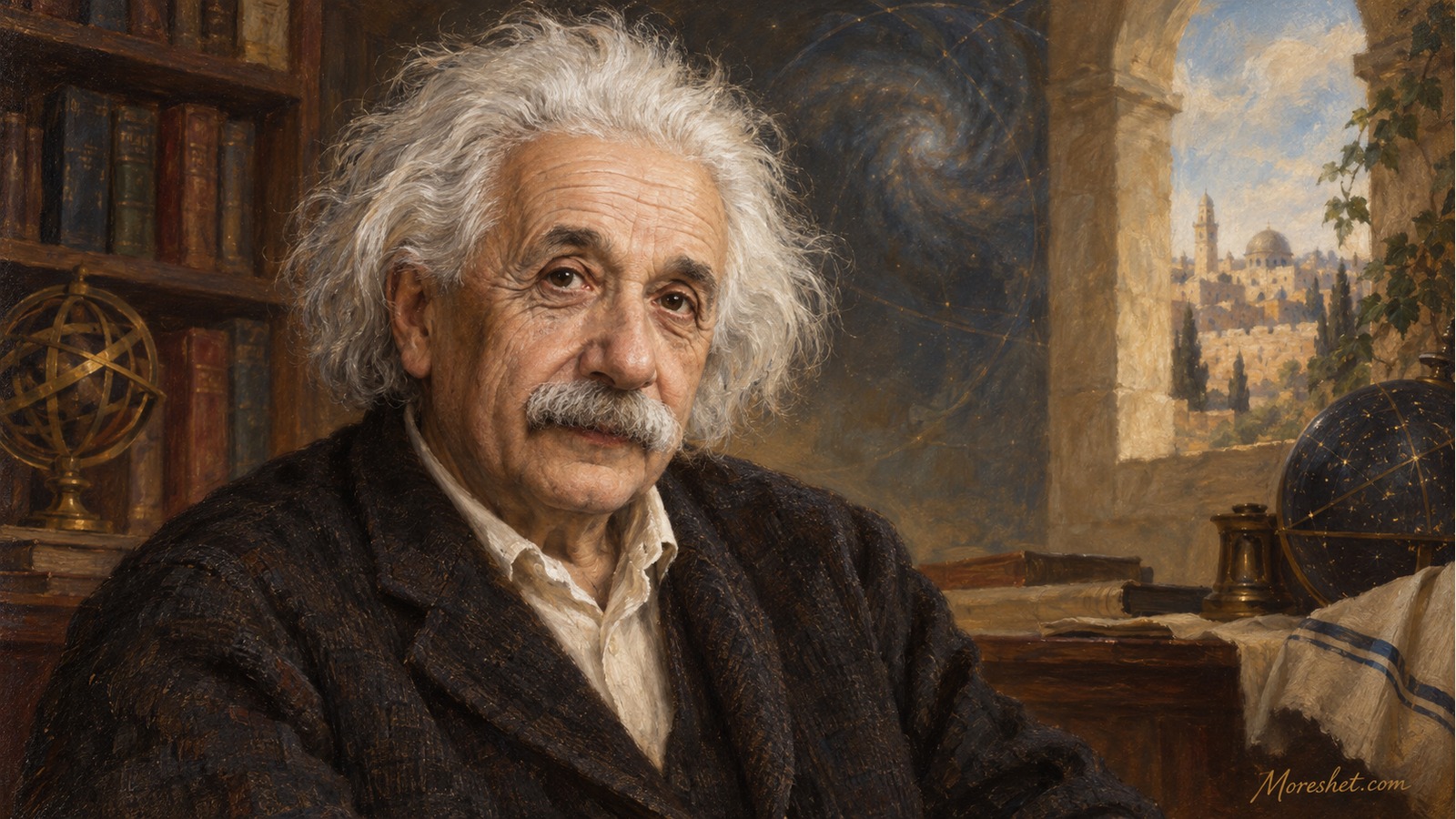
Albert Einstein — AI-generated artistic portrait · Moreshet.com
German-born Jewish theoretical physicist, Nobel Prize laureate, founder of relativity, pioneer of quantum theory, humanist, peace advocate and a defining figure in the scientific and Jewish heritage of the modern world
Albert Einstein was a German-born Jewish-American theoretical physicist and one of the most important scientists in human history. His special and general theories of relativity transformed the understanding of time, space, mass, motion and gravitation; his work on the photoelectric effect became a foundation of quantum theory and earned him the 1921 Nobel Prize in Physics; and his papers of 1905, his annus mirabilis, became cornerstones of modern physics. His name became a global synonym for genius, but his importance is deeper than the popular image. Einstein changed the way humanity thinks about the universe.
For Jewish and Israeli heritage, Einstein is far more than a famous scientist. He lived the 20th century in its full moral force: imperial Germany, Switzerland, the European scientific world of Berlin, the rise of Nazism, Jewish displacement, America, the nuclear age, human rights, a complex but deep relationship with Zionism, and the building of the Hebrew University of Jerusalem. He was not religious in the traditional sense, nor a conventional Jewish nationalist; yet he saw the Jewish people as a historical community of learning, suffering, ethical responsibility and spiritual aspiration. His story therefore belongs both to world science and to a central chapter of modern Jewish heritage.
Jewish childhood in Germany and the awakening of scientific wonder
Einstein was born on March 14, 1879, in Ulm, in the Kingdom of Württemberg in Germany, to a secular Ashkenazi Jewish family. His parents, Hermann Einstein and Pauline Koch, belonged to the German-Jewish bourgeois world in which education, science, music and enterprise were natural parts of culture. Soon after his birth the family moved to Munich, where his father and uncle Jakob worked in the electrical-equipment business.
As a child, Einstein was drawn to simple but mysterious natural phenomena. The famous story of the compass his father gave him when he was ill as a young boy captures the sense of wonder that shaped him: a small needle moving under the influence of an invisible force suggested that hidden laws stood behind the visible world. Before he became a scientist, he was a child asking why the world behaves as it does.
Formal schooling in Germany did not always suit his temperament. He disliked rigid discipline and rote learning, but excelled in mathematics and physics. He taught himself algebra, geometry and calculus, became interested in philosophy, loved music and played the violin. Already in youth, the quality that would define him was visible: the ability to imagine a simple thought experiment, hold it with stubborn clarity and draw from it a conclusion about the structure of reality.
Switzerland, the patent office and the miracle year
Einstein left Germany in his youth and moved to Switzerland. In 1896 he began studying at the Swiss Federal Polytechnic in Zurich, later ETH, in the program for mathematics and physics teaching. He was not a conventional student, but he possessed unusual independence of mind. In Zurich he met Mileva Marić, a Serbian physics student who later became his first wife and the mother of his sons Hans Albert and Eduard.
After graduation he struggled to find an academic post, and in 1902 he began working as a patent examiner in Bern. That job, seemingly peripheral to academic life, gave him time, independence and daily contact with questions of synchronization, signals, electrical devices and measurement. At the same time he and friends formed the Olympia Academy, a small informal circle for discussing science and philosophy.
In 1905 Einstein published four papers that transformed physics. He explained the photoelectric effect through a quantum idea of light; offered an explanation of Brownian motion that strengthened the evidence for atoms; introduced special relativity; and showed the equivalence of mass and energy, later expressed in the famous formula E=mc². In the same year he completed his doctoral dissertation at the University of Zurich. Few single years in the history of science have produced such a deep shift.
Relativity and the transformation of time, space and gravity
Einstein’s special theory of relativity, published in 1905, overturned the assumption that time and space are fixed and absolute frameworks. Instead, he showed that measurements of time and length depend on the motion of the observer, and that the speed of light is a fundamental constant of nature. The idea initially seemed strange, even impossible, but it elegantly resolved the tension between Newtonian mechanics and electromagnetism.
Einstein then devoted years to developing the general theory of relativity, completed in 1915. In it he described gravity not as an ordinary force acting at a distance, but as the curvature of spacetime caused by mass and energy. Bodies are not pulled in the old Newtonian sense; they move along paths determined by the geometry of the universe itself.
In 1919, after Arthur Eddington’s solar-eclipse observations, reports indicated that starlight was indeed deflected near the sun as general relativity predicted. The world press announced a revolution in science, and Einstein became an international public figure almost overnight. He may have been the first modern scientist to become a global cultural icon, someone whose face, name and ideas were known even to people who did not understand his equations.
Quantum theory, photons and the debate over reality
Einstein was one of the founders of quantum thinking, even though he later became one of its most famous critics. In his paper on the photoelectric effect, he argued that light can behave as discrete packets of energy, an idea that anticipated the photon concept and proved crucial to the development of quantum mechanics. It was for this contribution, rather than relativity, that he received the Nobel Prize in Physics.
His quantum contributions did not stop there. He worked on thermal fluctuations, statistical physics, radiation, stimulated emission, the properties of ideal gases and a collaboration with Satyendra Nath Bose that led to Bose–Einstein statistics and the idea of Bose–Einstein condensation. His 1917 paper on stimulated emission became an essential conceptual basis for later developments that led to the laser and maser.
Yet Einstein resisted the view that quantum randomness is fundamental and irreducible. He believed that a deeper physical theory should be able to explain reality in a more complete and deterministic way. His debates with Niels Bohr and the famous paper with Boris Podolsky and Nathan Rosen, known as the EPR paradox, became central to the philosophy of science and the physics of quantum entanglement. Even when his expectations were not accepted by the mainstream, his criticism generated questions that became engines of new research.
Berlin, global fame and the rise of antisemitism
In 1914 Einstein moved to Berlin and joined the Prussian Academy of Sciences. There he reached the height of his scientific status in Europe, but he also lived inside a Germany that was becoming more nationalist, violent and antisemitic. During the First World War he was one of the few prominent German intellectuals to distance himself from militarism. He preserved moral independence even when the academic environment expected full national identification.
In the 1920s Einstein became a symbol of the new science, but also a target of antisemitic attack. Nationalist movements and currents that denounced his work as Jewish physics attacked him and his theories. For antisemites, the success of a Jew in transforming the foundations of science was intolerable. From a Jewish historical perspective, this chapter matters: Einstein was not only a famous Jewish scientist, but a Jew whose genius became both a source of Jewish pride and a target of hatred.
In 1933, when Hitler came to power, Einstein was outside Germany and understood that he could not return. The Nazis confiscated his property, burned his books and stripped him of citizenship. He moved to the United States and joined the Institute for Advanced Study in Princeton, where he remained until his death. This move was part of the broader Jewish flight of minds from Nazi Europe, a Jewish tragedy that also strengthened American science in the 20th century.
Einstein, Zionism and the Hebrew University
Einstein’s relationship with Zionism was deep but not simple. He was not a nationalist in the usual sense, and for many years preferred a vision of a Jewish cultural and spiritual center in the Land of Israel alongside coexistence with Arabs. Yet he understood the Jewish need for security, collective dignity, educational institutions and a spiritual center after generations of persecution. He saw Zionism first as a project of cultural, moral and academic renewal.
Einstein worked alongside Chaim Weizmann to help establish the Hebrew University of Jerusalem. In 1921 he traveled with Weizmann to the United States to raise funds and support for the university, and later served in roles connected with its academic council. To him, a Hebrew university in Jerusalem represented the best of the Jewish contribution to the world: science, free thought, research, education and the placing of knowledge at the service of humanity.
His connection to the Hebrew University was not symbolic only. In his will, Einstein bequeathed his writings, literary estate and intellectual rights to the university. The Albert Einstein Archives in Jerusalem became a central home of his scientific and personal legacy. In this way, one of the greatest scientists in world history made Jerusalem and an Israeli academic institution the permanent home of his intellectual memory.
The State of Israel and the offer of the presidency
Einstein supported the creation of a Jewish national home and eventually supported the State of Israel, even while maintaining complex views about nationalism, Jewish-Arab relations and political morality. He was not a practical statesman, but his voice mattered in the Jewish and international worlds. He spoke about the need to secure the Jewish future, moral responsibility and the danger of national hatred.
After the death of Chaim Weizmann in 1952, Prime Minister David Ben-Gurion offered Einstein the position of second President of Israel. The offer expressed the immense respect of the Jewish people for him and the desire to see in him a symbol of spirit, science and morality. Einstein respectfully declined, feeling that he lacked the skills and experience required for such a public office.
The offer itself matters as much as the refusal. A young state, emerging from the Holocaust and the War of Independence, saw in a Jewish scientist in the diaspora a figure worthy of representing its sovereignty. This revealed Einstein’s unique place in the Jewish imagination: not a military leader, not a politician and not a rabbi, but a person of ideas, science and conscience.
Pacifism, the atomic bomb and the responsibility of the scientist
For many years Einstein described himself as a pacifist and opposed war. The rise of Nazism changed the limits of that position. In 1939, together with Leó Szilárd and at the urging of other refugee scientists, he signed a letter to President Franklin D. Roosevelt warning of the possibility that Nazi Germany might develop nuclear weapons and urging the United States to act. The letter helped draw American attention to the danger, though Einstein himself did not work on the Manhattan Project.
After the atomic bombing of Hiroshima and Nagasaki, Einstein became one of the most prominent voices against the nuclear arms race. He helped found the Emergency Committee of Atomic Scientists and advocated international control, disarmament and public awareness of scientific responsibility. Near the end of his life he also signed the Russell–Einstein Manifesto, warning humanity that in the nuclear age total war could become an existential catastrophe.
This chapter shows one of his most important moral contributions: the scientist is not only a discoverer of natural laws, but a human being living inside society and bearing responsibility for the possible uses of knowledge. Einstein understood that abstract ideas in physics could become enormous political, military and ethical power. His postwar voice was therefore one of warning and responsibility to humanity.
Human rights, racism and humanism
In the United States, Einstein spoke against racism and supported African American civil rights. He joined the NAACP, corresponded with W. E. B. Du Bois, visited Lincoln University, a historically Black college, and described racism as a disease of American society. As a Jew who had experienced antisemitism in Europe, he recognized the connection between prejudice, humiliation, exclusion and violence.
His humanism was not always politically systematic and sometimes provoked controversy. He leaned toward democratic socialism, supported the idea of world government that might prevent wars, opposed militarism and believed that education, science and international cooperation could restrain humanity’s destructive impulses. He was not a professional politician, but he used his prestige to intervene in moral questions he believed were too important to leave to governments alone.
His Judaism was secular, philosophical and humanist. He did not believe in a personal God who intervenes in human affairs, but he spoke of a religious feeling of wonder before the order of the universe. He saw himself as belonging to the Jewish people, identified with its fate and valued its traditions of learning and ethics, while rejecting religious or national superiority. This tension between deep Jewish belonging and human universalism is one of the most fascinating features of his life.
Music, imagination and public personality
Music was an inseparable part of Einstein’s life. He played the violin, especially loved Mozart and Bach, and sometimes described his thinking as connected to music. For him, science and music were not entirely separate worlds: both searched for order, beauty, structure and harmony behind experience.
His public personality combined simplicity, humor, stubbornness and refusal to obey convention. His wild hair, informal clothing and expressive face became a cultural icon. But behind the friendly image stood a complex human being: a man with difficult family relationships, personal conduct that has been historically scrutinized, and political views that often fit neither the right nor the left. His importance does not require turning him into a perfect figure. On the contrary, his historical greatness is clearer when he is seen as a real person, with contradictions, mistakes, depth and vision.
Death and the continuing life of his archive and science
Einstein died in Princeton, New Jersey, on April 18, 1955, at the age of 76. He continued to work, think and write until near the end. His ashes were scattered at an undisclosed location, while his brain was preserved after his death in circumstances that later raised ethical controversy. His public image only grew after his death, and in 1999 Time named him Person of the Century.
His scientific legacy continues to develop. General relativity stands at the foundation of modern cosmology, black-hole research, gravitational lensing, gravitational waves and the understanding of the universe on large scales. His quantum ideas continue to influence the physics of light, matter, information and entanglement. His equations are not only chapters in textbooks; they are part of the intellectual infrastructure of humanity.
His Jewish legacy also continues through the Hebrew University, the Einstein Archives, his writings, his public activism and the memory of a figure who made science an international language. He showed that a Jew could be a citizen of the world without severing his bond with his people, and that loyalty to scientific truth could coexist with deep moral responsibility.
Why this legacy belongs in Moreshet
Albert Einstein merits inclusion in Moreshet because his story connects scientific genius, Jewish identity, displacement from antisemitic Europe, support for academic renewal in Jerusalem, moral responsibility in the nuclear age and universal commitment to human rights. He did not only discover new laws of nature; he changed the social role of the scientist and made the figure of the Jewish scientist a world symbol of thought, conscience and intellectual freedom.
Moreshet.com documents Einstein because Jewish and Israeli heritage includes people whose influence reached the entire world from Jewish roots and from a moral connection to the Jewish people. Albert Einstein’s place in Moreshet rests on his contribution to modern physics, his influence on the Hebrew University, his decision to leave his writings to Jerusalem, his support for cultural Zionism and the State of Israel, and the way his life proved that Jewish heritage can speak in the language of science, humanism and responsibility to all humanity.