Amnon Shashua
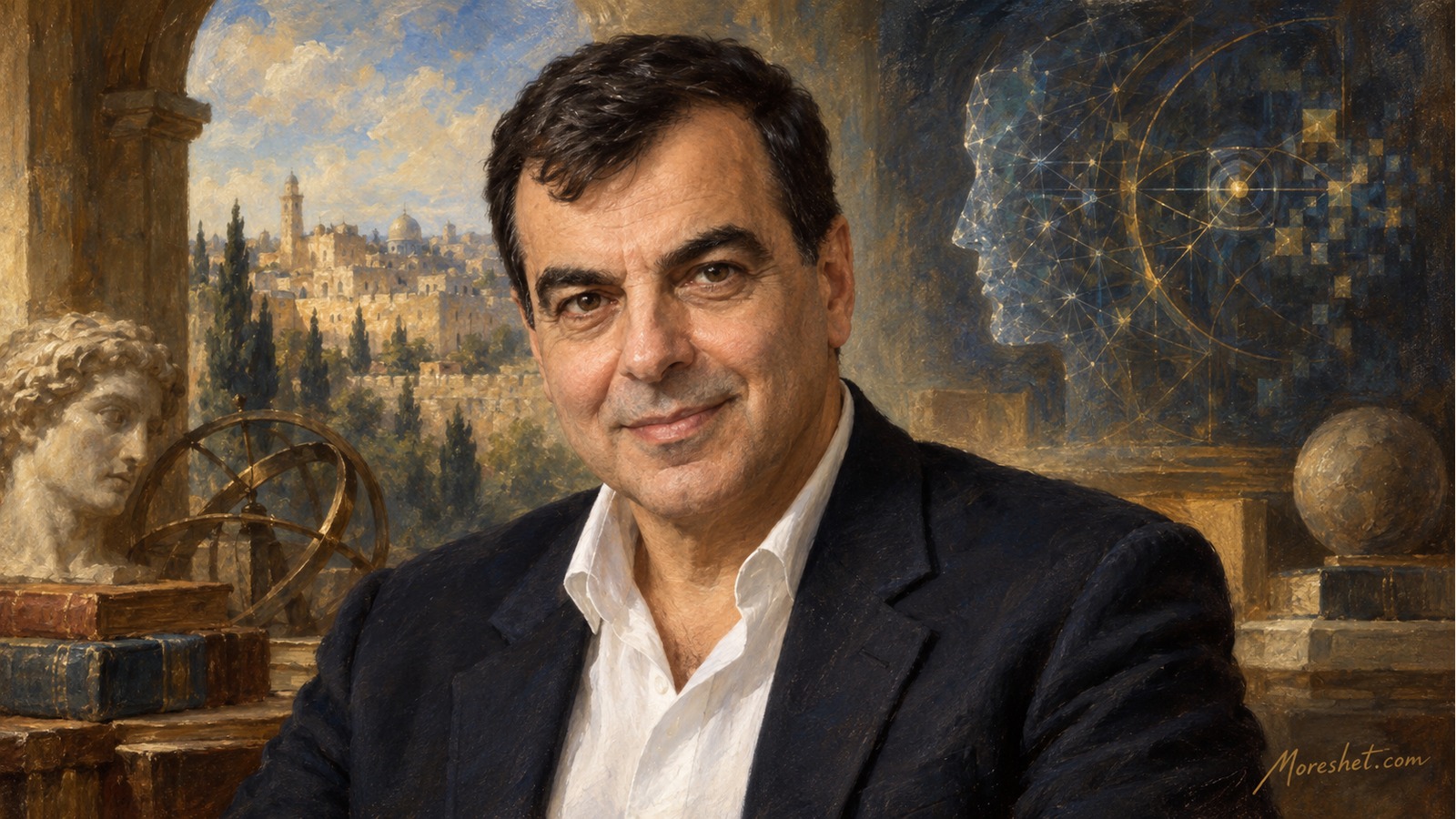
Amnon Shashua — AI-generated artistic portrait · Moreshet.com 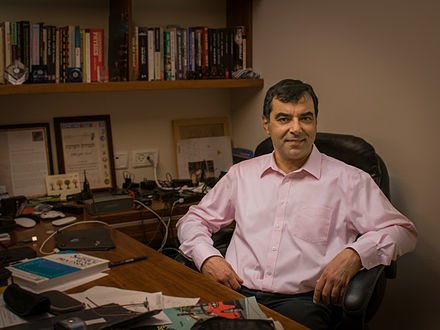
Amnon Shashua — image from the Moreshet archive
Israeli computer scientist, technology entrepreneur and philanthropist whose work turned computer vision into global systems for safety, accessibility and artificial intelligence
Amnon Shashua is an Israeli computer scientist, professor at the Hebrew University of Jerusalem, technology entrepreneur and philanthropist whose career has joined rigorous academic research with products that affect everyday human life. His work in computer vision, machine learning and artificial intelligence stands behind Mobileye, one of the best-known examples of Israel’s contribution to road safety and intelligent mobility; OrCam, which applied artificial vision to assist people who are blind or visually impaired; and additional ventures in digital banking, language models, robotics and physical artificial intelligence.
Shashua’s importance lies not only in the companies he founded, but in the pattern that runs through them: identifying a difficult scientific problem, formulating a computational solution, turning knowledge into a working system, and building organizations capable of bringing that system into the world. In that sense he represents a powerful strand of modern Israeli achievement: mathematics, engineering, entrepreneurial courage, social responsibility and the conviction that advanced technology should serve real human needs.
Education and the formation of a scientific path
Shashua was born on May 26, 1960, in Israel. The supplied biographical material describes him as having grown up in a family of Iraqi origin, studied computer engineering at ORT Technikum, and later served in the Israel Defense Forces as an armored corps officer. His early path already suggested the combination that would define much of his work: formal mathematical thinking joined to practical systems in complex real-world environments.
He earned a B.Sc. in mathematics and computer science from Tel Aviv University in 1985, an M.Sc. from the Weizmann Institute of Science in 1989 under Prof. Shimon Ullman, and a Ph.D. at MIT in 1993 while working in the Artificial Intelligence Laboratory. He then pursued postdoctoral work at MIT’s Center for Biological and Computational Learning under Prof. Tomaso Poggio. This placed him at a crucial intersection of human perception, geometry, learning theory and computer vision.
Academic career: computer vision as a scientific language
After a period at the Technion, Shashua joined the School of Computer Science and Engineering at the Hebrew University of Jerusalem in 1996. He was appointed associate professor in 1999, full professor in 2003, and served as head of the school from 2002 to 2005. Since 2007 he has held the Sachs Chair in Computer Science at the Hebrew University.
His research has addressed foundational problems in computer vision and learning: how a machine can identify objects, infer shape from images, detect salient structures, reason across multiple views, and learn from complex visual data. Topics that can sound abstract — multi-view geometry, tensors, optimization, graphical models and deep networks — became in his work tools for helping machines interpret the visible world rather than merely store images or measure pixels.
The academic significance of Shashua’s work is also visible in its movement beyond papers and conferences. He belongs to a generation of Israeli researchers who demonstrated that computer science research in Jerusalem and Israel could shape global industry, train students and collaborators, and provide the intellectual base for new technological frontiers. In 2026 he was elected an international member of the United States National Academy of Engineering for contributions to computer vision and its application to autonomous driving technology.
Mobileye: from visual research to road safety
In 1999 Shashua co-founded Mobileye with Ziv Aviram. The central idea was that cameras, algorithms and dedicated chips could help a vehicle understand its surroundings: detect lanes, pedestrians, other vehicles and possible dangers, then warn or act in time. At that stage it was both a scientific and an engineering bet, because it was far from obvious that a camera-based system could reach the reliability, cost and scale required by the global automotive industry.
Mobileye’s contribution was to turn computer vision from a laboratory discipline into an industrial safety system. The company developed advanced driver-assistance systems and autonomous-driving technologies, and worked with many car manufacturers to integrate them into vehicles. It helped make the idea of the seeing car — a vehicle able to read the road and its environment — part of the actual future of transportation.
Mobileye went public in New York in 2014 in one of the largest Israeli IPOs of its time. In 2017 Intel acquired the company for approximately $15.3 billion, one of the landmark transactions in Israeli high technology. In 2022 Mobileye was listed again on Nasdaq. Beyond the financial figures, the story matters because a company born from Israeli research became a global center for active safety, driver assistance and autonomous mobility.
In July 2026 Mobileye announced that Shashua had informed the board of his intention to step down as chief executive officer after a successor is appointed. According to the company, he will remain a director, and the board offered him the role of chairman once a new CEO is appointed. That wording matters: the transition was presented as a planned process, not as a completed departure. Even in that transition, Shashua was described as central to Mobileye’s long-term technology direction, especially in advanced AI, autonomous systems and humanoid robotics.
OrCam: artificial vision in the service of people
In 2010 Shashua co-founded OrCam Technologies, again with Ziv Aviram. If Mobileye focused on enabling vehicles to see the road, OrCam sought to put computer vision at the service of people who cannot rely fully on sight. The company’s devices were designed to read text, identify objects and faces, and help people who are blind or visually impaired function with greater independence.
The social meaning of OrCam extends beyond the device itself. It reflects a view of deep technology as something that need not remain in the hands of large industries alone; it can also become an instrument of accessibility, dignity and independence. For an archive of Jewish and Israeli heritage, this is a meaningful part of Shashua’s story: a scientist and entrepreneur applying advanced knowledge not only to a large market, but to a precise and deeply human need.
Further ventures: language, banking, robotics and physical AI
Over the years Shashua expanded his activity beyond the automotive field. AI21 Labs, which he co-founded with Prof. Yoav Shoham and Ori Goshen, operates in the field of language models and enterprise artificial intelligence. In this setting Shashua moved from computer vision to language understanding, while remaining on the same conceptual axis: building computational systems that can interpret, reason and assist people in complex cognitive tasks.
With ONE ZERO, Israel’s digital bank, another side of his entrepreneurship emerged: the use of technology and automation to reshape financial services. According to the bank’s own materials, Shashua is its founder and controlling shareholder. Here too the familiar pattern appears: applying advanced technology to a traditional sector and attempting to build a new infrastructure rather than merely improve an old one.
Through Mentee Robotics and AAI Technologies, Shashua moved into newer areas of artificial intelligence: humanoid robots, expert-based AI systems and physical AI. In January 2026 Mobileye announced an agreement to acquire Mentee Robotics for consideration of up to $900 million, a move intended to broaden the company’s capabilities into physical artificial intelligence — systems that understand context, act in physical space and combine perception, planning and safety.
Social action and philanthropy
Shashua’s biography also includes sustained social and philanthropic activity. The Shashua Family Foundation, which he founded with his wife Anat Ramaty Shashua, works to advance social and economic opportunity in Israel. According to the foundation materials and the supplied research, its activity includes support for underrepresented populations, employment and social integration, assistance to small businesses, education and scholarships.
During the COVID-19 period, the family established the Social Solidarity Foundation and the WE19 initiative, designed to assist small businesses during a time of economic crisis. This activity fits the broader pattern of Shashua’s public life: identifying a systemic problem, building an operating mechanism, and using resources and organization to affect people’s lives in practice.
Recognition and public honors
Shashua has received a series of honors in Israel and abroad. They include the Landau Prize, the Dan David Prize in artificial intelligence, the Automotive Hall of Fame Mobility Innovator Award, the 2023 Israel Prize for lifetime achievement and special contribution to society and the state, and election in 2026 to the United States National Academy of Engineering. In 2017 he was chosen to light a torch at Israel’s Independence Day ceremony.
The importance of these honors is not merely ceremonial. They reflect recognition across three circles of influence: scientific contribution to computer vision and artificial intelligence; industrial and economic contribution through building global Israeli companies; and social contribution through philanthropy and entrepreneurship aimed at widening opportunity and strengthening solidarity.
Israeli, Jewish and global meaning
Amnon Shashua’s story is a distinctly Israeli story of knowledge, daring and connection among university, military service, industry and civil society. It shows how a small country can influence global industries when it cultivates deep science, entrepreneurial initiative and execution capacity. For Israeli society, Mobileye and OrCam became examples of innovation that does not settle for local application, but seeks to set a global standard.
In a broader Jewish sense, his legacy belongs to a tradition of learning, problem-solving, communal responsibility and practical repair. This is not heritage as nostalgia alone, but living heritage: the ability to take abstract intellectual tools and use them to protect people, expand independence, create employment, build institutions and inspire the next generation of scientists and entrepreneurs.
Why this legacy belongs in Moreshet
Amnon Shashua merits inclusion in Moreshet because his life’s work records a contemporary Israeli and Jewish contribution with real-world consequence: academic research that helped make roads safer, assistive technology that expanded independence for people with visual impairments, companies that positioned Israel at the front of artificial intelligence, and philanthropy that addressed opportunity, solidarity and social responsibility. Moreshet.com does not preserve only the distant past; it also records the people who, in our own time, shape what Israeli creativity means in the world. In that sense, Shashua’s legacy is part of the wider story of a people, a state and a community that continue to generate knowledge, institutions and tools whose influence reaches far beyond their borders.