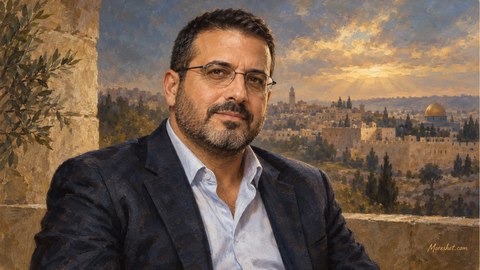
Artiom Dolgopyat
The Israeli gymnast whose Olympic floor-exercise gold became a defining moment in the country’s sporting history
Artiom Olegovich Dolgopyat is an Israeli artistic gymnast, Olympic champion, two-time world silver medalist and European champion on floor exercise. His gold medal at the Tokyo 2020 Olympic Games marked a turning point in Israeli sport: he became the first Israeli to win an Olympic medal in gymnastics and the country’s second Olympic champion. His achievement brought together years of disciplined training, recovery from serious injuries and the experience of a young immigrant who built an international career in Israel.
From Dnipro to Israel
Dolgopyat was born on June 16, 1997, in Dnipropetrovsk—now Dnipro, Ukraine—to Oleg Dolgopyat and Angela Bilan. His paternal grandmother was Jewish, and he has a brother, Maksim. His father had practiced gymnastics in his youth, and Artiom began training at the age of six. Before immigrating to Israel, he won the Ukrainian championship in his age category twice.
In 2009, at the age of 12, Dolgopyat immigrated to Israel with his family, in part because of their financial circumstances. He continued training with the Maccabi Tel Aviv gymnastics club under coach Sergei Weisburg. He attended Shevah Mofet School in Tel Aviv, which serves many immigrants from the former Soviet Union. Hebrew-language difficulties and the demands of elite training eventually led him to leave high school. He completed his military service as an active athlete at the Tel Hashomer base.
His move to Israel was more than a change of address. It required him to adapt to a new language, country and sporting environment while maintaining the demanding routine of an elite gymnast. His path therefore also reflects the experience of young immigrants who seek to build a future and contribute their abilities in Israel.
Establishing himself internationally
At the 2014 Summer Youth Olympic Games in Nanjing, Dolgopyat placed fifth in vault, eighth on floor exercise and tenth in the all-around competition. In 2015, he won gold on floor exercise at the Osijek Grand Prix in Croatia. In Israel, he also won the national floor-exercise title for the first time, taking it from Alex Shatilov, one of the country’s leading gymnasts and a specialist in the event.
His rise included major setbacks. At 14, he broke his leg during a training camp and underwent a lengthy rehabilitation. In late 2016, back pain kept him out of sport for three months. His return to competition after these injuries became part of the foundation of his later success, demonstrating the physical resilience required at the highest level of gymnastics.
World medals and national recognition
At the 2017 World Championships in Montreal, Dolgopyat won silver on floor exercise with a score of 14.533. He became the second Israeli gymnast to win a World Championship medal and the first to win silver. That year he also finished fourth on floor at the European Championships in Cluj, Romania; won silver at the Osijek Grand Prix; and took two gold medals—on floor exercise and pommel horse—along with bronze in vault at the 20th Maccabiah Games, which also served as the Israeli national championships. In December, the Olympic Committee of Israel named him Athlete of the Year at the Israeli Sports Awards ceremony.
At the 2018 European Championships in Glasgow, he qualified first for the floor-exercise final and won silver with a score of 14.466. He added medals at World Challenge Cup events, winning silver in Croatia and Slovenia and gold in Szombathely, Hungary, and Paris. At that year’s World Championships in Doha, he finished fifth on floor exercise with 14.566 points.
In 2019, Dolgopyat consolidated his place among the world’s leading floor specialists. At the World Championships in Stuttgart, he qualified first for the final with 15.033 and won silver in the final with 15.200, just one tenth behind gold medalist Carlos Yulo of the Philippines. At the European Championships in Szczecin, Poland, he again won silver after qualifying first for the floor final. He also collected four World Cup medals that year: gold in Baku, Osijek and Szombathely, and silver in Paris.
European champion and Olympic champion
At the 2020 European Championships in Mersin, Turkey, Dolgopyat won two medals. He took gold on floor exercise with 15.000 points after qualifying second for the final, and won bronze in vault. He became the second Israeli gymnast to win European gold and the first Israeli gymnast to win two medals at the same European Championships.
The defining moment came at the Tokyo 2020 Olympic Games. Dolgopyat competed on pommel horse and floor exercise. He scored 12.766 in the pommel-horse qualification and did not reach the final, but qualified first for the floor-exercise final with 15.200. In the final, he scored 14.933, tying Spain’s Rayderley Zapata. Their execution scores were also identical, so the title was decided by difficulty score, which was higher for Dolgopyat. He won the gold medal, giving Israel its second Olympic gold medal and its first at the Tokyo Games.
The victory was decided by fine margins, but it rested on years of preparation and the ability to perform under extraordinary pressure. Beyond the individual achievement, it raised the profile of gymnastics in Israel and added a new chapter to the country’s history of international sporting accomplishments.
Why Artiom Dolgopyat’s legacy belongs in Moreshet
Artiom Dolgopyat merits inclusion in Moreshet because his athletic accomplishments and personal journey illuminate important aspects of Israeli life. He arrived in Israel as a child, adapted to a new language and society, endured significant injuries and developed into an Olympic champion. His Olympic gold, two World Championship silvers, European title and extensive record in international competitions place him among the most accomplished Israeli gymnasts in the country’s history.
His story also speaks to Jewish and Israeli heritage in a broader sense. It reflects the ability of Israel to welcome young immigrants, develop talent and present that talent on the world stage. For young athletes, immigrants and families, his path offers a concrete example of how identity, perseverance and sustained work can converge in an achievement of national significance. Moreshet, the archive of Jewish and Israeli heritage, preserves such stories because they show how individuals shape the country’s public memory and international image. Moreshet.com therefore gives Dolgopyat’s contribution a meaningful place alongside the people whose lives have influenced Israeli society and its connection to the wider world.