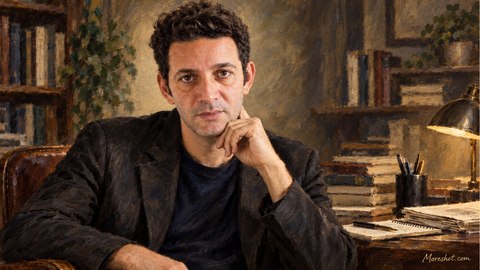
Yossi Melman
Journalist, author and chronicler of Israel’s intelligence community
Yossi Melman is an Israeli journalist, author and documentary creator whose work has made the country’s intelligence, security and foreign-policy history accessible to the public. For decades he has reported on national security, terrorism, espionage, nuclear affairs and international relations, combining investigative journalism with books, legal advocacy, theatre and film. His distinctive contribution has been to examine institutions that operate behind layers of secrecy and explain their significance to Israeli readers and to audiences abroad.
From immigration and military service to journalism
Melman was born in Poland and immigrated to Israel with his family in 1957. As a young man he belonged to the HaShomer HaTzair movement. In 1969 he enlisted in the Israel Defense Forces and volunteered for Sayeret Shaked, a reconnaissance and special-forces unit. He trained as a combat soldier, infantry squad commander, scout and medic, and took part in training and operational activity in the southern command, Sinai, along the Suez Canal, in Jordan, Lebanon and the Gaza Strip.
He studied history and international relations at the Hebrew University of Jerusalem and was a research fellow at Harvard University. After completing his military service, he began his journalism career at Israel’s Army Radio in 1973. He later worked as a reporter and radio broadcaster for Kol Yisrael. In 1980 he joined Haaretz as a correspondent covering military affairs, terrorism and foreign relations. From 1984 to 1988 he was the newspaper’s political and party-affairs correspondent, and he subsequently spent several years reporting from Britain and the United States.
Investigating power and secrecy
Melman became one of Israel’s best-known reporters on intelligence and national security. Over the years he worked for Haaretz, Maariv, Walla! and other outlets, and returned to Haaretz in 2019. His work has gone beyond breaking news. He has assembled documents and sources, reconstructed covert events and asked how security institutions exercise power in a democratic society.
In 1991 he petitioned Israel’s High Court of Justice for permission to publish the Marcus Klingberg affair, whose publication had been blocked by the military censor. The censor subsequently withdrew its objection. Melman was also involved in legal efforts concerning the publication of the names of the heads of the Shin Bet and Mossad, information about the Elhanan Tannenbaum affair and material relating to the submarine INS Dakar. These cases reflected his broader commitment to the public’s right to know and to the principle that national security cannot automatically place every matter beyond public scrutiny.
His investigative reporting brought significant recognition. In 2009 he received the Sokolov Award, Israel’s leading journalism prize, for investigative work and reporting on the security establishment. He received the Simon Rockower Award for Excellence in Jewish Journalism in 1994 and again in 2017, the latter together with Dan Raviv. He was also recognized for international investigative projects concerning terrorism, espionage, arms dealing and the global consequences of security policy.
Books that opened the intelligence world to readers
Melman has written numerous books on terrorism, covert diplomacy, Israeli intelligence, nuclear affairs and Israel’s relationships with the United States and Jordan. His subjects include the Abu Nidal organization, the changing character of Israeli society, espionage cases, the Iranian nuclear program and the history of Israel’s intelligence agencies. Among his major works are The New Israelis, The Spies, written with Eitan Haber, The Nuclear Sphinx of Tehran, written with Meir Javedanfar, and Spies Against Armageddon: Inside Israel’s Secret Wars, written with Dan Raviv.
His English-language book Every Spy a Prince, published in Hebrew as Imperfect Spies and co-written with Dan Raviv, presented the history of Israel’s intelligence community to a broad international readership. It became a New York Times bestseller and helped bring the stories of Israeli intelligence operations, successes and failures into the international conversation. The importance of these books lies not only in their subject matter, but also in their role as public history: they gave readers a framework for understanding how intelligence, diplomacy and security have shaped Israel.
Melman also wrote Autobiography of Running, a personal account of his relationship with endurance sport. In 2006, the Tel Aviv Cameri Theater staged The Good Son, a play he wrote with actor and director Rami Danon. Inspired by the Klingberg affair, the play explores loyalty and betrayal across the competing claims of country, family, science and ideology. It demonstrated his ability to turn a complex security story into an accessible human drama.
From journalism to documentary storytelling
Melman has extended his work into film and television. In 2016 he served as a consultant and participant in Alex Gibney’s documentary Zero Days, about American-Israeli cyberwarfare directed against Iran’s nuclear program. The film won a Peabody Award. In 2017 he was a scriptwriter and one of the creators of the documentary series The Mossad Cover Story, made with director Duki Dror and content editor Chen Shelah. The series traced the history and missions of Mossad and brought a subject usually associated with secrecy to a wide television audience.
In 2022 he co-wrote the script for the French-produced film and series Munich: Of Games and Blood. His documentary work has continued his central project in another form: preserving difficult episodes of Israeli and Jewish history while placing them within a wider moral and political context. By moving between journalism, books, theatre and screen, he has reached readers and viewers who might never encounter a conventional investigative report.
The athlete who founded Israman
Melman is also a long-distance runner and triathlete. Since 1994 he has taken part in dozens of marathons in Israel and abroad, ultramarathons and Ironman competitions. After suffering a heart attack and undergoing cardiac catheterization in 2009, he returned to marathon running. He was the initiator and founder of Israman, Israel’s Ironman competition, and managed it until 2011.
Israman helped develop Israel’s endurance-sport culture and established a major international sporting event in the country. His athletic life also became part of his public work: Autobiography of Running connected physical endurance, recovery and personal discipline with the broader story of his life.
Public relevance and lasting influence
Melman has repeatedly identified stories before they became central to Israeli public debate. In 2001 he reported on Arkady Gaydamak’s involvement in the “Angolagate” affair, years before Gaydamak became a prominent public figure in Israel. His subsequent reporting examined the relationship between wealth, reputation, business interests and public influence. The episode illustrates the way investigative journalism can test public images and bring private power into the public record.
In his “Arms Race” blog, published from 2008 to 2011, he combined writing about security with discussions of society, economics and running. That combination reflects a defining feature of his work: security is not treated as a remote professional sphere, but as a force that affects public spending, foreign relations, institutions and everyday Israeli life.
Why this legacy belongs in Moreshet
Yossi Melman merits inclusion in the archive because he created an extensive public record of one of the least accessible yet most consequential chapters of Israel’s history: the work of its intelligence and security institutions. Through reporting, court petitions, books, plays and documentaries, he shaped how Israelis and international readers understand the relationship between secrecy, security, democracy and historical memory.
His legacy is measured not simply by the number of articles or books he produced. It is visible in the readers who gained access to hidden chapters of Israeli history, in the public debates made possible by his pursuit of transparency, and in the place investigative security journalism occupies in Israel’s civic culture. For these reasons, Yossi Melman belongs in Moreshet and on Moreshet.com: his work preserved, interpreted and opened to public discussion knowledge that continues to influence Israel’s understanding of its institutions, its security history and its place in the wider world.