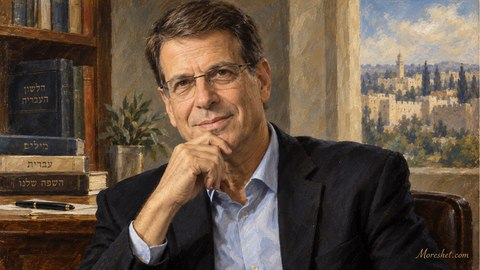
Yitzhak Eitan
The voice of Israel's public broadcasting for more than five decades
Yitzhak Eitan is an Israeli newsreader, radio broadcaster, editor and presenter whose voice accompanied many of the defining moments in the country's history. For decades he was one of the recognizable news voices of Kol Yisrael. Through his broadcasts, cultural programs and training of younger media professionals, he helped shape the experience of Israeli public broadcasting and preserve an important aural record of the country's life.
From Jerusalem neighborhoods to the studio
Eitan was born on September 9, 1945, as Yitzhak Tam, in Jerusalem's Nahlaot neighborhood, and grew up in Nahalat Tzadok. His religious parents were members of Yemenite Jewry who immigrated to Palestine in 1933 from Sana'a in northern Yemen. This Jerusalem and family background formed part of the human and cultural mosaic from which one of Israel's most enduring broadcasting voices emerged.
He began working at Kol Yisrael in 1961, while still a teenager, through the No'ar Oved Ve-Lomed movement. At first he worked as a production assistant on popular programs, in the record library and film library, and in youth radio plays. These early responsibilities introduced him to the many sides of radio: production, editing, music, acting and the disciplined use of the voice.
During his military service he served with Galei Tzahal, the Israel Defense Forces radio station, as a newsreader, editor and presenter. He worked on news bulletins, documentary programs and popular-music broadcasts, developing the professional control and on-air presence that would define his later career.
The voice that delivered the country's news
After his service with Galei Tzahal, Eitan returned to Kol Yisrael as a newsreader. He held that role until his retirement on September 28, 2012, when he presented his final news bulletin and said farewell to listeners. In November 2014 he occasionally returned to present news editions. On May 14, 2017, following the closure of the Israel Broadcasting Authority, he delivered the authority's final news bulletin in his own voice.
Over a long broadcasting career, Eitan reported events central to Israel's national story. He read the bulletin announcing the ceasefire at the end of the War of Attrition in August 1970 and the bulletin announcing the end of the Yom Kippur War. News footage from the period showed soldiers at the front gathering around radio receivers and reacting with excitement to the reports. He also broadcast the news that the Knesset had approved the peace agreement with Egypt and that the signing ceremony was expected to take place in Washington on March 26, 1979. Among the international events he reported was Richard Nixon's election as president of the United States in 1968.
His work involved more than reading prepared text. A public-broadcasting newsreader had to convey information quickly, clearly and responsibly, giving listeners a sense of continuity during war, political change and national crisis. Eitan's voice became part of Israel's collective sound memory, helping shape how generations of citizens experienced and remembered the country's history.
Radio, culture and the Hebrew language
Alongside his news work, Eitan presented news and weekly review programs on Reshet Bet, hosted public events for radio, and appeared in entertainment programs as an actor and impersonator. He also performed artistic readings and presented documentary programs. For two years, every Saturday afternoon, he hosted the Reshet Gimel program “Tziyunei Ha-Derekh.”
Eitan was also active in programs devoted to Hebrew itself. On “Du-Shevuaon La-Lashon Ha-Ivrit,” which he edited and presented, he hosted academics, linguists and language teachers. The program brought questions of language and usage to a broad listening public. For Eitan, broadcasting was therefore not only a way to deliver news but also a public space for strengthening spoken and formal Hebrew.
His connection to Yemenite Jewish heritage also appeared in his cultural work. He wrote Sabbath songs, including songs for the television program “Likrat Shabbat,” broadcast on Channel One on Fridays, and took part in artistic readings from the work of Rabbi Shalom Shabazi, one of the central poets of Yemenite Jewry. This work joined his professional life as a broadcaster with the preservation and presentation of a major Jewish literary and musical tradition.
Training the next generation and continuing to work
Through the Israel Broadcasting Authority's training center, Eitan led workshops in diction, reading and presentation for newsreaders and reporters. His influence therefore extended beyond the broadcasts he personally delivered: he passed practical knowledge to media professionals who later took on roles in Israeli radio and other forms of communication.
Alongside his radio career, he has hosted public and state ceremonies and narrated documentary and promotional films. He has also worked in painting, written songs including children's songs, and practiced graphology. Eitan lives in Mevaseret Zion. He is married to Yardena Shlomi, and they have three sons and six grandchildren.
Why Yitzhak Eitan belongs in Moreshet
Yitzhak Eitan merits inclusion in Moreshet because his more than five decades of work stood at the meeting point of communication, history, culture and language. As a Kol Yisrael newsreader, he brought reports of wars, peace agreements and major Israeli and international developments into homes across the country. As an editor, presenter and host, he extended radio into documentary work, entertainment, music and discussions of Hebrew. As a trainer, he helped younger broadcasters and reporters develop the professional skills required by public media.
His connection to Yemenite Jewish culture, his readings from the work of Rabbi Shalom Shabazi and his Sabbath songs add a further dimension of cultural preservation and transmission. His legacy is not limited to a list of positions. It lives in the voices, texts and memories of listeners who encountered news and culture in Hebrew, and in the professional standards he passed on to colleagues and succeeding generations. For these reasons, and because of his place in the history of Israeli public broadcasting, Moreshet.com preserves his story as part of the living history of Israeli society and Jewish culture in Israel.