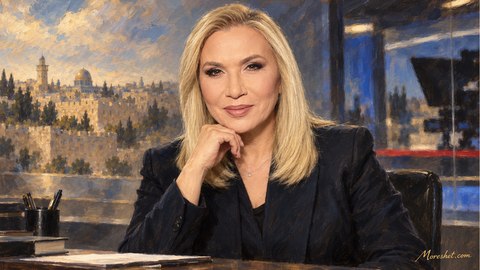
Yael Dan
An Israeli journalist and broadcaster who made interviewing a vehicle for public accountability, social visibility and change
Yael Dan is an Israeli journalist, broadcaster and media personality whose career has stretched across radio, television and public affairs. Her importance lies not only in the number of programs she presented, but in the kind of journalism she practiced. Dan brought direct questions, field reporting and sustained human attention to the center of Israeli broadcasting. Again and again, she used the interview to give visibility to people and subjects that might otherwise have remained outside the public conversation.
From Kibbutz Dan to Galatz
Dan was born on August 27, 1952, as Yael Horowitz, and grew up in Kibbutz Dan in Israel’s Upper Galilee. Her father, Elimelech Horowitz, was a founder of the Beit Usishkin Museum in the kibbutz, an institution devoted to the region’s natural and historical heritage. She was educated in the kibbutz until leaving in 1970 to enlist in the Israel Defense Forces, where she served at Galatz, the IDF radio station.
Galatz provided the starting point for a long career in Israeli media. The station has played an influential role in shaping the country’s journalistic and cultural language, and Dan became one of the broadcasters associated with its ability to combine news, conversation and personal testimony. Although she later worked across many media platforms, radio remained a central part of her professional identity.
A pioneering television journalist
Dan began her television career on Israel’s Channel 1, presenting Observation (Tatzpit). She was among the first presenters of the program to do more than introduce reports prepared by others: she went into the field, produced the reports and then presented them herself. This connection between reporting and presentation gave viewers a direct sense of the journalist’s encounter with reality.
She went on to host Personal Story and Culture Journal on Channel 1. Over the years she also presented magazines and programs on Channel 8 and Educational Television, voiced commercials on commercial television, and hosted programs on the commercial channels, including Private Area, Between the News with Ben Caspit and Emanuel Rosen, and Against All Odds. Her range covered current affairs, culture, personal interviews and social reporting.
Interviews that became public events
Some of Dan’s interviews became landmarks in Israeli media. In 1997, on Personal Story, she conducted an exclusive interview with Uri Zohar, approximately two decades after he had withdrawn from the entertainment world. The encounter allowed viewers to hear from a major cultural figure who had chosen distance from that world, and demonstrated Dan’s ability to create a serious conversation with people who did not readily expose themselves to the media.
On the same program, Dan interviewed Sara Netanyahu, the wife of Prime Minister Benjamin Netanyahu. The interview ended angrily after a series of embarrassing questions, becoming a widely remembered example of the tension between an interviewer’s determination to pursue difficult questions and a public figure’s wish to control the boundaries of exposure. Dan also conducted Channel 1’s first interview with Suha and Yasser Arafat. During the conversation, she calmed their infant daughter—a brief human moment that also reflected the personal attentiveness often visible in her work.
Doing Noon: bringing overlooked voices into public view
Beginning in 1998, Dan hosted the Galatz news magazine Doing Noon (Osim Tzohorayim). The program combined current affairs, interviews and social reporting, becoming a familiar part of the listening routine of Israeli audiences. Dan used the program not only to report events, but also to return to people after the headlines had faded and follow their lives over time.
One of the central subjects she brought forward was the experience of survivors of sexual trauma. By giving survivors a public platform and continuing to accompany their stories, Dan helped turn an often-silenced subject into an issue that demanded public attention. Her work had two dimensions: it offered recognition to people whose experiences had frequently been hidden, and it encouraged institutions and decision-makers to confront the need for prevention, early identification and effective treatment.
Through the program, Dan led the #Hatzilu campaign, which called for a national, multi-year emergency program to protect children who had suffered sexual abuse. The campaign emphasized early detection, prevention of deepening trauma and access to appropriate care. In this way, Dan connected journalism with civic action: broadcasting did not end with telling a story, but sought to influence public priorities and institutional policy.
A practical result associated with this activity was a legislative change approved by the Knesset in November 2018. Initiated and promoted by Dan through the program, the change allows survivors of sexual assault to identify themselves in the media without requiring a judge’s permission. The change has significant human and public importance because it strengthens survivors’ ability to decide whether and how to tell their stories, while removing a legal barrier for those who choose to speak.
The final broadcast of Doing Noon took place on June 30, 2025, after it was decided that the program would end its run that year. Its conclusion marked the close of a long period in which Dan made a regular daytime broadcast into a platform for news, testimony and social questions.
Award recognition and cultural work
In 2019, Dan received the Sokolov Award for Electronic Media as well as a lifetime achievement award. The honors recognized a career spanning decades and combining journalistic professionalism with a sustained commitment to social issues and the public she served.
Dan also appeared in film. She played an interviewer in Giraffes (2001) and portrayed Kochi in Live on Air, a 2009 student film directed by her son Alon Mitlpunkt. These appearances added a cultural dimension to her public identity and reflected the familiarity she had acquired within Israeli society.
Roots, family and the Israeli experience
Dan’s life and career are connected to several institutions that shaped modern Israel: the kibbutz, Galatz, public broadcasting, Educational Television and commercial media. She is married to playwright and theater director Hillel Mittelpunkt. They have two children, including Alon Mittelpunkt, formerly a News 13 journalist, and Maya Mittelpunkt, an actress and voice artist. Dan lives in central Tel Aviv.
Her path—from the Upper Galilee to radio and television studios and then to the center of public debate—also mirrors the development of Israeli media. Her work rests on a clear understanding that journalism is not only the transmission of information. It can create a space in which people are heard, difficult questions are asked and individuals become part of the society’s shared story.
Why this legacy belongs in Moreshet
Yael Dan merits inclusion in Moreshet because she helped shape Israeli journalism and broadcasting while demonstrating how an interview can become an instrument of public responsibility. She was among the presenters who brought field reporting to the television screen, conducted memorable interviews with major public figures and, over many years, gave sustained attention to people whose experiences were often excluded from the mainstream conversation.
Her most consequential legacy can be seen in her work with survivors of sexual trauma. The continuing coverage, the #Hatzilu campaign and the legislative change she advanced illustrate how journalism can affect people’s lives and contribute to institutional change. Dan therefore belongs to the story of Israeli society and the evolution of its public discourse. Moreshet and Moreshet.com preserve this contribution not as a generic story of celebrity, but as the record of a broadcaster whose work left a tangible mark on culture, public institutions and the ability of individuals to tell their own stories.