Uzi Eilam
A commander, scientist and architect of Israel’s defense research establishment
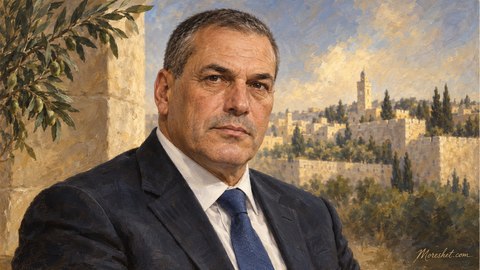
Uzi Eilam, born Uzi Trachtenberg on May 19, 1934, is a retired Israel Defense Forces brigadier general, engineer and senior national security official whose career helped shape Israel’s military and technological capabilities. He commanded paratroopers in formative campaigns, helped establish military research and development frameworks, served as director general of the Israel Atomic Energy Commission, and led Israel’s defense research and development administration for more than a decade. His life links the battlefield experience of Israel’s early years with the scientific and institutional infrastructure that later became central to the country’s technological strength.
From Kibbutz Tel Yosef to the Paratroopers
Eilam grew up on Kibbutz Tel Yosef. After completing secondary school, he entered military service through the Gadna youth corps, trained as an instructor and officer, and volunteered for the paratroopers in 1954. He took part in the Black Arrow reprisal operation in the Gaza Strip, was wounded during the fighting, and received the Chief of Staff’s Commendation for his courage and leadership. The commendation was later converted into the Medal of Courage.
In 1955 he was among the founders of the Paratroop Reconnaissance Unit under Meir Har-Zion. He went on to command a company, serve as intelligence officer of the Paratroop Brigade under Ariel Sharon, and command a company in the Nahal Paratroop Battalion during the Sinai Campaign. These early assignments established the combination of field leadership, operational initiative and technological curiosity that characterized his later public service.
Engineering and Command in a Formative Era
After leaving the IDF in 1957, Eilam earned a degree in mechanical engineering from the Technion and later completed a master’s degree in operations research. He worked as an engineer, taught at the Hebrew University of Jerusalem, and began studying business administration at Stanford University. After returning to Israel, he managed production at the Amanor plant in Beit Shemesh before rejoining the military in armament and technology positions.
During the Six-Day War, Eilam commanded the 71st Battalion of the 55th Paratroop Brigade in the battle for Jerusalem. After the Old City was captured, he was, according to the supplied sources, the first person to blow a shofar at the Western Wall, before Chief Rabbi Shlomo Goren. Beyond this memorable episode, his major contribution in those years was professional and operational: he brought together infantry command experience with a practical understanding of weapons, protection and systems planning.
In 1968, Eilam joined a team headed by Avraham Adan that examined defensive arrangements along the Suez Canal. Representing infantry requirements and technological issues, he helped develop concepts that contributed to the construction of the Bar-Lev Line. He subsequently served as deputy commander and commander of the Jordan Valley Brigade, head of the General Staff Armament Branch, and deputy head of the IDF research and development unit.
Leading Defense Research and Development
Three days before the outbreak of the Yom Kippur War in 1973, Eilam was appointed head of the IDF research and development unit and became a member of the General Staff. During the war he took part in directing the campaign from the General Command Post. After leaving the army, he taught business administration at Tel Aviv University, but his experience as both commander and engineer continued to shape his understanding of the relationship between science, industry, government and national security.
In January 1976, Eilam became director general of the Israel Atomic Energy Commission, serving until 1985. From 1986 to 1997 he was the Ministry of Defense’s chief scientist and director of the Directorate of Research and Development. In that role he oversaw research, development and technological infrastructure, and was responsible for advancing weapons systems and defensive capabilities of importance to Israel. His work involved more than administering individual projects. He operated at the point where scientific ideas become national capabilities, and where cooperation among the IDF, defense institutions, industry and academia produces strategic advantage.
From 1998 to 2001, Eilam headed the Ministry of Defense mission to Western Europe, based in Paris. He also helped strengthen Israel’s technological and security relationships with other countries. His distinctions include a certificate of excellence from Singapore’s Ministry of Defense for contributing to technological ties between Israel and Singapore, the Rabin-Brown Award for contributing to technological relations between Israel and the United States, and the Israel Defense Prize for lifetime achievement in 2002.
Writing, Research and Preserving Experience
After leaving government service, Eilam became a senior researcher at the Institute for National Security Studies at Tel Aviv University. He continued to contribute to professional and public discussion on security, technology, terrorism, Europe, defense exports and Israel’s international partnerships. He also served in public and civic organizations concerned with research and development, missile defense, music and opera.
His 2009 autobiography, Eilam’s Arc: How Israel Became a Military Technology Powerhouse, first published in Hebrew as Keshet Eilam: Ha-Tekhnologia ha-Mitkademet – Sod ha-Otzma ha-Yisraelit, offered an insider’s account of the growth of Israel’s defense research and development establishment. An English translation was published by Sussex Academic Press in 2011. His later books also addressed the Yom Kippur War and security affairs through nonfiction and fiction, including Testimony from the Pit, California Triangle, A Trap in Paris, Singapore under Attack, The Blood Trail, Night Raid, White Smoke at the Vatican and The Dance of the Bees.
The importance of Eilam’s writing extends beyond autobiography. It preserves the perspective of a person who moved between combat units, command centers, laboratories and state institutions, helping readers understand how the human and organizational foundations of Israel’s technological power were built over time.
Why this legacy belongs in Moreshet
Uzi Eilam merits inclusion in Moreshet because he worked at several of the points where Israel’s security, science and technology were shaped: as a paratroop commander in early campaigns, as a participant in the creation of research and development structures, as director general of the Israel Atomic Energy Commission, and as the leader of the defense research and development system during crucial decades. His influence lies not only in the offices he held, but in the systems, professional relationships and culture of innovation that he helped strengthen.
His legacy also consists of transmitting experience. Through his books, research and public work, Eilam made complex chapters in Israel’s security and technological history more accessible to later generations. That is why his story belongs on Moreshet.com: it is part of the broader history of people who built the institutions of the Jewish state, protected its independence and turned scientific and organizational knowledge into a national resource with significance beyond Israel itself.