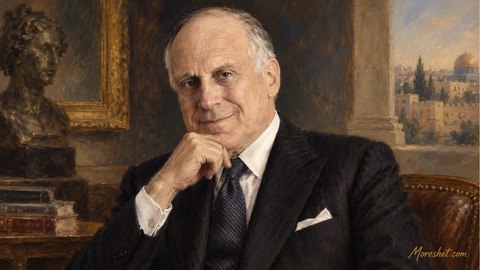
Stan Polovets
A Russian-American business leader and philanthropist who helped shape TNK-BP and built major initiatives for Jewish identity and communal life
Stan Polovets is a Russian-American businessman and philanthropist whose career has connected international energy, investment, consulting and Jewish communal development. He played a central role in creating TNK-BP, one of the largest ventures in the history of Russia’s energy sector, and later devoted much of his work to philanthropic institutions designed to strengthen Jewish identity, education and belonging across the Jewish world.
Polovets’s story links immigration, entrepreneurship and large-scale corporate leadership with the conviction that capital, expertise and organizational experience can serve public and communal purposes. Through the Genesis Prize Foundation, Genesis Philanthropy Group and other initiatives, he helped direct resources and attention toward leaders, organizations and programs that reinforce Jewish life and relationships among Jewish communities in Israel and the Diaspora.
From Moscow to the United States
Polovets was born on June 8, 1963, in Moscow, then part of the Soviet Union. His family immigrated to the United States in 1976, and he became a naturalized American citizen in 1983. His personal experience gave him a direct understanding of migration and of the transition between different cultural, social and economic worlds.
He earned a Bachelor of Science degree from California State University, Northridge, in 1985. He then attended Stanford University, graduating in 1989 with an MBA and a master’s degree. Before graduate school, he worked as an analyst for Exxon, a management consultant at KPMG and a defense analyst at RAND, a public-policy research organization.
Early work in energy and consulting
After Stanford, Polovets joined the global headquarters of Ernst & Young in New York. He was responsible for establishing the firm’s consulting business in the former Soviet Union and Eastern Europe. The assignment placed him at the center of the region’s economic transformation after the collapse of the Soviet Union, connecting Western business expertise with markets and institutions undergoing profound change.
In 1992, he founded RPI, Inc., a communications and consulting firm focused on the Russian energy sector. He served as its chief executive until the company was sold in 1998 and advised the Minister of Oil and Gas of Turkmenistan and the general director of Mazeikiu Nafta, Lithuania’s national oil company. RPI’s two flagship publications, Russian Petroleum Investor and Caspian Investor, examined investment, market and industry developments in Russia and the Caspian region. The publications continued under Thomson Reuters, extending the firm’s professional influence beyond its original ownership.
Building TNK-BP
In 2001, Polovets joined Tyumen Oil Company, known as TNK, as vice president of mergers and acquisitions. In 2002 and 2003, he represented TNK in negotiations that produced a $15 billion merger with BP and created TNK-BP. At the time, the transaction was Russia’s largest corporate deal and the largest foreign investment in a Russian company.
TNK-BP eventually became one of the world’s ten largest non-state oil producers. It controlled more than 18 percent of Russia’s total oil production and operated not only in Russia but also in Ukraine, Brazil, Venezuela and Vietnam. The company was therefore more than a financial transaction: it created a major international business structure linking Russian capital, global management and vast energy resources.
From 2003 to 2006, Polovets held several senior positions in the TNK-BP Group, including senior vice president and chief of staff to the company’s president, Bob Dudley, who later became chief executive of BP. In 2006, Polovets briefly left the group to become first vice president of Uralsib, a major Russian financial institution.
In 2007, he became chief executive of the Alfa-Access-Renova Consortium, or AAR, which owned a 50 percent stake in TNK-BP. In that role, he represented AAR on the company’s board and board committees, as well as on the boards of important subsidiaries and affiliates, including Slavneft and TNK Trading International.
In 2013, as AAR’s chief executive, Polovets was involved in executing the sale of AAR’s 50 percent stake in TNK-BP to Rosneft for $28 billion. BP sold its stake in a parallel transaction. The combined $55 billion sale was described in the supplied material as the largest merger-and-acquisition transaction in Russian history and one of the largest energy deals of its decade. Between 2003 and 2013, AAR shareholders received more than $20 billion in dividends, while the value of their stake increased from $7.5 billion to $28 billion.
International business and academic leadership
After his years at TNK-BP, Polovets continued to work in international investment and corporate leadership. From May 2013 through December 2019, he served as lead non-executive director of L1 Energy, the international investment vehicle of Alfa Group. From 2014 to 2016, he was chairman for Russia and Eastern Europe at Edelman. From 2014 until 2020, he served as a senior adviser to Access Industries, a privately held group with long-term holdings in natural resources, chemicals, media, telecommunications, real estate and other fields. In that capacity, he represented Access as lead non-executive director on the board of Clal Industries, a major Israeli holding company with investments in industrial manufacturing, technology and consumer businesses.
In 2020, Polovets was elected chairman of the board of Anchiano Therapeutics, a NASDAQ-listed biopharmaceutical company. He stepped down in 2021 after the company merged with Israel-based Chemomab Therapeutics. This role reflected his continuing involvement in international investment and in Israeli innovation.
Polovets has been associated with the Council on Foreign Relations, New York University’s President’s Global Council and the Board of Overseers of the NYU Tandon School of Engineering. From 2014 to 2019, he also served on the Board of Overseers of Stanford University’s Hoover Institution. These positions reflect a sustained interest in education, research and international public affairs.
Philanthropy and Jewish identity
Polovets’s most distinctive contribution to Jewish life has been his role in building philanthropic institutions focused on identity, Jewish pride and ties among communities. He is a co-founder and chairman/CEO of the Genesis Prize Foundation. The foundation awards an annual $1 million prize to an exceptional individual whose achievements can inspire and instill a sense of pride in the next generation of Jews.
The prize has a permanent endowment of $100 million and operates as a partnership between the Genesis Prize Foundation and the Jewish Agency for Israel. Its significance extends beyond recognition. Laureates have directed their prize money toward charitable causes, often with additional donations raised to increase the impact. The prize has thus served as a vehicle for philanthropy in areas including education, health, human rights, assistance to Holocaust survivors, culture and community development.
Polovets is also a co-founder and CEO emeritus of Genesis Philanthropy Group. He served as its founding chief executive from its establishment in 2007 until July 2014. The organization maintained offices in Moscow, New York, London and Tel Aviv and became one of the major private foundations working in Jewish philanthropy. Polovets represented the group on the boards of nonprofit organizations it supported, including serving as vice chairman of Hillel Russia.
This work was especially significant because it reached beyond established institutions in Israel and the United States to Jewish communities in the Russian-speaking world. Support for Jewish education, young leadership and communal organizations helps communities preserve language, memory and intergenerational connection while participating in a broader global Jewish network.
Helping children with learning and behavioral difficulties
In 2003, Polovets established, funded and managed the Vnimanie Foundation, a nonprofit organization dedicated to supporting Russian children with learning disabilities and behavioral disorders. The foundation combined his managerial experience with a focused social purpose: providing children, families and professionals with resources and support in areas that frequently receive insufficient attention.
The foundation’s board included prominent public figures, among them former Soviet leader Mikhail Gorbachev. Its executive director was Sergei Filatov, who had previously served as chief of staff to Russian President Boris Yeltsin. This structure brought together private resources, public experience and awareness of a pressing social need, giving the issue a wider public profile.
Why this legacy belongs in Moreshet
Stan Polovets merits inclusion in Moreshet because his work has had a meaningful effect in two spheres. In business, he helped create TNK-BP and execute one of the largest energy transactions in Russian history. In public and Jewish life, he helped build and support institutions advancing identity, education, leadership and philanthropy.
The Genesis Prize Foundation and Genesis Philanthropy Group gave practical form to the idea that Jewish heritage is not only a memory of the past but also a responsibility in the present and an investment in the next generation. His work on behalf of children with learning and behavioral difficulties adds a direct social dimension to his philanthropy. Together, these achievements—entrepreneurship, institutional leadership and support for Jewish communities in Israel and around the world—make his story relevant to Moreshet.com, an archive devoted to people and institutions that have shaped Jewish life, Israeli society and the relationships between them.