Shlomo Nitzan
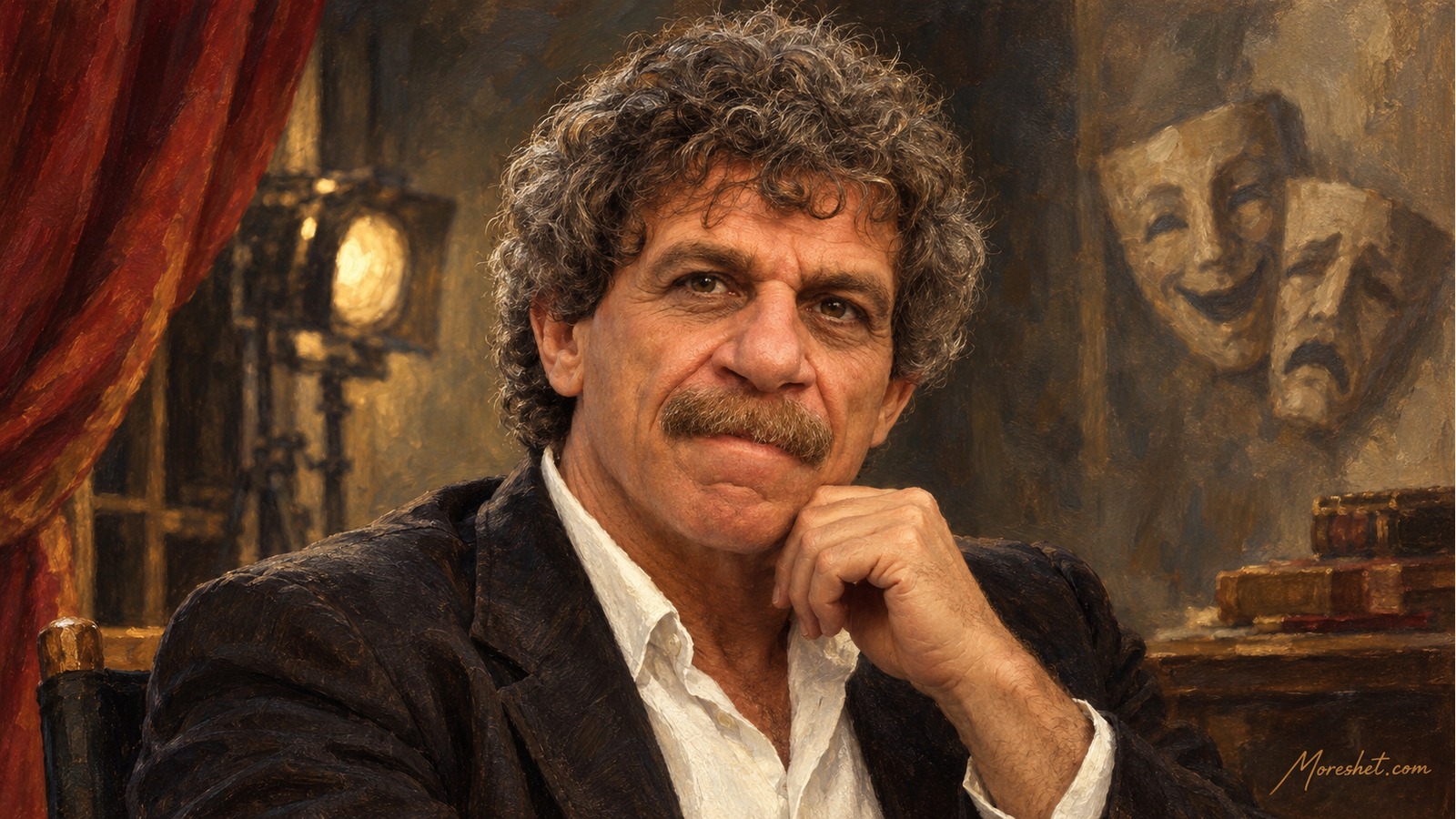
Shlomo Nitzan — AI-generated artistic portrait · Moreshet.com
Israeli actor, singer, entertainer, satirist and radio broadcaster who helped bring Hasidic stories to the modern stage and became a familiar voice in Israeli television, journalism and cultural memory
Shlomo Nitzan, born Shlomo Mintz, is an Israeli actor, singer, entertainer, satirist and radio broadcaster whose career has crossed theater, television, radio and journalism. What makes his work especially distinctive is the connection he repeatedly created between modern Israeli popular culture and the traditional Jewish world he knew from childhood: Hasidic stories and melodies, Hebrew literature, Jewish storytelling, humor and cultural memory.
Nitzan helped initiate Ish Hasid Haya — There Once Was a Hasid — one of the influential stage productions in Israeli Jewish culture; appeared in children’s television programs remembered by generations of Israelis; spent many years writing for the satirical newspaper section Davar Aher, for which he and his colleagues received the Sokolov Prize; delivered satirical commentary on some of Israeli television’s most watched Friday-night entertainment programs; and presented long-running Israel Radio programs devoted to Hebrew song, Jewish stories and current events. Across these different forms he maintained a recognizable voice: humorous, literate, rooted in Jewish tradition and skilled at turning a written text into living performance.
A Haredi childhood in Haifa
Nitzan was born in Haifa on December 22, 1941, as Shlomo Mintz, together with his twin sister Deborah, to Pinhas and Sarah Mintz. He grew up in a Haredi family. His father owned a household-goods shop, and his uncle was Binyamin Mintz, a leader of Poalei Agudat Yisrael who later served as Israel’s Minister of Postal Services.
His education immersed him in Jewish texts and religious life. He studied at Yeshivat HaYishuv HeHadash in Tel Aviv under Rabbi Yehuda Kolodetsky, continued at Yeshivat HaDarom in Rehovot and then spent about a year and a half at the Mercaz HaRav yeshiva in Jerusalem before entering military service.
This background later became one of his most unusual artistic resources. When secular Israeli culture of the 1960s began looking again toward the Jewish world from which parts of the new Hebrew culture had distanced themselves, Nitzan did not have to approach Hasidic tradition as an outsider. He carried songs, stories, humor and ways of speaking from his home and yeshiva years.
From the yeshiva world to the theater
After military service, Nitzan turned to acting. He was among the last students of actor and director Zvi Friedland, an important teacher from the founding generation of Hebrew theater. In the mid-1960s he began performing in productions including Moon of the Twins, Aharon Megged’s Five-Five and The Dybbuk from Neve Sha'anan.
For Nitzan, entering the theater did not require erasing his earlier religious world. He soon began searching for ways to bring the material on which he had grown up into contemporary Israeli performance. That search produced his most important early cultural initiative.
Ish Hasid Haya: a bridge from Hasidic memory to the Israeli stage
In 1968 Nitzan initiated the idea for Ish Hasid Haya at Bimot Theater. Dan Almagor edited and adapted the material, Yosef Yizraeli directed, Yaakov Agmon produced, and the cast included performers such as Hanna Roth, Danny Litani, Lulik, Batya Barak, Deborah Dotan and Nitzan himself. Nitzan’s contribution extended beyond performing. He helped bring into the creative process Hasidic stories, memories and songs that he knew from his religious upbringing, his family and his yeshiva years.
The project was culturally significant. Mainstream secular Israeli culture was still deeply engaged in constructing a new Hebrew identity, and the culture of the Eastern European Jewish town and Hasidic world could easily be treated as something that belonged to a discarded past. Ish Hasid Haya proposed something different: Hasidic tradition could be presented on a modern stage not as museum material, but as living culture filled with music, humor, wisdom and emotional force.
The production became a major success and was performed hundreds of times across Israel. Songs and melodies associated with it, including Avraham'le Melamed, Forest, Forest and A Letter to the Rabbi, became part of Israeli musical memory. The work was also translated into English and reached Broadway, and new Israeli productions revived it decades later. Its continued life is evidence of the durability of the original idea: connecting inherited Jewish culture with contemporary Israeli audiences.
Hasidic and Jewish songs for a new audience
After Ish Hasid Haya, Nitzan continued performing Jewish and Hasidic material and recorded several albums with actress Nira Rabinovitch. These recordings helped move melodies and songs that had traditionally lived mainly within families, synagogues and religious communities into records, radio and mainstream Israeli cultural life.
The significance goes beyond music. Hasidic song carries language, memory, belief, humor and the emotional history of entire Jewish communities. Nitzan was among the performers who could transmit that material to a largely modern Israeli audience without reducing it to caricature and without requiring the audience to be religious in order to understand its emotional power.
Bringing S. Y. Agnon to the stage
Nitzan’s connection to Hebrew and Jewish literature took another important form in 1979, when he and Yitzhak Gormezano Goren adapted S. Y. Agnon’s A Simple Story for the stage at Habima, Israel’s national theater. Adapting Agnon required a particular kind of translation: moving from dense literary prose into spoken dialogue, dramatic rhythm and physical performance.
The adaptation proved durable and was staged again at Haifa Theater in 2009. Nitzan also returned to Agnon as a performer, presenting evenings devoted to readings of the Nobel laureate’s stories in 1988 and 1992.
These projects demonstrate a recurring principle in his career: literature does not have to remain on the page. A story can gain another life when carried by a human voice, timing, humor and theatrical presence.
A familiar figure in Israeli childhood
During the 1970s and 1980s Nitzan became widely known to younger audiences through children’s television programs including Ma Pit'om and Rega im Dudley. In the era before multichannel television, such programs were common experiences for a large part of an Israeli generation, and their performers became part of collective childhood memory.
Nitzan brought to children’s television the same combination found elsewhere in his work: performance, song, storytelling and humor that did not speak down to its audience. At the 1980 Israeli Children’s Song Festival he performed My Family, written by Yoram Taharlev and Nurit Hirsh. The song placed second, and Nitzan also co-hosted the festival with Yardena Arazi and Menachem Einy.
“Nu, what do you say?” — satire at the center of Israeli television
During the 1980s and early 1990s, Nitzan presented a recurring satirical segment on major Israeli television entertainment programs, first on Sha'a Tova, then Siba LaMesiba, and later Sofshavua. These were central Friday-night programs on Israel’s only national television channel during much of that period.
His familiar opening, “Nu, what do you say?”, introduced a format in which he read items from the press and responded with humorous commentary. Politics, bureaucracy, politicians and the week’s absurdities became material for performance. The structure was simple, but it allowed Nitzan to serve as a comic interpreter of Israeli public life.
In 1983 he received the David’s Harp Award in television for his satirical work, recognition of his standing not only as an entertainer but as a distinctive commentator on Israeli current affairs.
Davar Aher and twenty-one years of written satire
Nitzan was also a central member of the team behind Davar Aher, the satirical section that appeared for twenty-one years, first in the newspaper Davar and later in Yedioth Ahronoth. His colleagues included Danny Kerman, Yair Garbuz and Teresa Eisenberg.
Davar Aher occupied an unusual place in Israeli journalism. Week after week it transformed headlines, political personalities, national events and the conventions of newspaper language into parody. Its satire was entertainment, but also civic criticism: a way of returning reality to readers in exaggerated form so they could recognize its absurdities more clearly.
In 1993 Nitzan, Kerman, Garbuz and Eisenberg received the Sokolov Prize for written journalism for their work on Davar Aher. The award formally recognized satire as serious journalistic work with a public contribution.
Israel Radio: Hebrew song, Jewish stories and the week’s events
Radio was one of Nitzan’s longest professional homes. For many years he presented programs on Kol Yisrael, including programs on the history of Hebrew song and on Jewish stories. Until the closure of the Israel Broadcasting Authority in 2017, he also delivered a weekly Friday-afternoon segment on Reshet Bet in which he commented on current events and read prose and poetry.
This work brought together several of his strengths: a recognizable radio voice, literary sensitivity, knowledge of Hebrew song, Jewish cultural memory and comic timing. For listeners, his presence became part of the rhythm of the Israeli weekend.
His programs on Hebrew song also carried an archival function. Public radio can preserve cultural memory by returning older songs and performers to public attention, explaining the people behind a work and placing music within the story of the country. Nitzan participated in that tradition for many years.
The Sholem Aleichem House Prize and cultural recognition
In 1990 Nitzan received the Sholem Aleichem House Prize for his contribution to the stage, culture and the theater of the Land of Israel. The recognition was especially fitting for an artist whose work repeatedly moved between modern performance and Jewish cultural memory.
Together with the David’s Harp Award and the Sokolov Prize, it also demonstrates the breadth of his career. These honors came from television, culture and theater, and journalism — different fields that Nitzan had managed to connect through one recognizable artistic personality.
Tradition without a museum, satire without detachment
One of Nitzan’s most lasting contributions is the way he presented traditional Jewish culture to secular and mixed Israeli audiences. He did not present it only as a past that must be preserved, nor only as a religious system that audiences had to accept or reject. Through Ish Hasid Haya, radio, Agnon readings and Jewish recordings, tradition appeared as living culture: funny, musical, wise and emotionally immediate.
His Haredi upbringing gave this work unusual authenticity. He knew the language from within while spending his adult life at the center of Israeli theater, broadcasting and journalism. That allowed him to mediate between worlds without reducing either one to stereotype.
His satire worked in a comparable way. It did not ask audiences to detach themselves from Israeli society, but to laugh at it from within. Nitzan became, in effect, a storyteller of two interconnected worlds: the Jewish cultural inheritance that preceded the state and the Israeli society that grew around him.
A legacy of voice, story and shared memory
A career spanning theater, singing, television, newspapers and radio can look like a collection of separate jobs. In Nitzan’s case, a clear thread connects them: the power of a story carried by a human voice. Whether the material was a Hasidic tale, an Agnon story, a children’s song, a newspaper headline or a radio monologue, his work repeatedly centered on the moment when text becomes performance.
This gave his career significance beyond entertainment. Ish Hasid Haya returned stories and melodies to the stage; his Agnon work returned prose to the spoken voice and theater; his radio programs connected listeners with Hebrew song and Jewish storytelling; and his satire preserved, in its own way, the political language and public absurdities of several decades of Israeli life.
Why this legacy belongs in Moreshet
Shlomo Nitzan merits inclusion in Moreshet because his career creates an unusually direct bridge between Jewish heritage and Israeli popular culture. He helped initiate Ish Hasid Haya and brought Hasidic stories and melodies from his home and yeshiva background into one of Israeli theater’s enduring works; he adapted and performed S. Y. Agnon; appeared in children’s television and song festivals; became a familiar figure in Israeli satire; and received the Sokolov Prize for his contribution to written journalism.
Moreshet.com documents Shlomo Nitzan because Jewish and Israeli heritage is preserved not only in archives and history books, but also in songs people remember, stories passed between generations, satirical lines that accompany public life and radio voices that give old texts a new life. Nitzan’s place in Moreshet rests on his ability to take inherited Jewish cultural material and give it a modern Israeli voice, while using humor, broadcasting and journalism to record and interpret the society in which he lived.