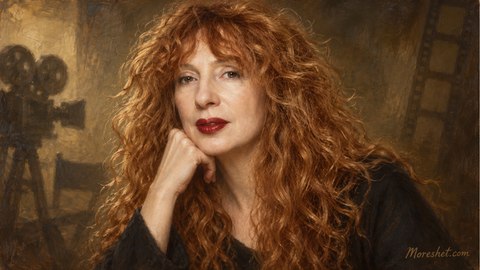
Rivka Michaeli
The actress, comedian, television host and radio broadcaster who helped shape Israeli popular culture for more than six decades
Rivka Michaeli is one of the most recognizable figures in Israeli entertainment. From her childhood in Jerusalem to her work in theater, cinema, television and radio, she has moved confidently between comedy, satire, music, dramatic acting and live hosting. For decades, she was present at the moments when Israelis gathered around a radio or television set, turning her individual talent into part of the country’s shared cultural memory.
Michaeli was born on April 14, 1938, in Jerusalem, during the British Mandate. Her father, Abraham Michaeli, was a lawyer whose family had immigrated to Mandatory Palestine from Georgia in the late nineteenth century. Her mother, Blaha, née Kosovsky, was an eighth-generation native of the country, a member of the Rivlin family and a translator. Michaeli attended the Hebrew University Secondary School. Her Jerusalem upbringing and family background placed her within the many languages, traditions and stories that helped form Hebrew culture.
From Radio to the Stage
Michaeli’s attraction to voice, impersonation and storytelling appeared early. In 1949, at the age of eleven, she began appearing on children’s programs on Kol Yisrael, Israel Radio. After serving in the Israel Defense Forces’ Army Radio, she continued at Kol Yisrael, hosting programs including Home Visit, What We Had There and Apple and Tree. Radio taught her to speak directly to a mass audience, create a character through voice alone and turn the intimacy of broadcasting into a public presence.
At the beginning of the 1960s, director Yosef Milo heard her radio impersonations and invited her to join the Haifa branch of the Theater Club. She took unpaid leave from Kol Yisrael and made the move to the stage. At the club she performed with the women’s quintet HaYechafaniyot, and later appeared in Those Were the Days with Galia and Haim Topol. In 1964 she created the entertainment show A Difficult Childhood with Yossi Banai, beginning an artistic partnership that continued in later performances and songs.
During these years she also hosted beauty-pageant ceremonies and a popular hit parade. According to testimony associated with Naomi Shemer, Michaeli observed that Jerusalem of Gold lacked a reference to the Old City; Shemer subsequently added the second verse beginning, “How the water cisterns have dried, the market square is empty.” As a hit-parade host, Michaeli also popularized the Hebrew word lehit, meaning “hit,” as an alternative to the foreign term schlager. The word entered everyday Hebrew and has since been used far beyond music.
Satire, Music and Cinema
Michaeli never confined herself to a single role. She became a singer and performer of comic songs, a film actress and a host of major cultural events. She appeared in Uri Zohar’s Our Neighborhood and Ephraim Kishon’s successful film Blumilch Canal, followed by roles in Salomonico, What a Wonderful Country, Shlager and King for a Day.
During the 1970s she led solo shows including Desire Notebooks, Overtime and Twenty-Six, performing comic songs such as Yosef John, Rivka John, Twenty-Six and Benjamin Ze’ev. She took part in the first Children’s Song Festival in 1970, placing second with Zvi Has a Problem, and recorded children’s albums in which she sang and played multiple characters, including Yoni Was Sick and Bim Bam Boom. Through these recordings and performances, she reached children not only as a television personality but also through music and characters that remained part of several generations’ childhood memories.
In 1974 she joined the satirical television program Head Cleaning. Her impersonations of Prime Minister Golda Meir and Knesset Speaker Yisrael Yeshayahu demonstrated her ability to combine vocal precision, comic timing and social observation. The program’s popularity established her as one of Israel’s leading comedians and showed how satire could be both widely accessible entertainment and a way of examining leadership, language and everyday life.
Michaeli also hosted the Mizrahi Song Festival from 1971 to 1975 and the Hebrew Song Festival from 1972 to 1980. These positions placed her at the center of major Israeli music events and made her a familiar presence to audiences from different communities. She did more than introduce performers: she helped create the televised ceremony in which songs, artists and the Israeli public met.
The Queen of the Friday-Night Airwaves
During the 1980s and early 1990s, Michaeli became one of Israeli television’s leading hosts. Reason for a Party and Weekend, broadcast on Israel’s sole television channel on Friday evenings, were central entertainment programs for many families. Michaeli could manage a conversation, sustain the rhythm of a live show, move naturally between music and humor, and make guests feel part of an informal encounter. Her impersonations with Tuvia Tzafir and the satirical segment by Shlomo Nitzan became part of the television language of the period.
She also appeared on That’s It!, where she played the radio host “Mrs. Answer” and an occasional caller. She hosted the Israeli Eurovision selection competitions in 1986 and 1988, presented the preschool program Kindergarten Party, and later hosted Blind Date, morning programs and panel shows. Her ability to move between children, families, music audiences and satire was a major source of her public reach.
In 1981 she recorded I Don’t Have a Dull Moment, written and composed by her close friend Naomi Shemer and arranged by Roni Weiss. The song reflected Michaeli’s continuing partnerships with major creators of Hebrew culture. Alongside her work for adults, she continued recording for children; in 1989 she released the video My Cookbook, featuring several other well-known Israeli performers.
From Comedy to Dramatic Acting
In 1992 Michaeli played the mother of a son with AIDS in Amos Guttman’s Amazing Grace. The role marked an important turn in her career. After years in which she was identified primarily with comedy, impersonation and entertainment programs, she demonstrated that she could carry a complex and deeply sensitive dramatic role. The film appeared at international festivals, and the success of her performance broadened the way audiences and directors viewed her as an actress.
She subsequently appeared at the Cameri and Habima theaters in productions including Man Is Man, The Blossoming of Love, A Couple from Heaven, Uncle from Cape Town, Beginner’s Studio, Love Letters, The Strange Case, Netanya and Woman, Owner of a House. She performed in Hanoch Levin’s The Suitcase Packers, Edna Mazya’s The New Criminals, In Miniature at Gesher Theatre and other productions. In 2018 she received the Israeli Theater Award for lifetime achievement.
Her film work continued with appearances in Kadosh, Buzz, Life Is Life, We Must Be Happy, Driver, Dr. Pomerantz and The Property. She won the Ophir Award for Best Supporting Actress for We Must Be Happy. She also became a familiar voice to younger audiences, dubbing Gran in The Croods and Professor Minerva McGonagall in the Harry Potter film series.
A Career That Continued to Renew Itself
Beginning in 2011, Michaeli appeared in the television series Golden Girls alongside Miki Kam, Tiki Dayan and Hanna Laszlo. The series brought an older female character to the center of the screen as funny, commanding and fully present, demonstrating that a long career could continue to evolve with changing audiences, formats and expectations. Michaeli also appeared in Elisha, Where Do You Live?, Miller’s Crossing, Never Too Late, This Is Not the Age, Dad Tries, My Sister Skips a Grade, Shakshuka, Michael and Quarrelsome Childhood.
She continued to work in theater in the later decades of her career. In The Heiress she played Grandma Malka; she appeared in The Pill at Beit Lessin Theatre; and in 2022 she starred in I’m Your Grandma at the Cameri. In 2024 she appeared in Naomi and Norma at the Cameri and played Regina in The Property. She also began hosting the podcast Grandma Types with Ben Sharoni, extending her distinctive voice into a newer medium.
Recognition and Public Engagement
Michaeli has received the Golden Screen Award for lifetime achievement, the Israeli Television Academy Award for lifetime achievement, a lifetime achievement award for her contribution to Israeli radio, the Ophir Award and the Israeli Theater Award for lifetime achievement. In 2014 she was named a Tel Aviv–Jaffa honorary citizen, and in 2011 Ben-Gurion University awarded her an honorary doctorate in recognition of her contribution to Israeli culture. These honors are not merely a list of prizes. Together, they reflect the breadth of her work across several institutions, generations and media.
Michaeli is a member of the public council of B’Tselem. Her public presence has added another dimension to her artistic identity: she has used her voice to address social questions and human rights. Yet the central achievement of her legacy was built through sustained professional work — creating characters, hosting programs, bringing music to broad audiences and helping give many performers and creators a place in the public sphere.
Why Rivka Michaeli Belongs in Moreshet
Rivka Michaeli merits inclusion in Moreshet because her career documents a central chapter in Israeli culture: the transition from early state radio to mass television, and from stage performance and popular song to cinema, theater and digital media. She helped create moments, songs, characters and programs that reached homes throughout Israel, influencing how Israeli audiences laughed, listened, sang and saw themselves.
Her legacy is found not only in awards or in the description “the first lady of Israeli entertainment,” but in her sustained collaboration with writers, composers, performers and theaters, her ability to give emerging talent a public platform, and her example of artistic renewal without losing contact with an audience. For Moreshet.com, Michaeli is an essential figure for understanding the development of Hebrew and Israeli entertainment and for preserving the memory of the artists who shaped the country’s shared cultural imagination.