Rafael Eitan
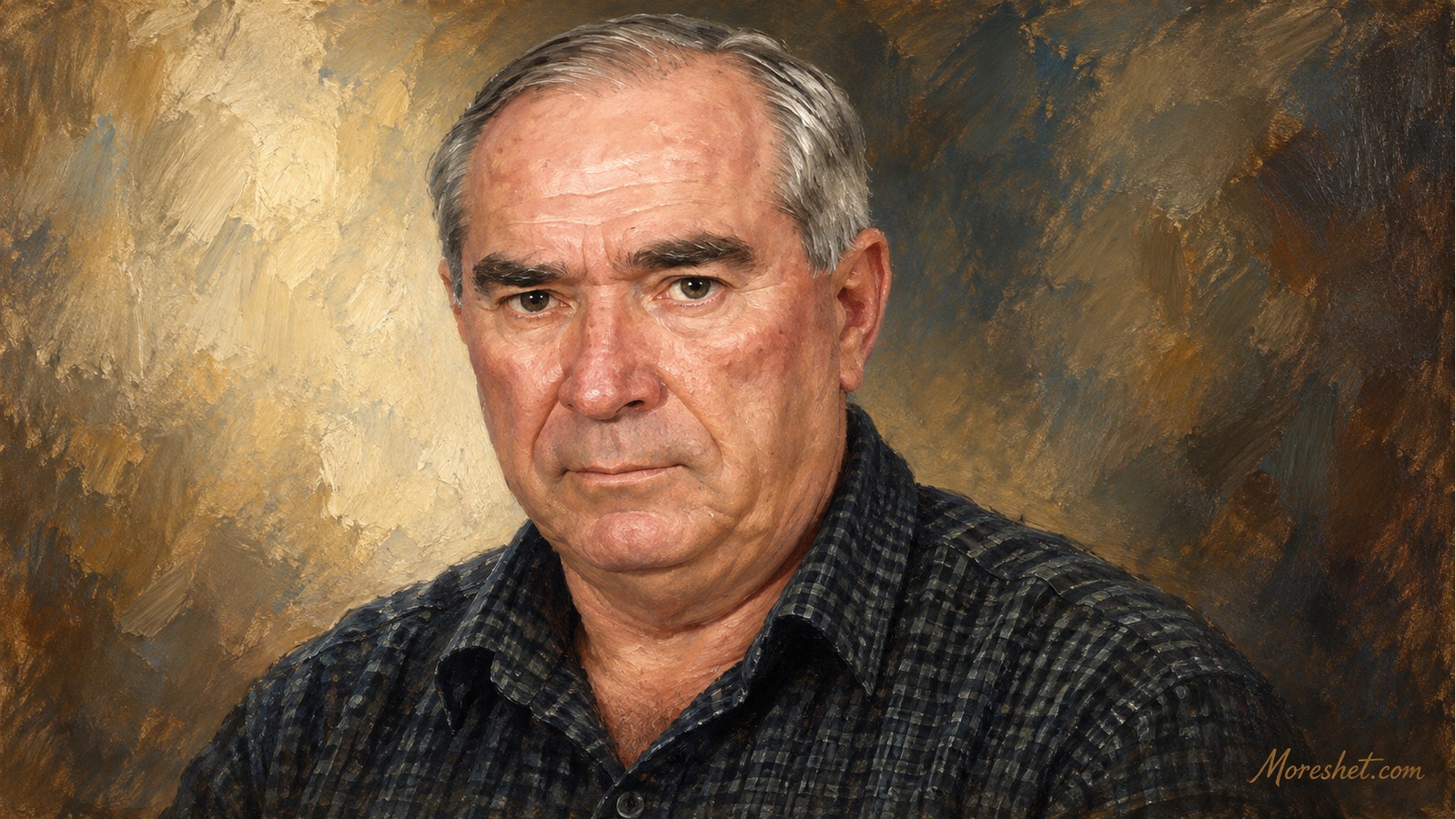
Rafael Eitan — AI-generated artistic portrait · Moreshet.com
Rafael “Raful” Eitan, the 11th Chief of Staff of the Israel Defense Forces, Palmach fighter, paratroop commander, Northern Command chief, founder of major IDF social and technological programs, Knesset member and Israeli minister
Rafael Eitan, known across Israel by the nickname Raful, was the 11th Chief of Staff of the Israel Defense Forces, a Palmach fighter, paratroop commander, head of Northern Command, head of the Operations Directorate, Knesset member, Minister of Agriculture, Minister of the Environment and Deputy Prime Minister. He became one of the Israeli figures most strongly associated with the image of the fighting sabra: a son of Moshav Tel Adashim, farmer, paratrooper, light aircraft pilot, glider, amateur carpenter and soldier known for discipline, blunt speech, personal toughness and a sparse style of command.
Eitan’s life follows major chapters in the history of Israel: the Palmach generation, the War of Independence, the paratroopers of the 1950s, the Six-Day War, the War of Attrition, the Yom Kippur War, the defense of the northern border, the peace treaty with Egypt and the evacuation of Sinai, Operation Opera in Iraq, the First Lebanon War, the transition from military command to politics, the rise of small secular right-wing parties, and Israel’s continuing struggle over security, education, identity, settlement and state responsibility. His figure inspired deep admiration and sharp controversy, but his imprint on the IDF and on Israeli society is unmistakable.
Childhood in Tel Adashim and a family of guards and farmers
Rafael Eitan was born on January 11, 1929, in Moshav Tel Adashim in the Jezreel Valley, as Rafael Kaminsky, the youngest child of Eliyahu Eitan and Miriam née Orlov. His parents were among the founders of the moshav. His father, who immigrated to Palestine from Ukraine, was one of the founders of Hashomer, and the home in which Rafael grew up carried the ethos of labor settlement, self-defense, farming and personal discipline. His mother arrived in the country in the early twentieth century and worked in Sejera, where she met his father.
Contrary to a myth that circulated in Israeli public memory, later genealogical work and testimony indicated that both of his parents were Jewish, rather than descendants of Subbotniks as was sometimes claimed. Eitan himself did not rush to refute the myth, perhaps because it fit his public image as a hard son of the land, close to soil and to the tradition of the guards. In fact, his family belonged to the Zionist labor settlement stream that built the moshavim of the valley.
His childhood in Tel Adashim was tied to work, nature, weapons and discipline. His father raised his children strictly, taught Rafael to shoot at a young age and gave him a sense of personal responsibility and toughness. Raful lived in the moshav for most of his life, and even after reaching the top of the military and political hierarchy he carried the image of the moshavnik: a person of land, labor, repair, tools and outward simplicity.
The Palmach and the War of Independence
In 1946, at the age of seventeen, Eitan joined the Palmach. He trained as a fighter in the Palmach reconnaissance unit of Mishmarot and learned under commanders who influenced him deeply. In 1947 he trained as a squad commander. This period shaped his language of command: knowledge of terrain, initiative, personal example, rapid movement and the willingness to lead from the front.
During the War of Independence he fought in the Harel Brigade and the Fourth Battalion. He took part in battles on the road to Jerusalem, including the Castel, Nabi Samuel and the battle for the San Simon Monastery. At San Simon he was severely wounded in the head, yet continued fighting. That wound, like later wounds in his life, became part of his public image as a fighter who did not withdraw even when injured.
After the first truce he returned to service, completed an officers’ course and became deputy company commander. Already in Israel’s first war he learned the price of combat, the importance of direct leadership and the central place of Jerusalem and the roads to it in the consciousness of the 1948 generation. For him, the army was not an ordinary career path but a natural continuation of settlement, guarding and the fight for statehood.
The paratroopers, reprisal raids and the Medal of Courage
After the War of Independence, Eitan returned to his farm in Tel Adashim, but later resumed regular and reserve service in different roles. In the early 1950s he completed parachute training, learned to fly light aircraft and entered the developing world of the IDF paratroopers. He commanded a company in Battalion 890, met Ariel Sharon and became one of the leading field commanders of the paratroop units in their formative years.
In the raid on the Quntilla police post on October 28, 1955, Eitan charged at the head of his men, climbing a steep cliff under enemy fire and eliminating a firing position that had blocked the force’s advance. For this action he received a Chief of Staff citation, later converted into the Medal of Courage. Shortly afterward, in December 1955, he was badly wounded in Operation Olive Leaves on the eastern shore of the Sea of Galilee, and bullets and fragments were removed from his body in surgery.
In the 1956 Sinai Campaign, Eitan commanded Battalion 890 in the parachute drop east of the Mitla Pass, the first combat parachute drop in IDF history. The drop and the Sinai fighting established his place as a leading paratroop commander. He belonged to the generation of commanders who made the paratroopers a symbol of initiative, daring, mobility and personal leadership.
Paratroop commander, the Six-Day War and the wound in Sinai
After the Sinai Campaign, Eitan continued to rise in the IDF. He studied at the Command and Staff College, served as deputy commander of the Paratroopers Brigade, attended the U.S. Marine Corps Command and Staff School, served as head of the Operations Branch in the General Staff, studied in the first class of Israel’s National Security College, and in May 1964 was appointed commander of the regular Paratroopers Brigade.
Eitan was also a man of gliding and flight. In 1966 he set an Israeli gliding record when he flew from the Megiddo airstrip toward Eilat. His hobbies — flying, gliding, carpentry and agricultural work — reinforced his image as a man of practical skill and action, not only a staff officer.
During the Six-Day War, as a colonel, he commanded the Paratroopers Brigade under Israel Tal’s division in the Rafah salient and the Gaza Strip. During the fighting he learned that his nephew, a company commander in Battalion 890, had been killed. On the fourth day of the war he was severely wounded in the head near Romani in northwestern Sinai. At the hospital in Beersheba, the bullet and fragments that had remained from his War of Independence injury were removed from his head. Even after this wound, he returned to service and to central command roles.
The Jordan Valley, Chief Paratroop Officer and the northern front
After the Six-Day War, Eitan was appointed commander of the Jordan Valley Brigade and led operations in a sector that included pursuits of armed squads infiltrating from across the Jordan River. In March 1968 he commanded a brigade force in the Karameh operation. The valley was then one of the focal points of the struggle against infiltration and terrorism, and Eitan gained experience in pursuit, prevention and continuous activity along a long and complex border.
In June 1968 he became Chief Paratroop Officer, and in January 1969 was promoted to brigadier general when the combined Infantry and Paratroops Command was created. In this role he commanded Operation Gift in December 1968, a raid on Beirut International Airport in which Lebanese civilian aircraft were destroyed. He also took part in the Green Island raid and was sent to examine whether Kurdish fighters in Iraq could expand their struggle from guerrilla warfare to wider operations.
In 1972 he was appointed commander of the 36th Division. When the Yom Kippur War broke out on October 6, 1973, his division moved to the Golan Heights and played a central part in blocking the Syrian attack. The 36th Division focused on the northern sector of the Heights and later participated in the transition to counterattack and the advance into the Syrian salient. After the war, Eitan commanded IDF forces in the war of attrition in the Syrian enclave.
Northern Command, the Good Fence and the Operations Directorate
In October 1973 Eitan was promoted to major general, and in April 1974 he became head of Northern Command. During this period the IDF faced a complex reality on the Lebanese border, against the background of the Lebanese Civil War, PLO activity and Israel’s relations with Christian forces in Lebanon. Eitan was among those who shaped the connection with Christian elements in Lebanon and the creation of the Good Fence, through which aid, medical treatment, limited commerce and civilian and military contacts took place.
At the end of 1976 he secretly met Bachir Gemayel, leader of the Lebanese Phalanges, aboard an Israeli naval missile boat in the Bay of Jounieh. These contacts were part of a broader Israeli effort to create security depth and influence in Lebanon, but they also carried political and moral risks that later became fully apparent.
In August 1977 Eitan was appointed head of the Operations Directorate and deputy chief of staff. In that role he was involved in Operation Litani in 1978, launched after the Coastal Road massacre in order to strike PLO infrastructure in southern Lebanon. Before the operation, he read Haim Nahman Bialik’s poem On the Slaughter to soldiers at an assembly, linking the memory of pogroms with terrorism against Israel. This reflected the way he connected Israeli security with Jewish historical memory.
The 11th Chief of Staff of the IDF
On April 16, 1978, Rafael Eitan was appointed Chief of Staff of the IDF on the recommendation of Defense Minister Ezer Weizman, replacing Mordechai Gur. His term lasted five years and three days, the longest tenure of any IDF chief of staff. From the beginning, he emphasized discipline, austerity, order and efficiency. He ordered soldiers to wear berets on their heads, collect spent cartridges after firing practice, align women’s uniform colors with men’s uniforms and significantly reduce the military entertainment troupes.
These steps were sometimes viewed as small symbols, but for Eitan they expressed a worldview. An army is not only a weapons system; it is a system of habits, order, personal example, responsibility and frugality. Raful believed that everyday discipline produces resilience in war, and that an army still under the heavy shadow of the Yom Kippur War had to return to clear foundations of command.
During his tenure, the IDF continued to operate against militant targets in Lebanon through raids, airstrikes and special operations. As chief of staff, Eitan also commanded the IDF’s redeployment under the peace treaty with Egypt and the return of the Sinai Peninsula, including the evacuation and demolition of Yamit in April 1982. Historically, he was a chief of staff required both to use force in Lebanon and Iraq and to carry out withdrawal and settlement evacuation under a peace agreement.
Raful Youth and the Talpiot program
One of the projects most closely identified with his tenure as chief of staff was the special IDF integration program known publicly as Raful Youth. Under this framework, young people from the margins of Israeli society were drafted into the army in an effort to provide structure, training, discipline, education and a path toward civilian integration. Eitan saw the army as a security institution, but also as a social institution capable of opening a path for young people whom the civilian system had failed.
This project arose from a deep view of the IDF as a melting pot and a school of Israeli citizenship. It was not free of difficulties, criticism or individual failures, but it expressed the belief that even youth pushed to the margins could find in military service a framework of worth, responsibility and progress. To this day the term Raful Youth is associated with the attempt to use military service as a path of social repair.
At the same time, Eitan accepted the proposal of Professor Felix Dothan and Professor Shaul Yatziv to establish the Talpiot program. The program was designed to identify young people with exceptional scientific ability, train them in a combined framework of science, military service and research, and integrate them into IDF research and development units and defense industries. Talpiot became one of Israel’s most important elite programs, connecting security, science, technology and leadership.
Operation Opera and the doctrine of preventing existential threats
In June 1981, during Eitan’s tenure as chief of staff, Israel launched Operation Opera, the airstrike on Iraq’s Osirak nuclear reactor. The operation was approved by the government of Prime Minister Menachem Begin and carried out by the Israeli Air Force. As chief of staff, Eitan was responsible for preparing the military and implementing the operational decision. The strike drew international condemnation at the time, but later became one of the leading symbols of Israel’s security doctrine of preventing declared enemies from acquiring nuclear capability.
The operation took place shortly after the death of Eitan’s son Yoram, an Israeli Air Force pilot killed in a training accident in May 1981, giving this chapter a heavy personal dimension. Eitan continued in his position and national responsibility despite deep family grief. His tough public image often concealed the personal costs that decades of military service imposed on him.
Operation Opera was part of a broader picture of his tenure: a chief of staff willing to use precise long-range force when he identified a strategic threat, but also a commander operating within a political system in which the final decision belonged to the government. This chapter illustrates his place at the junction of military command, intelligence, technology, policy and national responsibility.
The First Lebanon War and Sabra and Shatila
The First Lebanon War was the most difficult and controversial chapter of Eitan’s term as chief of staff. After the attempted assassination of Israel’s ambassador in Britain, Shlomo Argov, in June 1982, and fire from Lebanon toward northern Israel, the IDF launched Operation Peace for Galilee. Its initial goals included pushing the PLO away from the northern border and damaging its infrastructure in Lebanon, but the campaign quickly expanded deep into Lebanon and to Beirut.
Militarily, the IDF achieved significant results, including major damage to Syrian forces in Lebanon and the removal of the PLO from its main bases. Alongside these achievements came failures, casualties, political entanglement and declining public support as the war lengthened. The Battle of Sultan Yacoub, the presence in Beirut and the prolonged stay in Lebanon made the war one of the formative and traumatic events in Israeli society.
In September 1982, Christian Phalangist forces carried out the massacre in the Sabra and Shatila refugee camps after the assassination of Bachir Gemayel. The Kahan Commission found that the IDF was not directly involved in the massacre, but assigned responsibility to Israeli military and political leaders for failing to prevent a foreseeable danger. Regarding Eitan, the commission found that he bore responsibility as military commander, but did not recommend his removal because his term was already near its end. This chapter remains inseparable from any evaluation of his tenure: alongside command and army-building achievements, it raises hard questions of responsibility, judgment and supervision of allies in wartime.
End of military service and entry into politics
On April 19, 1983, Rafael Eitan completed his term as chief of staff. He recommended Avigdor Ben-Gal as his successor, but Moshe Levi was appointed. After retiring, he continued to volunteer for reserve duty as a pilot on liaison and intelligence missions, receiving the representative rank of major. Even after decades of command, his practical connection to flying and field work remained part of his identity.
Soon after leaving the army he entered politics. He was first associated with the Ein Vered circle and with supporters of the Whole Land of Israel in the labor settlement movement, and later founded the Tzomet party. He represented a tough right-wing security and diplomatic line, alongside relatively liberal and secular positions on religion and state, criticism of religious coercion, support for drafting yeshiva students, a desire to simplify bureaucracy, sympathy for market economics and interest in environmental conservation.
His political image rested on the reputation built in the army: honest, tough, simple, unpolished, close to the soil and unafraid of confrontation. His direct style attracted many supporters, but also produced harsh and offensive statements that drew strong criticism. In this sense, Raful the politician was a continuation of Raful the commander: great personal magnetism, uncompromising language and sometimes difficulty separating sharpness from extremity.
Tzomet, the Knesset and government
Eitan was elected to the 11th Knesset on the Tehiya-Tzomet list and later led Tzomet as an independent party. In the 12th Knesset he served as Minister of Agriculture in Yitzhak Shamir’s government from 1990 to 1991. Agriculture suited his public image and life story: a moshav-born worker of the land who saw farming as part of the Zionist foundation of the state.
Before the 1992 election, Tzomet became a party identified almost entirely with him. It won an exceptional eight seats. Many supporters were drawn to his perceived integrity, his record as chief of staff, the educational programs he had advanced in the army, his security positions, his secular state outlook and his desire for electoral reform. Eitan chose not to join Yitzhak Rabin’s government, but his faction later split, and some of its members supported the Rabin government and the Oslo II Accord.
In 1996 Tzomet ran as part of the Likud-Gesher-Tzomet list headed by Benjamin Netanyahu. After Netanyahu’s victory, Eitan was appointed Minister of Agriculture and Minister of the Environment, as well as Deputy Prime Minister. The public security ministry, which had been promised to him, was not given because of a legal investigation concerning political use of information from IDF databases; the proceeding ended without conviction of a criminal offense. His final government term was less influential publicly, and in the 1999 election Tzomet failed to pass the electoral threshold.
Personal life, books and death in Ashdod
In January 1952 Eitan married Miriam, whom he had known since childhood in Tel Adashim. They had five children: Yohanan, who died in childhood from an asthma attack; Yoram, an Israeli Air Force pilot killed in a training accident in 1981; Ruti, Galia and Nurit. In 1996 he divorced Miriam and married Ofra Meirson, director of the Ahava youth village and a left-wing activist. After his death, Meirson described a more vulnerable side of him and argued that behind the tough public image he carried trauma from his military service.
Eitan published books including Raful: A Soldier’s Story, written with Dov Goldstein, The Fourth Parachute Opened, and Building a Port Here: Letters from a Nagging Grandfather. His books and late writing reflected his style: direct, practical, personal and tied to the army, family, work and the building of the country.
On November 23, 2004, Eitan arrived at the Ashdod port, where he worked on the Jubilee Port project and oversaw construction of the breakwater. While inspecting storm damage on the pier, he was apparently struck by a large wave, swept into the sea and drowned. His body was recovered by Israeli Navy personnel. He was buried the next day in Tel Adashim. Questions were later published about the circumstances of his death, but the accepted explanation is that he died in a drowning accident while working at the port.
Commemoration and continuing influence
After his death, several Israeli projects and institutions were named after him. The port where he died was named Eitan Port. A section of Route 60 in the area of Tel Adashim and Nof HaGalil was named for him. The Paratroopers Brigade training base was named Camp Eitan, and schools, streets, the Afula railway station and social initiatives also carry his name.
The Eitan volunteer group of the Maase organization was created as a service track for young people from geographic and social peripheries, in the spirit of Raful’s emphasis on integrating youth into a framework of responsibility, service and contribution. The Raful association initiated scholarships, prizes, a visitors’ site in Tel Adashim and research and educational projects in settlement and security. In Mitzpe Ramon, a pre-military academy bearing his name works with youth from Israel’s socioeconomic periphery.
This commemoration shows that Raful’s memory is not limited to that of a chief of staff or politician. He is also remembered as a symbol of education through service, the connection between army and society, personal responsibility, frugality, physical work, settlement and youth integration. His figure remains complex: admired by many, controversial to others, but impossible to remove from the Israeli story.
Why this legacy belongs in Moreshet
Rafael Eitan merits inclusion in Moreshet because he embodies a central chapter in the security, settlement and social heritage of the State of Israel. He was a Palmach fighter, a War of Independence veteran, one of the outstanding paratroop commanders, a commander on the Golan Heights in the Yom Kippur War, head of Northern Command, the chief of staff who led the IDF through a peace redeployment, a strategic operation in Iraq and war in Lebanon, and a public figure active in agriculture, environment, education and national service.
Moreshet.com documents Eitan because Jewish and Israeli heritage includes difficult, practical and complex figures whose influence is visible in institutions, the army, education and politics. Rafael Eitan’s place in Moreshet rests on the combination of Palmach, paratroopers, military command, responsibility for Israel’s security, social projects such as Raful Youth, the founding of the Talpiot program, public service and a legacy of labor, discipline, land and service. Understanding him helps explain the Israel of the fighting founding generation and its transition from existential struggle to a society confronting power, responsibility, education and memory.