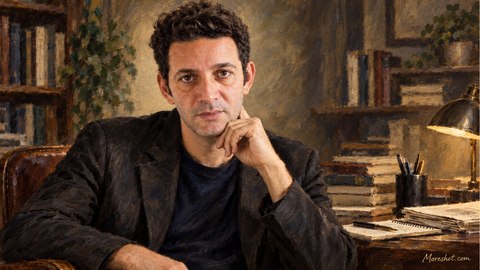
Oded Ben-Ami
Journalist, broadcaster and former IDF Spokesperson who brought national events into human focus
Oded Ben-Ami is an Israeli journalist and media figure whose career has connected military reporting, political communication, public service and television news. For more than five decades, he has worked at points where Israeli society needs reliable information and human explanation: first as a reporter and editor, later as a senior government and military spokesperson, and then as the longtime presenter of the current-affairs program Six with. His distinctive contribution has been to make major national events understandable without losing sight of the people living through them.
From military radio to public journalism
Ben-Ami was born on November 22, 1952, to Shmuel Ben-Ami, who was born in Czechoslovakia, and Shulamit, who was born in Romania. He grew up in Rehovot and studied at the Amos de-Shalit High School. He began his military service in the Artillery Corps, but after his first year transferred in 1971 to Galatz, the Israel Defense Forces radio station.
At Galatz he worked in editing and presenting before becoming the station’s military and security correspondent. He covered that beat during the Yom Kippur War and later continued in the role as a career serviceman. His early experience established the combination of accuracy, speed and contextual judgment that would define his later work in broadcasting and public communication.
Ben-Ami subsequently edited and presented programs on Kol Yisrael and worked as a military correspondent for Israel’s Channel 1. In 1977 he hosted the eighth Mizrahi Song Festival, demonstrating the breadth of his work across news, live broadcasting and Israeli cultural programming.
Political reporting and international perspective
From 1985 to 1989, Ben-Ami was Kol Yisrael’s political correspondent. The position placed him close to the work of government, foreign policy and the decisions that shaped public life. He then served as the Israel Broadcasting Authority’s correspondent in Washington from 1989 to 1992, including during the Gulf War. Reporting from the United States gave him a close view of the strategic and diplomatic relationship between Israel and America during a period of regional crisis.
From 1992 to 1995, he served as communications adviser to Prime Minister and Defense Minister Yitzhak Rabin. Moving from journalism into senior public service allowed him to apply his understanding of both government decision-making and the news media. His role involved helping communicate political and security matters to journalists and the public at a consequential stage in Israel’s history.
IDF Spokesperson at the rank of major general
In 1996, Chief of Staff Amnon Lipkin-Shahak appointed Ben-Ami IDF Spokesperson and awarded him the rank of brigadier general. He served as a member of the IDF General Staff during the first Netanyahu government and the government of Ehud Barak.
The IDF Spokesperson’s office must communicate during military operations and security crises while balancing public accountability with operational needs. Ben-Ami’s background as a military and political reporter, together with his experience in government communications, gave him an unusually broad understanding of that responsibility. His service illustrated the importance of professional communication in the relationship among the army, the government and Israeli society.
Six with and the human dimension of national news
After leaving the IDF in January 2001, Ben-Ami joined Channel 2 News, initially working as a newsreader. From January 2005 he became a regular presenter of the current-affairs program Six with. Over the years, the program became a familiar meeting point for the day’s events: politics and security, social and economic questions, personal stories and decisions affecting ordinary citizens.
His contribution as a presenter goes beyond introducing headlines. He connects public events with the people who experience them, giving viewers a way to understand how a national crisis enters the life of a family, a community or an individual. His interviewing style has made room for facts, accountability and emotion without treating personal pain as merely another news item.
During the Second Lebanon War and the years that followed, he gave sustained attention to Israeli soldiers held captive or missing. Beginning in July 2006, he ended each program by counting the days since the capture of Eldad Regev, Ehud Goldwasser and Gilad Shalit. The recurring count turned the fate of the soldiers and the uncertainty endured by their families into a continuing part of the national conversation.
Among his notable interviews were a conversation with Karnit Goldwasser, the wife of Ehud Goldwasser, about two weeks after his body was returned from Lebanon, and an interview with Yuval Arad, daughter of missing navigator Ron Arad, concerning captive soldier Gilad Shalit. These conversations showed how television journalism can preserve the human meaning of a security story and give families a dignified place in public memory.
Education, public trust and family
Ben-Ami holds bachelor’s and master’s degrees in political science from the University of Haifa. His academic training complements a career that has moved between journalism, government, defense and public communication. In 2009, after Benjamin Netanyahu returned to the office of prime minister, Netanyahu offered him a position as an adviser; Ben-Ami declined and continued his work in journalism.
Ben-Ami is married to the sculptor Orna Ben-Ami and is the father of three children, including journalist and author Yuval Ben-Ami and actress Tamar Livni. His older brother, Haim Ben-Ami, held a senior position in the Ministry of Defense. The family’s connection to art, journalism and public service forms part of the broader cultural setting in which Ben-Ami’s career developed.
In August 2024, Ben-Ami opened one of his programs by thanking U.S. President Joe Biden for his conduct during the Israel–Hamas war. According to the supplied source, Biden subsequently called him, spoke with him at length and thanked him for his remarks. The episode reflected Ben-Ami’s public standing and the way Israeli broadcasting can become a point of contact between Israeli society and leaders abroad.
Why this legacy belongs in Moreshet
Oded Ben-Ami merits inclusion in Moreshet because his work has occupied several of the institutions through which Israelis have understood their own history: military and political reporting, public service, IDF communications and television news. He did not merely observe national events. He helped explain them, placed them in context and created conversations in which officials, families and citizens could encounter one another.
His treatment of the captive and missing soldiers is especially significant. By maintaining a visible, recurring reminder and by interviewing members of affected families, he helped keep their fate in the national consciousness. That work shows how journalism can preserve memory, give people in crisis a public voice and strengthen the connection between state institutions and society.
For Moreshet, Ben-Ami’s career is also a record of Israeli media’s development from radio reporting and public broadcasting to continuous television news. His work gives readers of Moreshet.com a concrete view of how journalism helped shape public understanding, civic memory and the shared language of Israeli life.