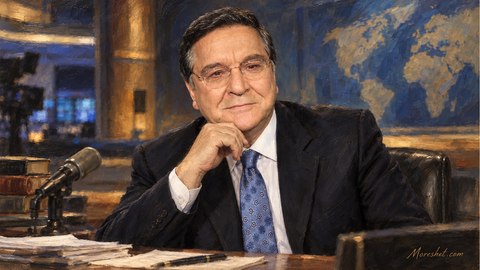
Nissim Meshal
Israeli journalist, broadcaster and influential voice in public affairs
Nissim Meshal is an Israeli journalist, television presenter and radio broadcaster whose career has followed the central developments of Israeli public life for decades. From reporting on political parties and diplomatic affairs to managing Israel Television, helping establish Channel 2 and hosting prominent current-affairs programs, Meshal helped shape how Israelis encountered their leaders, understood national events and discussed the issues defining their society.
From an immigrant childhood to journalism
Meshal was born in Iraq on May 25, 1949, and immigrated to Israel with his family at the age of one. The family lived for eight years in the Talpiot ma'abara, or transit camp. He studied at the Anaf HaHayim school in Jerusalem and at the municipal religious high school in Bnei Brak. His early life reflected the experience of many immigrant families building new lives in Israel, while his later career brought him into the country's most influential public institutions.
After enlisting in the Israel Defense Forces, he volunteered for the Paratroopers and served in the Paratroopers' Nahal unit. He trained as a combat soldier and completed an infantry squad-commanders course. As a reservist, he also fought in the Yom Kippur War. This military experience, together with his personal background, informed a journalistic career repeatedly focused on national security, government and society.
Political reporting and leadership at Israel Television
In 1977, Meshal began working as a political-party correspondent for Israeli Television. He covered the elections for the Ninth Knesset in 1977, the Tenth Knesset in 1981 and the Eleventh Knesset in 1984. Election reporting placed him at the center of the country's democratic conversation, explaining the parties, rivalries and political choices that shaped public life.
In 1984, he edited and produced the current-affairs program Moked. From 1986 to 1989, he served as a Washington correspondent, covering United States–Israel relations, the U.S. presidential election won by George H. W. Bush, the Iran–Contra affair and the Jonathan Pollard case. His reporting connected Israeli audiences with diplomatic and security developments that directly affected the country's international position.
After returning to Israel in 1989, he became director of Israel Television for one year. The position placed him in a key leadership role at the public broadcaster during a period when television was the principal source of national news and public information for much of Israeli society.
Helping establish Channel 2
In 1990, Meshal left the first channel and became one of the senior figures in the directorate responsible for establishing Channel 2. His work there formed part of the transition from a single public television system to a more competitive and varied broadcasting environment. He later moderated televised debates between Yitzhak Shamir and Yitzhak Rabin, and between Benjamin Netanyahu and Yitzhak Mordechai. These debates made direct encounters between political candidates accessible to a mass audience and helped turn televised political confrontation into a defining feature of election coverage.
In 1995, Meshal returned to Israel Television as a political correspondent. He covered major diplomatic and political developments, including secret contacts between Yitzhak Rabin and Syrian President Hafez al-Assad, Israel's diplomatic relations with the United States, implementation of the Oslo Accords, the assassination of Yitzhak Rabin and the formation of Israel's twenty-sixth government under Shimon Peres after the assassination. His reporting documented a period of profound political change and national shock as it unfolded.
Meshal H ot, radio and direct public conversation
Meshal returned to Channel 2 in 1997, where he edited and hosted Meshal Hot and presented Popolitika for a year. The programs combined interviews with figures in the week's headlines, discussions of current affairs, investigative reports, field stories and opinion polls. Their format brought political and social issues into direct conversation with a broad audience, while requiring public figures to answer questions in a highly visible setting.
Meshal Hot returned to the air in December 2008 ahead of the elections for the Eighteenth Knesset, and another season began in October 2012. One particularly remembered interview featured Naftali Bennett and addressed his attitude toward refusal of orders. The broader importance of the program lay in the platform it created for debates and questions that affected the country's political life and public discourse.
Alongside his television work, Meshal hosted the daily radio program Meshal Al HaBoker for many years on Radio Without a Break, broadcasting each day at 9:00 a.m. In May 2018, he moved from a daily program to a weekly Friday broadcast on the same station. His movement between television and radio enabled him to remain in sustained contact with different audiences and to follow Israel's public agenda across the day and the week.
Why this legacy belongs in Moreshet
Nissim Meshal merits inclusion in Moreshet because his work occupies an important place in the history of Israeli journalism and broadcasting. He covered elections, diplomacy and national security; led Israel Television; participated in the establishment of Channel 2; and hosted programs that made political and public debate part of everyday life for large Israeli audiences.
The significance of his career lies not only in the positions he held, but in the people and events he brought before the public. Through reporting, interviews, televised debates and current-affairs programs, he documented decisive periods in Israel's history and created forums in which leaders and public figures had to address society directly. Moreshet.com therefore preserves both the personal story of an immigrant from Iraq and a valuable chapter in the development of Israeli television, radio and journalism.