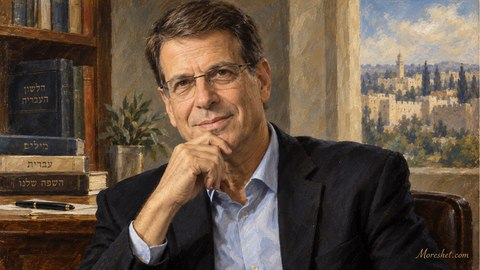
Moshe Chovav
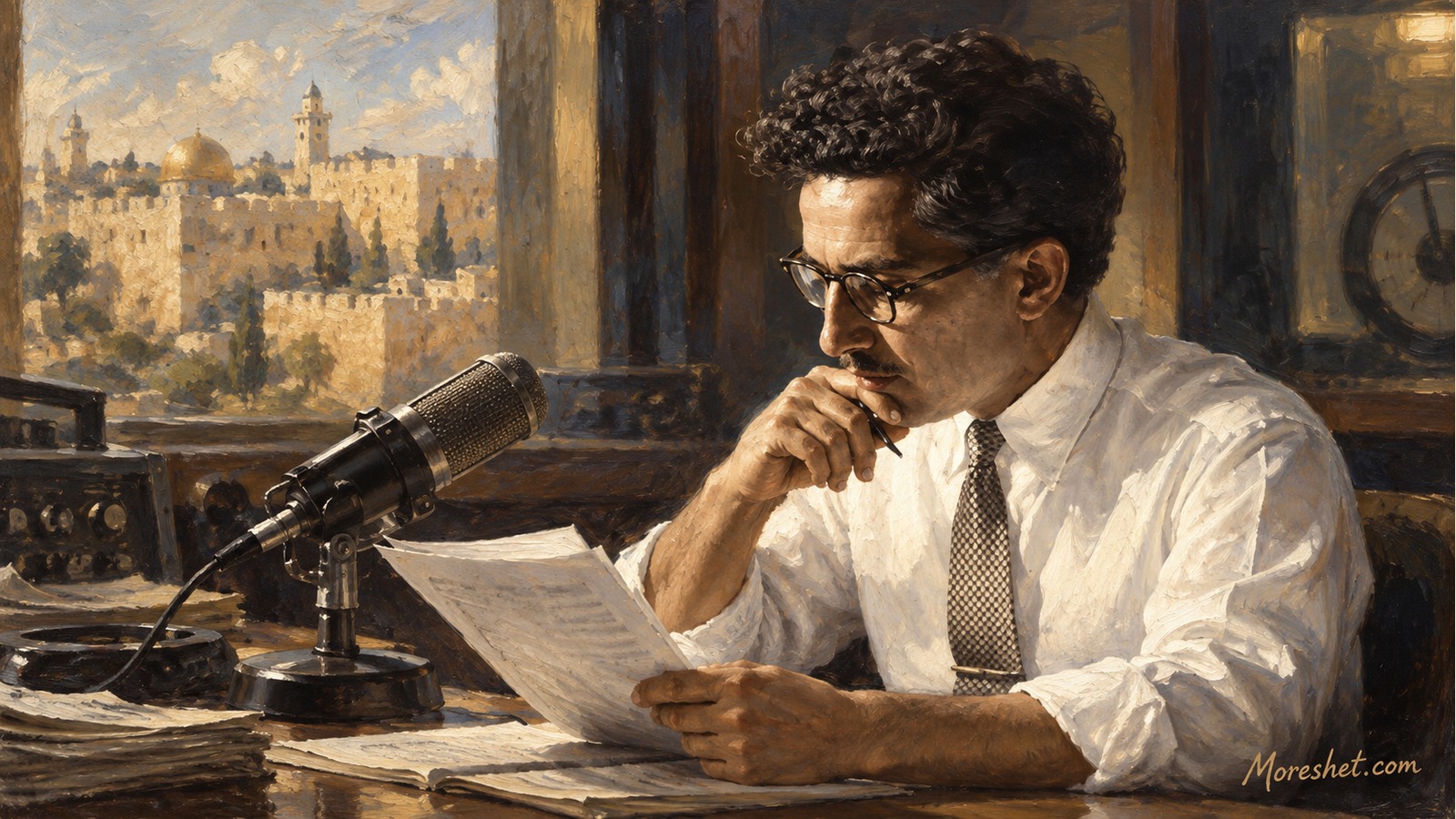
Moshe Chovav — AI-generated artistic portrait · Moreshet.com
The voice of Israeli radio and a pioneer of Hebrew news broadcasting
Moshe Chovav was one of the defining voices in the history of Israeli radio. For decades, he was among the best-known news announcers of Kol Yisrael, a professional manager and a leader in public broadcasting, helping shape the way Hebrew sounded in the young State of Israel. His deep voice, precise pronunciation and command of the guttural consonants made him a model of Hebrew broadcasting.
Jerusalem roots, education and public service
Chovav was born in Jerusalem on February 7, 1930, to Mazal and Haim Mahabub, in a family of seven children. The Mahabub family had immigrated from Yemen in the late nineteenth century. His father was a scribe of sacred texts and a cantor, while his mother worked in domestic service at the Hebrew Gymnasium and insisted on maintaining a Hebrew-speaking home. This family background joined Jewish tradition, living Hebrew and the sense of public purpose characteristic of Jerusalem during the Yishuv period.
The family lived in a one-room apartment in Jerusalem's Bukharim neighborhood. Chovav attended a religious school and served as a counselor in the Bnei Akiva youth movement. After high school, he completed an accelerated teacher-training program. As part of a year of service with the Palmach, he taught at an elementary school in Hadera. Together with his older sister, Rauma, he joined the Haganah, and during the War of Independence he fought in Jerusalem with the Yonatan Company.
The voice that became a symbol of Kol Yisrael
In 1951, Chovav began working at Kol Yisrael. At the time, the station held auditions for announcers to read the daily biblical passages. His older sister Rauma Eldar, who had worked as a Kol Yisrael announcer since 1948, encouraged him to audition. He passed successfully and joined the announcing staff.
Chovav's contribution went beyond his own broadcasts. In 1956, he became head of the Jerusalem announcers' department. Over the course of his career, he also served as head of Kol Yisrael's announcers' department, head of its operations division and, ultimately, director of Kol Yisrael. He therefore helped not only to present broadcasts but also to establish professional standards for a public broadcasting service at a time when radio was the central mass medium in Israeli society.
His dramatic voice and exact pronunciation gave his words unusual authority. He was chosen to read news bulletins of special national importance, including announcements of the deaths of national leaders. For many listeners, his voice became part of the collective memory of decisive moments in Israel's history: a voice that brought the news into the home while giving it a clear, restrained and dignified Hebrew form.
Professional pioneering in radio and television
In the early 1960s, Chovav traveled abroad at his own expense for professional training in television, which had not yet begun broadcasting in Israel. Shortly after Israeli television was established in 1968, he was invited to create the new station's production services. After several months, he returned to radio, having found that the new medium was not his natural professional home. The assignment nevertheless reflected the trust placed in him to help build emerging broadcasting systems.
In 1978, Chovav ended his tenure as director of radio, but continued to present the Friday evening news and the opening bulletin after the Sabbath. During this period, he was also appointed responsible for broadcasts abroad on behalf of the Jewish Agency. That role extended his reach beyond Israeli listeners to Jewish communities around the world seeking to remain connected to Israel, the Hebrew language and Israeli society.
Family, culture and continuity
Early in his career at Kol Yisrael, Chovav met Drora Ben-Avie, who worked in the radio record library. Drora was the daughter of Itamar Ben-Avi and the granddaughter of Eliezer Ben-Yehuda, the reviver of the Hebrew language; the two later married. They had two sons, including journalist and food writer Gil Hovav and Itamar Chovav, owner of the record company IMP. Chovav's older sister, Rauma Eldar, was also a well-known announcer, and his niece Hadassah's daughter is singer Daphna Armoni.
Drora Ben-Avie died at the end of 1981. Around 1982, Chovav married Hana, a Danish citizen whom he met in Jerusalem. The couple went to Scandinavia on an emissary assignment for the Jewish National Fund and lived in Copenhagen. In 1987, Chovav underwent heart surgery in Israel. He died of a heart attack in Copenhagen on the eve of Yom Kippur 5748, October 2, 1987, after flying from Israel. He was 57 and was buried on Har HaMenuhot beside his first wife.
A legacy that continues in sound
Moshe Chovav's influence did not end with his death. More than three decades later, his recorded voice still opens the morning broadcasts of Kan Bet with verses from the Shema. The continuing use of that recording connects ancient Jewish tradition, the Hebrew language and contemporary public broadcasting. Streets in Jerusalem's Ramat Beit HaKerem neighborhood and in Beersheba have been named after him.
The importance of Chovav's legacy lies in the rare combination of media professionalism and cultural and national service. He helped establish Hebrew announcing as a profession governed by standards of pronunciation, rhythm, clarity and public responsibility. Through his voice, news, biblical passages and moments of national remembrance reached the public; through his managerial work, he helped develop the system and the professionals who delivered them.
Why Moshe Chovav belongs in Moreshet
Moshe Chovav merits inclusion in Moreshet because his life stands at a central meeting point in Israel's history: between Jewish communities arriving in the country, the meeting of tradition and renewed Hebrew, and the passage from national memory to modern mass communication. He was not simply a familiar radio voice, but a professional and manager who helped shape the language through which the State of Israel told its stories.
His recordings, broadcasting style and continuing presence on Kan Bet show how heritage can survive not only in books and memorial sites but also in the everyday listening habits of the public. Chovav's Yemenite Jewish roots, service during the War of Independence, contribution to Kol Yisrael and connection to the family of Hebrew's revival give Moreshet.com a lasting reason to preserve his story. He used his voice and his work to influence Israeli culture and the way generations of Jews experienced Hebrew, news and shared remembrance.