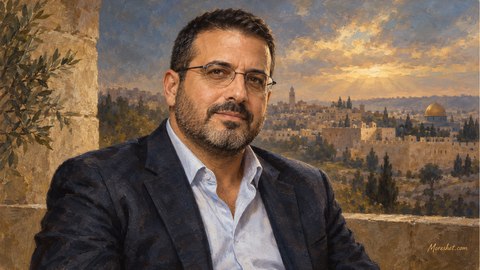
Michael Shorr
Engineer, industrial leader, and director general of Israel Military Industries
Michael Shorr (December 25, 1920 – September 26, 2011) was an Israeli engineer and one of the important builders of Israel’s defense industry. He served as director general of Israel Military Industries (IMI) for 17 years, during a period in which the organization developed from a defense-production framework serving a young state into a technologically capable industrial enterprise with substantial export activity. Shorr brought together training in chemical engineering, practical experience in weapons development, and long-term managerial leadership. He received the Israel Security Prize twice: first for a professional achievement and, in 1991, for lifetime achievement.
From immigration to defense engineering
Shorr was born in Odesa, then part of the Soviet Union, and immigrated to Mandatory Palestine in 1938. He joined the Haganah and became involved in its weapons-production activities, beginning a career in a field that was crucial to the Jewish community’s struggle to establish and defend a state. After completing his chemical-engineering studies at the Technion in 1945, he worked as a test engineer at Israel Military Industries.
Following the War of Independence, Shorr managed IMI’s propellant plant. Propellants—materials used to propel shells, rockets, and other weapons—were a central component of an independent defense-manufacturing capability. For his work during this period, he received the Israel Security Prize in 1959.
Developing technology and industrial capacity
During the 1960s, Shorr managed IMI’s explosives and propellants division. Under his leadership, the division became the foundation for the company’s missile and rocket branch. Among the systems developed in this sphere were 20 mm aircraft shells, an air-to-air cannon, napalm bombs, and runway-cratering bombs.
These systems were used by the Israel Air Force, including runway-cratering bombs used during Operation Focus in 1967. Shorr’s contribution was not limited to an individual weapon or product. He helped build the engineering, organizational, and manufacturing base that enabled Israel to develop and produce defense systems needed for its security rather than depending entirely on foreign supply.
In 1967, Shorr became deputy director of IMI while continuing to manage its chemical and rocket plants division. These responsibilities placed him at the intersection of research and development, industrial production, and the operational needs of Israel’s defense establishment.
Leading IMI and guiding its transformation
In July 1972, Shorr was appointed director general of IMI, which at the time operated as a supporting unit of the Ministry of Defense. He held the position until 1989 and then served as chairman of the board from 1990 to 1991. His years at the helm were a formative period in IMI’s development as a broad-based industrial organization with activity in Israel and abroad.
During his tenure, IMI’s exports grew from tens of millions of dollars to approximately half a billion dollars. His leadership also saw the development of manufacturing for the civilian aviation sector. This expansion strengthened not only Israel’s defense-industrial independence but also the ability of Israeli industry to enter international markets and apply its capabilities to civilian aviation.
As chairman, Shorr led the change in IMI’s status to that of a government-owned company. The transition reflected IMI’s evolution from an organization operating within the Ministry of Defense framework into an enterprise with a more independent industrial and business structure, responsible for development, manufacturing, and exports.
Professional recognition and personal legacy
In 1985, the Technion awarded Shorr an honorary doctorate in technical sciences, recognizing his distinctive contribution to the development of military industry in engineering, management, and economics, as well as his work to strengthen Israel’s defense system. After he left IMI’s management, he received the Israel Security Prize for lifetime achievement in 1991.
Shorr was married to Gabriella, and they had four children. Their son, Arik Shorr, later served as chief executive officer of Tnuva. Michael Shorr died in 2011 at the age of 91 and was buried at the Tel Mond cemetery.
Why Michael Shorr’s legacy belongs in Moreshet
Michael Shorr merits inclusion in Moreshet because his life represents a decisive stage in the construction of modern Israel: the transformation of limited, underground production capabilities into an advanced defense industry able to develop knowledge, manufacture on a broad scale, and export its products internationally. His work as an engineer and executive affected Israel’s defense systems, the professionals who worked at IMI, and the industrial infrastructure on which the country depended for decades.
His achievements joined science and engineering with public service and national responsibility. The development of propellant, explosive, rocket, and civilian-aviation manufacturing, together with the expansion of exports and the transition of IMI into a government-owned company, explains why his legacy extends beyond his personal titles. Moreshet.com preserves the memory of people who built Israel’s institutions and capabilities in practical ways, and Shorr is a compelling example of such a builder: a professional whose technical knowledge, sustained leadership, and commitment to national security helped shape the country’s industrial history.