Leonid Nevzlin
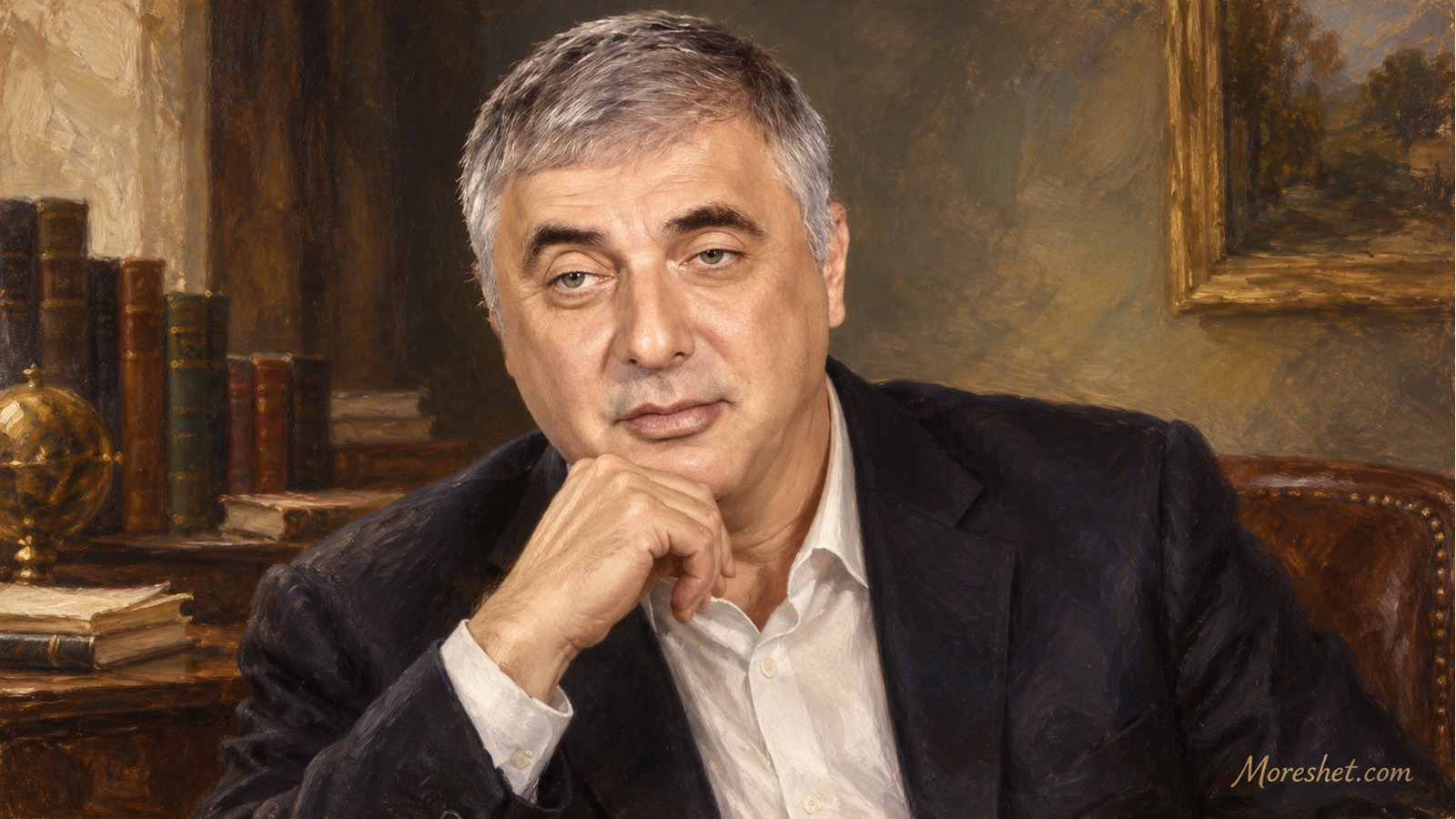
Leonid Nevzlin — AI-generated artistic portrait · Moreshet.com
Business leader and philanthropist who built lasting institutions for Jewish education, research and peoplehood
Leonid Borisovich Nevzlin, born in Moscow in 1959, is an Israeli businessman, investor and philanthropist of Russian origin. His career moved from software engineering and state industry in the late Soviet Union to senior positions in Russian banking, energy and public institutions. After immigrating to Israel, he directed a substantial part of his resources and experience toward Jewish education, historical research, cultural institutions and the relationship between Israel and Jewish communities worldwide.
His most enduring contribution is institutional. Through the NADAV Foundation, his support for the Museum of the Jewish People and the creation of a research center at the Hebrew University of Jerusalem, Nevzlin helped develop platforms through which Jews can study their history, encounter the diversity of Jewish communities and consider the future of Jewish peoplehood.
From Soviet engineering to Russian business
Nevzlin studied software engineering at the Gubkin Russian State University of Oil and Gas in Moscow and later completed studies in economics, management and marketing at the Plekhanov Russian University of Economics. From 1981 to 1987 he worked as a software engineer for Zarubezhgeologia, an external-trade organization connected to the Soviet Ministry of Geology.
His transition into entrepreneurship and management began in 1987, when he met Mikhail Khodorkovsky and became deputy director of the Center for Scientific and Technical Creativity of the Youth. The initiative belonged to the first wave of private enterprise emerging in the final years of the Soviet Union. It led to the establishment of Bank Menatep, one of Russia’s first private banks.
Nevzlin served as the bank’s president from 1989 to 1991 and subsequently held senior positions including vice chairman of the board and head of public relations. In 1996 he became vice president of Yukos, then controlled by the Menatep Group, and later served as first vice chairman of Yukos’s board. His responsibilities extended beyond finance: he worked in corporate communications, government relations, human resources and organizational development.
From 1997 to 1998 he was first deputy director general of the Russian news agency ITAR-TASS, where he developed a plan for its gradual transformation into a joint-stock company. Between 2001 and 2003 he represented the Republic of Mordovia in Russia’s Federation Council. In 2003 he became rector of the Russian State University for the Humanities, linking his managerial career with the world of higher education and research.
Rebuilding Jewish institutions in Russia
Nevzlin also played a role in the rebuilding of Jewish communal and cultural life in post-Soviet Russia. In 2001 he became president of the Russian Jewish Congress. During this period he supported research, educational and cultural initiatives devoted to the history of Russian and East European Jewry, including the development of the Moscow Jewish Cultural Center and the International Center for Russian and East European Jewish Studies.
He supported educational programs developed with World ORT, the Jewish Agency for Israel and the American Jewish Joint Distribution Committee. These initiatives mattered because they restored Jewish history and culture to public life in Russia while connecting local Jewish communities with institutions in Israel and elsewhere. They also helped create an educational infrastructure for a generation growing up after decades in which Jewish identity and communal history had been heavily restricted.
Immigration to Israel and the NADAV Foundation
Nevzlin immigrated to Israel with his family at the end of 2003. In 2004 he established the NADAV Foundation to support Jewish studies, Jewish education, research, Israel-Diaspora relations and a sense of belonging to the Jewish people among young people in Israel and Jewish communities around the world.
The foundation’s work has extended beyond one-time donations. It has helped build programs, research centers and institutions designed to continue operating over time. One expression of this approach is the NADAV Peoplehood Prize, presented to figures including author Elie Wiesel, former Israeli Supreme Court Chief Justice Aharon Barak and Rabbi David Stav. The prize recognizes work that connects learning, public responsibility and the ties linking Jewish communities across borders.
The Museum of the Jewish People and Jewish scholarship
One of Nevzlin’s most visible contributions is his role in the renewal of Beit Hatfutsot, now the Museum of the Jewish People. In 2004 he joined with the Israeli government in creating a relief fund intended to revive the museum and strengthen its activities. He served as chairman of its international board of governors, and since his daughter Irina Nevzlin began chairing the board in 2012, he has held the title of founding chairman.
This support helped the institution move beyond the model of a museum devoted primarily to documenting communities of the past. It strengthened its role as an educational and cultural institution addressing Jewish identity in the present. In 2006, the NADAV Foundation established the International School for Jewish Peoplehood Studies at Beit Hatfutsot. Through exhibitions, educational programs and work with groups and young people, the museum presents Jewish history as a diverse story of communities, creativity, memory and intergenerational connection.
Nevzlin also created the Leonid Nevzlin Research Center for Russian and Eastern European Jewry at the Hebrew University of Jerusalem. The center supports scholars documenting and interpreting the lives of Jews in a region that was for centuries one of the major centers of Jewish life. Its work preserves sources, experiences and memories that might otherwise remain outside the broader historical record.
He has served on the boards of the Hebrew University of Jerusalem and Tel Aviv University, as well as on the governing bodies of the Jewish Agency for Israel, Keren Hayesod and the Jewish People Policy Planning Institute. He has also been a long-term supporter of Ezra LeMarpeh, a charitable organization assisting patients and their families.
Media, public discussion and writing
In 2011 Nevzlin acquired a 20 percent stake in Haaretz. In 2014 he founded Liberal, a Hebrew-language monthly magazine whose first issue appeared in May of that year. Inspired in part by international magazines such as The Atlantic, The New Yorker and The Economist, Liberal was created as a forum for analysis of Israeli politics, society, communications and culture. This work reflects Nevzlin’s longstanding interest in the media as a force that shapes public conversation and enables a democratic society to examine itself.
His publications include Man with a Ruble, co-written with Mikhail Khodorkovsky and concerned with free-market economics, and Public Relations – Who Needs Them?, which examines the importance of public communication in the modern era. His book Choosing the Minority was published in 2024.
Public confrontation and life in Israel
From the final years of his time in Russia, Nevzlin was associated with forces opposed to the policies of Vladimir Putin. After leaving Russia, he faced criminal proceedings in absentia and was convicted there in 2008. Nevzlin described the case as political persecution. Israel rejected requests for his extradition, and in 2008 the Israeli Supreme Court found insufficient grounds to extradite him or revoke his Israeli citizenship. Because the legal proceedings were contested, the Russian conviction should be distinguished from the findings of Israeli courts and from decisions reached in other jurisdictions.
Following Russia’s invasion of Ukraine, Nevzlin renounced his Russian citizenship. Although his public biography includes legal disputes and political confrontation, his principal legacy in Israel lies in the institutions and philanthropic programs he helped build: research centers, educational initiatives, support for the Museum of the Jewish People and efforts to connect Jewish communities across the world.
Why this legacy belongs in Moreshet
Leonid Nevzlin merits inclusion in the archive because his impact in Israel extends beyond the story of a successful businessman. Through the NADAV Foundation, his support for the Museum of the Jewish People and the research center at the Hebrew University, he invested in knowledge, institutions and educational programs that enable Jews to understand their shared history and strengthen connections between Israel and the Diaspora.
That contribution can be seen in the lives of students, researchers, educators and museum visitors who encounter Jewish history through these institutions, and in the ability of those institutions to continue their work beyond the founding generation. Moreshet therefore records Nevzlin not only as a figure of wealth and business, but as a builder of cultural and educational infrastructure for the Jewish people. His story belongs on Moreshet.com because it shows how private initiative can become public institutions with a durable effect on Jewish heritage, Israeli life and the wider understanding of Jewish history.