Jon Stewart
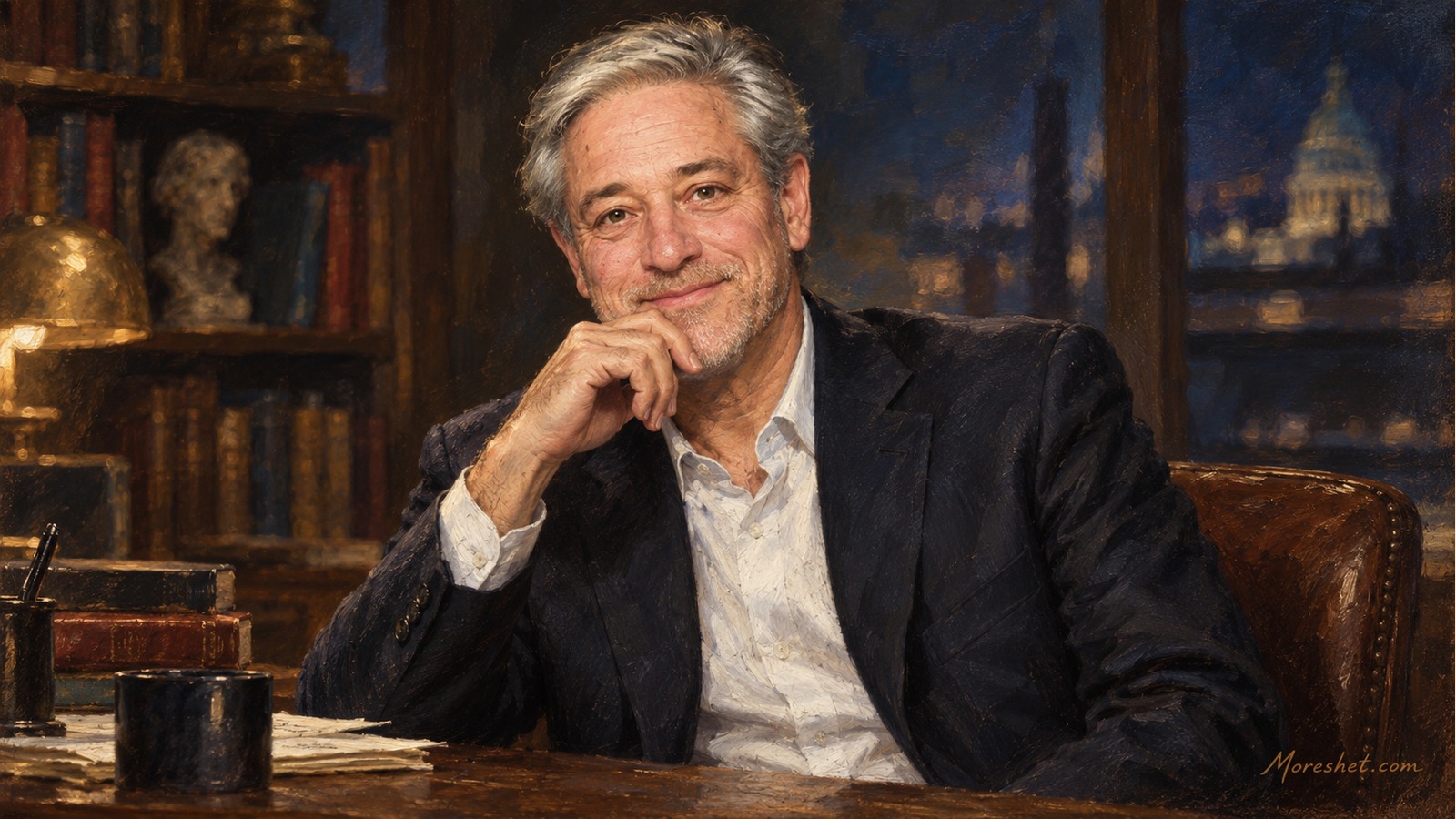
Jon Stewart — AI-generated artistic portrait · Moreshet.com
The Jewish-American comedian who turned television satire into a tool for examining power, media and public responsibility
Jon Stewart, born Jonathan Stuart Leibowitz on November 28, 1962, is a Jewish-American comedian, writer, actor, producer, director and television host. For 16 years, from 1999 to 2015, he hosted The Daily Show on Comedy Central and transformed it from a successful satirical program into a cultural institution that shaped how millions of viewers understood news, politics and the media. After a long absence, he returned to host weekly Monday episodes beginning in February 2024.
Stewart's importance extends beyond his ability to make audiences laugh. By combining news footage, commentary, comic editing and television reporting, he created a space in which viewers could examine the gap between leaders' statements and their actions, between journalism and performance, and between institutional power and public accountability. Alongside his creative work, he used his public platform to advocate for 9/11 first responders, veterans exposed to toxic substances, workers' rights and animal welfare.
Childhood, family and Jewish identity
Stewart was born in New York and grew up in New Jersey in an Ashkenazi Jewish family of four sons. His mother, Marian Leibowitz, née Laskin, was a teacher and later an educational consultant. His father, Donald Leibowitz, worked as an energy coordinator for the New Jersey Department of the Treasury. His family's roots reached back to Poland, Ukraine and Belarus, and Stewart has said that he experienced antisemitism and bullying as a child because he was Jewish.
As a young man, he began using the name Jon Stewart rather than his family name, Leibowitz, and legally changed his name in 2001. He connected the change to his complicated relationship with his father, not to a denial of his background. Jewish identity, the experience of being a minority and sensitivity to abuses of power and humiliation became part of the cultural landscape from which his public voice emerged.
Stewart initially studied chemistry and later switched to psychology at the College of William & Mary in Virginia, graduating with a bachelor's degree in 1984. He also played soccer for the college, coached at a high school and held a range of jobs. His experience as a bartender, waiter, stock clerk and puppeteer for children with disabilities gave him an unvarnished familiarity with working life and with audiences outside the entertainment industry.
From small comedy clubs to national television
In 1986, Stewart moved to New York to pursue stand-up comedy. He did not take the stage until 1987, gradually becoming a regular performer at the city's comedy clubs. In 1989, he obtained his first television job as a writer for Caroline's Comedy Hour. He later appeared on Comedy Central's Short Attention Span Theater and hosted programs on MTV, including You Wrote It, You Watch It.
In 1993, he created and hosted The Jon Stewart Show, MTV's first talk show. Although the program was eventually canceled, it already displayed the qualities that would define his work: rapid pacing, improvisation, an interest in popular culture and an ability to turn current events into accessible entertainment. He also acted in film and television, and in 1998 published his first book, Naked Pictures of Famous People, a collection of humorous stories and essays that reached the New York Times bestseller list.
The Daily Show: Satire as a public language
In 1999, Stewart succeeded Craig Kilborn as host of The Daily Show. The program combined news footage, interviews, field pieces and satire aimed at politicians, media organizations and public figures. Under Stewart, it grew into an internationally recognized brand and a training ground for a generation of comedians, writers and hosts, including Stephen Colbert, John Oliver, Samantha Bee, Hasan Minhaj, Larry Wilmore, Trevor Noah and Bassem Youssef.
Stewart did not present the program as a replacement for a conventional newscast. Instead, he used the distance between comedy and journalism to expose failures that were not always visible in formal news broadcasts. By juxtaposing contradictory statements, editing speeches and ridiculing media manipulation, the program invited viewers to become critical participants. For many young people, it served as a first gateway into political events and democratic institutions.
The program's influence was reflected in its professional achievements. The Daily Show won numerous Emmy Awards, Peabody Awards for its coverage of the 2000 and 2004 presidential elections, and a Grammy Award for the audiobook version of America (The Book): A Citizen's Guide to Democracy Inaction. Written by Stewart and the program's staff in 2004, the book sold millions of copies and used satire to explain the structure of American government, the history of its institutions and the tension between democratic ideals and political reality.
Stewart also served as a producer and creative force behind programs that extended his influence beyond his own desk, including The Colbert Report and The Nightly Show with Larry Wilmore. In doing so, he helped create a professional and creative ecosystem in which comedy, commentary and civic responsibility could coexist.
Books, film and independent work
Stewart and the Daily Show writers followed their first book with Earth (The Book): A Visitor's Guide to the Human Race, published in 2010 as a satirical guide for an alien civilization discovering Earth after humanity's disappearance. The book continued his examination of institutions, habits and contradictions in human society.
In 2014, Stewart directed his first feature film, Rosewater, based on the memoir of Iranian-Canadian journalist Maziar Bahari, who was imprisoned in Iran. Stewart wrote the screenplay, produced and directed the film, bringing the story of a journalist deprived of his freedom to a broad cinema audience. In 2020, he wrote, produced and directed the political comedy Irresistible, starring Steve Carell, Rose Byrne and Chris Cooper.
After leaving The Daily Show in 2015, Stewart became an executive producer of The Late Show with Stephen Colbert and continued to appear in political and media segments. From 2021 to 2023, he hosted The Problem with Jon Stewart on Apple TV+, a series built around one major public issue per episode, including the treatment of veterans exposed to toxic burn pits. The format allowed time and complexity for subjects that are often compressed into the news cycle.
From comedy to public responsibility
One of the clearest expressions of Stewart's influence was his advocacy for 9/11 first responders and emergency workers who became ill after working at the World Trade Center site. He brought firefighters, police officers and other responders onto his program and gave them a national platform at a time when their struggle for medical care and legislative support had not received sustained attention.
In 2010, he helped raise public awareness of legislation intended to provide treatment and compensation. After leaving The Daily Show, he repeatedly appeared before Congress and in the media to demand permanent funding for the September 11th Victim Compensation Fund. In 2019, legislation was enacted extending the fund through 2090. For this advocacy, Stewart received New York City's Bronze Medallion in 2019, the city's highest civilian honor.
Stewart also advocated for veterans exposed to toxic burn pits and other hazardous substances during military service. Through his program, interviews and congressional appearances, he presented their experiences and the difficulty many faced in receiving recognition and care. His campaigning contributed to public momentum around the Honoring our PACT Act, enacted in 2022 to expand healthcare and funding for veterans exposed to toxic substances.
This work showed what made Stewart distinctive. The same person who made jokes about powerful institutions was willing to stand before those institutions on behalf of people who were sick, injured or forgotten. Comedy was not merely a style for him; it was a way to draw attention, disrupt complacency and turn an individual story into a public obligation.
Compassion, animals and community
In 2015, Stewart adopted a vegetarian diet and later became vegan, influenced by his wife, Tracey, a longtime vegan and animal-rights advocate. The couple established Bufflehead Farm in New Jersey and later operated the property and another approved site as sanctuaries for animals rescued from the meat, egg and dairy industries. The sanctuaries provide protection and care while bringing questions about the treatment of animals into everyday community life.
Stewart has been married to Tracey since 2000, and they have two children. His family life and work at the farm reveal another dimension of his public character: alongside criticism of large institutions, he has pursued personal responsibility and the creation of practical communities based on care, protection and recovery.
Recognition and lasting influence
During his career, Stewart received numerous Emmy Awards for his work as a writer, producer and host, Peabody Awards recognizing the public value of his political satire, and a Grammy Award for comedy. He received an honorary Doctor of Arts degree from the College of William & Mary, his alma mater. In 2005, he and the Daily Show writing staff received the National Council of Teachers of English George Orwell Award for Distinguished Contribution to Honesty and Clarity in Public Language.
In 2022, Stewart received the Mark Twain Prize for American Humor from the John F. Kennedy Center for the Performing Arts. The honor recognized not only his comic talent but also his long-term contribution to American culture and public conversation.
Why Jon Stewart's legacy belongs in Moreshet
Jon Stewart merits inclusion in Moreshet because he represents an unusual meeting point of Jewish-American culture, satire, media and civic responsibility. He transformed the experience of skepticism toward authority and the perspective of a minority into a communication style that reached enormous audiences. Through The Daily Show, his books and his films, he influenced how people—especially younger viewers—read the news and evaluate the conduct of leaders and institutions.
His legacy cannot be measured only by awards or years on television. It is visible in the writers and performers he helped develop, in the programs that grew from his creative community, in the public debates his work sharpened and in the people who gained treatment, compensation and recognition after disaster or military service. The combination of humor and sustained action on behalf of first responders and veterans makes his contribution relevant far beyond entertainment.
For readers of Moreshet.com, Stewart's story records how a person of Jewish heritage can shape mainstream culture without abandoning criticism, compassion or responsibility. It demonstrates that satire can be more than entertainment: it can be a form of civic education, a way of preserving memory and a means of making institutions hear people whom they might otherwise overlook.