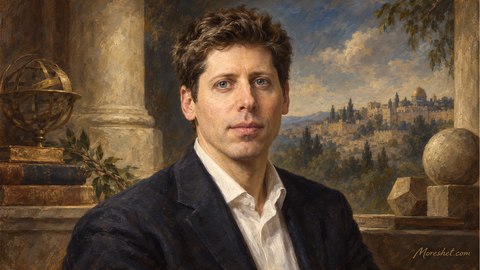
Hermann Minkowski
The mathematician who gave space and time a shared geometric language
Hermann Minkowski (1864–1909) found geometry where others saw mainly numbers and equations. He developed the geometry of numbers and gave special relativity a unified description of space and time. Although he lived only forty-four years, his ideas became part of the working foundations of modern mathematics and physics.
Early distinction and scientific friendships
Minkowski was born into a Jewish family in Aleksotas, now part of Kaunas. His family moved to Königsberg, where he attended university. While still a student, he received recognition from the French Academy of Sciences for work on quadratic forms. He later taught in Bonn, Königsberg, Zürich and Göttingen and maintained a close intellectual friendship with David Hilbert. Albert Einstein was among his students in Zürich.
Looking at numbers through geometry
In the geometry of numbers, Minkowski used shapes and lattices of points to investigate questions about integers. An arithmetic problem could become a question about volume, position or symmetry, yielding conclusions about numerical solutions. His work demonstrated the power of connecting branches of mathematics that initially appear separate.
Giving relativity a geometric form
Following Einstein’s special theory of relativity, Minkowski developed a four-dimensional framework in which events have spatial and temporal coordinates together. Minkowski spacetime provided a geometric way to understand relations between events and observers. It did not replace Einstein’s theory; it clarified its structure and expanded the tools available for developing it. His 1908 lecture, Space and Time, became a landmark presentation of the idea.
Why this legacy belongs in Moreshet
Moreshet includes Minkowski for changing the language in which science thinks. Moreshet.com records a Jewish European contribution with worldwide consequences: a new framework can be as important as a new observation. His work made previously hidden relationships visible and gave later researchers a durable foundation on which to build.