Hallel Naaman
An actor, director and teacher who helped shape Israeli theatre and generations of performers
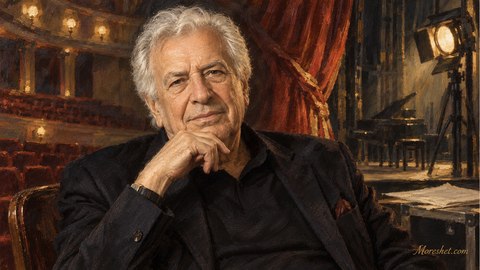
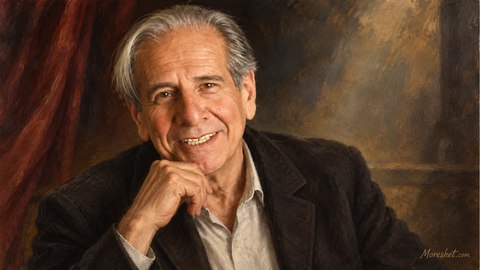
Hallel Naaman (November 23, 1929–March 23, 2019) was an Israeli actor, director and acting teacher. He helped found the Bamat Ha-Sakhkanim theatre and established the Akhsania School for Theatre Studies. For more than six decades he worked onstage, behind the scenes and in the classroom, contributing to the development of Hebrew theatre in Israel during a formative period of artistic and social change.
From childhood in Mandatory Palestine to the theatre
Naaman was born in Austria as Helmut Frisch. His mother was Genia Vidochansky, née Frisch. In 1936, at the age of seven, he immigrated with his family to Mandatory Palestine. After high school he joined the Palmach in 1946 and took part in the battles of Israel's War of Independence. After his discharge, he was among the founders of Kibbutz Tzora. The experience of belonging to the generation that built both the country and its institutions remained an important background to his later artistic and educational work.
Naaman then studied for three years at the acting school directed by Mania Arnon and also trained at the studios of Peter Fry and Hai Kaylos. From 1953 to 1959 he performed at Ohel Theatre and Cameri Theatre, and from 1960 to 1965 he worked at Haifa Theatre. These years gave him experience in different theatrical settings and performance styles, preparing him for his later work as a director and teacher.
Independent stages and new Israeli writing
In 1965 Naaman helped establish Bamat Ha-Sakhkanim, where he worked as an actor, director and teacher. In 1968 he left the company and founded the Open Theatre, an independent fringe theatre that offered a platform to Israeli writers and theatrical material not always represented in the established institutions. At a time when new local drama was still not a standard part of the country's major stages, Naaman presented plays by Amos Kenan, Hanoch Levin and Israel Eliraz.
At the Open Theatre he directed Jean Genet's The Thief's Journal and Solomon Grip (1970), Hanoch Levin's first play that was not a political satire. The production's success reflected Naaman's ability to recognize a new dramatic voice and create the conditions in which it could mature. He was not simply a director of finished texts; he built working processes in which actors and writers could discover the distinctive character of a play.
After closing the Open Theatre in 1970, Naaman continued to direct independently. At Cameri Theatre he directed Eli Shraiber's Chaim Chaim and Israel Eliraz's The Living on the Dead, a production regarded as one of the early Israeli experiments combining film and theatre. In 1972 he joined Cameri as a director and actor and became a member of its artistic committee. There he established Stage 2 in the Tzavta auditorium, creating an additional venue for more intimate and experimental work.
During this period he also directed The Angel Will Come by Moshe Ben-Shaul in a Cameri–Tzavta collaboration, John Herbert's The Account, and The Effect of Gamma Rays on Man-in-the-Moon Marigolds. After leaving Cameri in 1976, he continued as an independent director and later worked at Khan Theatre. He also founded an amateur theatre in Ramla, where Yossi Sias was active as a young man, and worked on a theatre project with Yigal Mossinson. In 1999 he returned to Tzavta to direct Butterfly in a Fist, in which Israel Poliakov appeared in his first dramatic role.
A teacher who developed actors as individuals
One of Naaman's most lasting contributions was in education. In 1987 he began teaching at the Kibbutzim College School of Acting and directed an annual production there. In 1990 he founded the Akhsania School for Theatre Studies, where he taught acting through individual instruction until the end of his life. His method began with a close understanding of the actor's personality and an effort to develop that personal identity as a means of understanding and embodying a role.
For Naaman, acting studies were not merely a matter of acquiring technique. He expected actors to examine themselves, understand a character's motives and approach a role through an extended process of observation, rehearsal and maturation. His productions likewise relied on long rehearsal periods. He involved performers in the creative process and sometimes in the direction itself, giving them artistic responsibility rather than limiting them to the execution of instructions.
Alongside his work at the Akhsania, he taught and directed at Beit-Zvi, the Nisan Nativ Acting Studio and the Holon School of Acting. His influence therefore extended beyond the productions he directed: it continued through the actors and theatre makers who carried his approach into Israeli stages and classrooms.
One-person theatre and screen work
Naaman directed a number of one-person productions, including Madness Teacher, starring Yona Elian and recipient of the Kinor David Prize; Small Change by Yehudit Hendel, starring Rachel Dobson at the Teatroneto festival; and Miss Else, starring Dafna Dekel, for which he received the Teatroneto Directing Prize. He also directed Hagar, starring Yarden Bar-Kochba, which won first prize at Teatroneto; Son of the Sands with Rivka Bachar; and Oumi with Meli Gold. In 2011 he directed another production of Miss Else, starring Kaipo Cohen.
His work as an actor also extended into cinema. His first film was Hot Sands (1960). He later appeared in The Policeman (1971), Joker (1976), The Honey Connection (1977), A Married Couple (1983), Night Soldier (1984) and Beyond the Walls (1984). He also acted in A Strange Woman, Snow in August, Duel and other films. His roles ranged from a demonstrator to a security officer and a father, allowing him to bring his presence to audiences beyond the theatre. Over the years he also acted in and directed radio dramas.
Anthroposophy and a view of the actor as a whole person
In the 1980s Naaman was introduced to anthroposophy through a lecture by Yeshayahu Ben-Aharon. The encounter influenced his outlook on life and on theatrical work. He hosted a study group at his home in Givatayim, and this interest was consistent with his educational approach: he viewed the actor as a whole person with an inner life, not merely as an instrument for delivering a text.
Hallel Naaman died on March 23, 2019. He was survived by his wife, Ofra, and his daughter, actress Natalie Naaman. In his final years, although health problems left him bedridden, his artistic and educational work remained part of the memory of his students and colleagues.
Why Hallel Naaman belongs in Moreshet
Hallel Naaman deserves recognition as a figure who strengthened Israeli theatre on several fronts at once. He was an active performer, a director who sought new ways of telling stories, an institution builder who created independent frameworks, and a teacher who devoted much of his life to developing others. The Open Theatre and Cameri's Stage 2 expanded opportunities for Israeli playwrights and experimental work; his one-person productions contributed to the standing of the form in Israel; and the Akhsania School expressed his conviction that actors grow through personal attention, discipline and an understanding of their own identity.
Naaman's story belongs to Israel's cultural heritage: it is the story of a generation that helped build the country and then helped build its artistic language and institutions. His influence was measured not only by the productions he directed but also by the performers he taught and the theatre communities he nurtured. For these reasons, his life and work merit preservation in Moreshet. Including him on Moreshet.com honours an artist and educator whose commitment to the stage, to students and to Israeli creation became part of the country's cultural record.